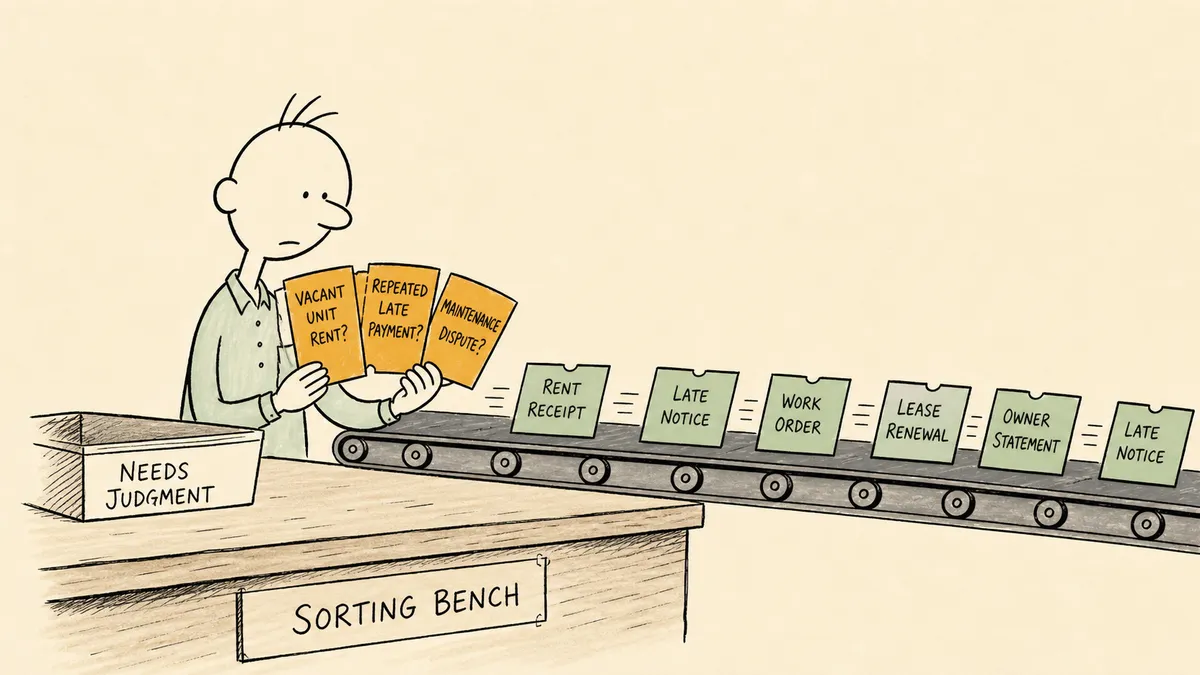
Property management automation is two purchases pretending to be one. There is the platform that runs your portfolio, and there is the layer that handles the work between your platform and everything else. Most operations leaders buy the first, assume it covers the second, and then spend the next year doing the second by hand. The platform was never the problem. The work it does not reach is.
This article is for the VP or director of operations evaluating how to automate a property management operation, not the platform itself. If you are choosing the system of record, that is a different and well-covered decision. The decision nobody walks you through is what to automate inside it, what genuinely needs a person, and where the work lives that no single platform was built to close.
What property management automation software actually covers
The category, as it shows up when you search for it, is the lifecycle of running rental property: tenant onboarding, rent collection, maintenance ticketing, lease renewals, accounting, and owner reporting. The vertical platforms that own this category are the names you already know. AppFolio, Buildium, and DoorLoop anchor the mid-market and up, with TenantCloud and RentRedi serving smaller portfolios and independent landlords. Each one is a complete system of record for properties, leases, residents, and the money moving through them.
These platforms are good at what they do, and that should be stated plainly before anything else. For the core lifecycle, they are the right starting point for nearly every portfolio, and most operators do not need to look further to automate the bulk of their week.
What gets lost is that this is one layer of two. The platform is the system of record. Sitting on top of it is the connective work: the data moving between the platform and the systems it does not own, and the exceptions that route to people the platform cannot reach. The category markets itself as if those two layers are the same product. They are not, and conflating them is how teams end up with a strong platform and a stubborn backlog of manual coordination they cannot explain.
The two layers operations leaders should evaluate separately
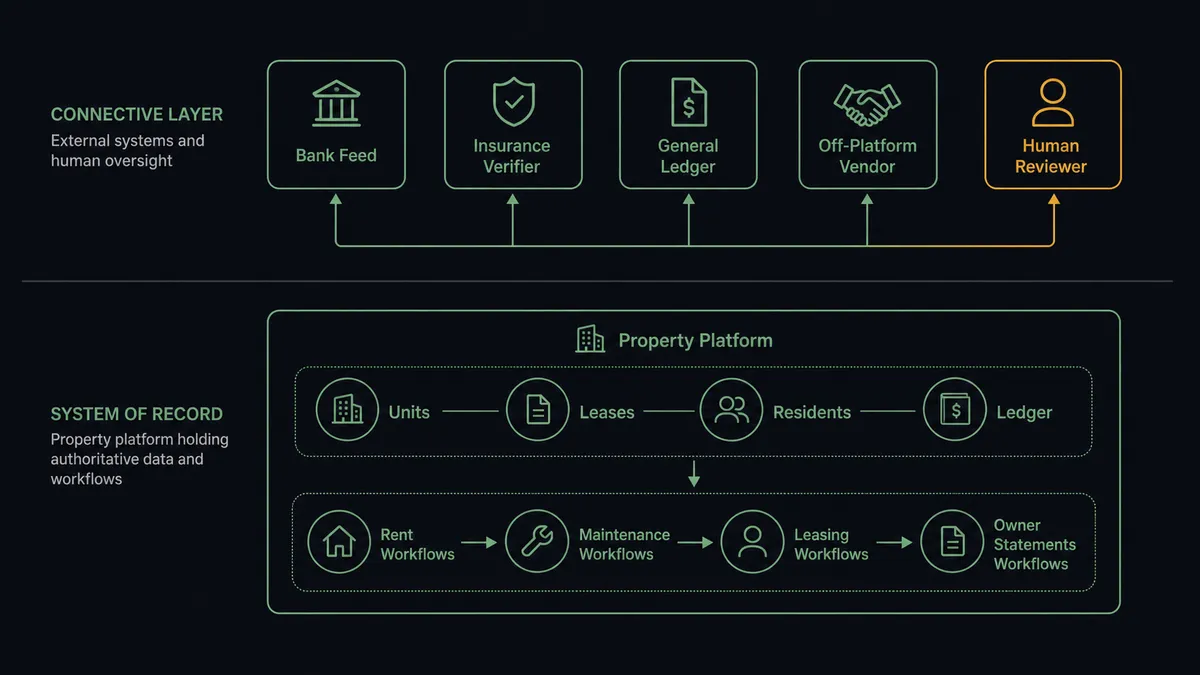
Layer one is the system of record. It holds your units, leases, residents, ledger, and the standard workflows that run against them. This is what you are buying when you buy AppFolio or Buildium, and it is the larger, more visible purchase.
Layer two is the connective layer. It is the work that routes exceptions to people, reconciles data between the platform and adjacent systems, and pulls a human in when a decision needs judgment. It is quieter, it rarely shows up in a platform demo, and it is almost never on the RFP. Which is exactly why it goes unsolved.
Here is what most articles on this topic will not say. The standard advice treats automation as a feature checklist you turn on inside your platform: switch on autopay, switch on maintenance routing, switch on owner statements, count the hours saved. That advice is fine as far as it goes, and it covers the first layer well. But it quietly assumes the last stretch of manual work is a feature you have not enabled yet. It is not. The work that resists automation is structural. It lives between systems and between people, in the space no single-vendor platform was designed to own, and no amount of toggling features inside the platform reaches it.
That is the seam worth naming, because it is where an entire category sits. The layer that listens to what your platform of record emits, gathers the context the platform does not hold, and brings a person in at the moments that need a decision is not a feature of the platform. It is a category of its own, an orchestration layer that sits above the systems of record and coordinates the work and the people moving across them. FlowRunner is built for that layer. The reason to evaluate the two layers separately is that one of them, the connective one, will not get evaluated at all if you fold it into the platform purchase.
[ ]
]
What the vertical platforms automate well
Be specific about the first layer, because the platforms genuinely earn it. Inside a system like AppFolio or Buildium, the core lifecycle automates cleanly:
- Rent collection and reconciliation. Autopay, late-fee assessment, late notices, and matching incoming payments against the ledger, all inside the platform.
- Maintenance. Request intake from residents, vendor dispatch from your vendor list, and status updates back to the resident.
- Leasing. Lease document generation, e-signature, and renewal workflows tied to lease dates.
- Owner reporting. Standard owner statements and accounting exports on a schedule.
For these, the platform is the answer and a connective layer would be overkill. A maintenance request that comes in through the platform, gets triaged, dispatched to a vendor already in the system, and followed up on is work the platform owns end to end. If the automation you need is in-platform, enable it there and do not buy a second tool to do what the first one already does.
The detail that matters is the boundary condition. All of this works because the data and the people involved live inside the platform. The resident is in the platform. The vendor is in the vendor list. The ledger is the platform’s ledger. The moment a workflow needs data the platform does not hold, or a person the platform cannot reach, you have crossed into the second layer.
Where the vertical platforms leave gaps
The gaps are not platform weaknesses. They are the predictable edge of any single system of record, and they cluster in a few recognizable places.
Routing to people outside the system. The decision that needs a regional manager, an owner, outside counsel, or a third-party vendor who never made it into your platform is the decision the platform struggles to route. One pattern operations leaders describe repeatedly is the inability to tag or route work to people who sit off the core system. The platform can assign a task to a platform user. It cannot easily pull in someone who does not have a seat.
Cross-system reconciliation. When the platform’s numbers and your general ledger or bank feed disagree, that disagreement surfaces as reconciliation work, not as a clean sync error you can ignore. Someone has to look at both, understand why they differ, and decide what is correct. As one operations leader put it about a different stack, it is not really a sync error, it is catching inconsistencies that were entered somewhere after the fact, where the data simply does not make sense. Property management has the same shape: the platform, the bank, and the books each hold a version, and a person reconciles the difference.
Disputes and edge cases that need context-rich review. A resident dispute, a complaint, a damage claim contested by a tenant. These need a human reading the full context, and the context is rarely in one place.
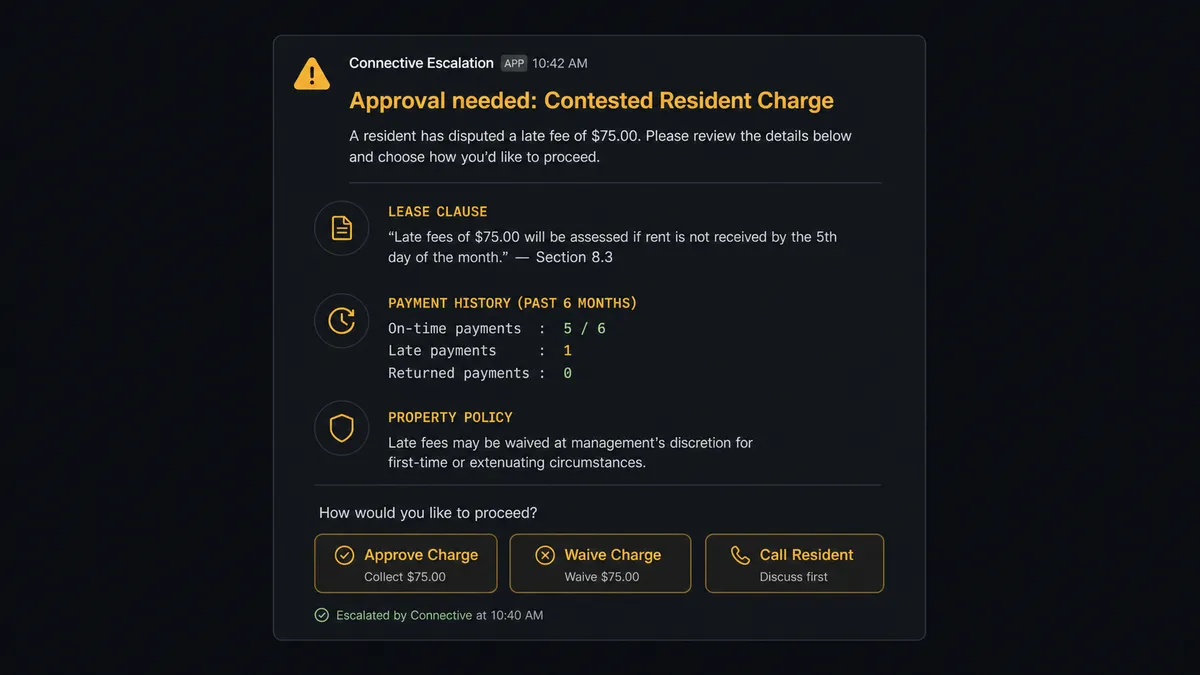
Approvals that must pause and ask. An approval where the right answer depends on the lease, the payment history, and a property-level policy at the same time cannot be rubber-stamped from inside one module. It needs the workflow to stop, gather the pieces, ask a person, and resume with the answer attached.
Custom fee and commission logic. Management fees, leasing commissions, and owner splits that vary by property, owner, or contract often live in a spreadsheet beside the platform because they do not fit the platform’s standard model.
[ ]
]
Every one of these has the same signature. Data in more than one place, a judgment call a person should make, and no native home inside a single platform. This is the work that one operations leader, describing automation they had already built, summed up by saying it got them to about 85% of where they wanted to go, and the missing piece was the intelligent human in the middle. Treat that number as one operator’s description of their own state, not a benchmark for the category. The shape of it, though, is what recurs: the platform handles the bulk, and the last stretch is exceptions and cross-system routing.
How to evaluate the connective layer
You evaluate the second layer by looking at where the first one already failed you, which means looking somewhere other than the platform demo.
Start with the work that currently lives outside any system. The spreadsheets, the recurring email threads, the Slack channel where exceptions get sorted out by hand. That residue is the connective layer made visible. It is the work the platform did not reach, and it is the most honest specification you will get for what a second layer needs to do.
Then map which of those exceptions actually need a person and which only feel like they do. Some can run end to end once something coordinates the systems involved. Others need judgment and should route to a human every time. The goal is not to automate the judgment away. It is to automate everything around the judgment so the person only touches the decision. If you have not yet sorted your processes into worth-automating and not, how to decide which workflows are worth automating is the place to start before you evaluate any tool.
When you do evaluate candidate tools, hold them to two specific tests:
- Can it call your platform’s API and act on what it returns? A connective layer that cannot read and write to your system of record is not connective.
- Can it route work to people who are not users of that platform? This is the test most automation tools quietly fail. Routing to a platform user is easy. Routing a decision, with full context, to an owner or a regional manager who lives in email is the capability that closes the gap.
One more test, learned the hard way by anyone who has shipped automation into production: the human-routing step is where automations break when it is bolted on as an afterthought rather than designed in. Why automations fail in production is worth reading before you assume the escalation path will take care of itself. It will not. It is the part that needs the most design, because it is the part that runs when something has already gone sideways.
A practical buying sequence
The order of operations matters more than the tool selection, because buying in the wrong order is how the second layer never gets solved.
- Pick the vertical platform first. Choose the system of record that fits your portfolio size and asset mix. AppFolio, Buildium, DoorLoop, and the rest each anchor on a slightly different segment. This is the larger decision and it should come first, because everything connective sits on top of it.
- Run it for a full cycle. A month, a quarter, a full turnover season. Do not buy anything else yet. Let the platform do what it does and watch where work still falls through the cracks.
- Document the residue. Write down every process that still lives in a spreadsheet, an email thread, or a person’s head. That list is your connective-layer requirements, written by reality instead of by a vendor.
- Layer connective automation against the specific gaps. Buy the second layer to close the residue you documented, not to chase capabilities you might theoretically use. Speculative automation is how teams end up with tools nobody adopts.
- Pilot one exception-routing workflow end to end. Pick the single most painful cross-system exception, build it, route it to a real person, and run it for real. Prove the pattern on one workflow before you expand. Proof beats a roadmap.
This sequence is deliberately slow at the start, because the most expensive mistake is buying the connective layer speculatively, before the platform has shown you exactly where it leaks.
Where a connective layer like FlowRunner fits
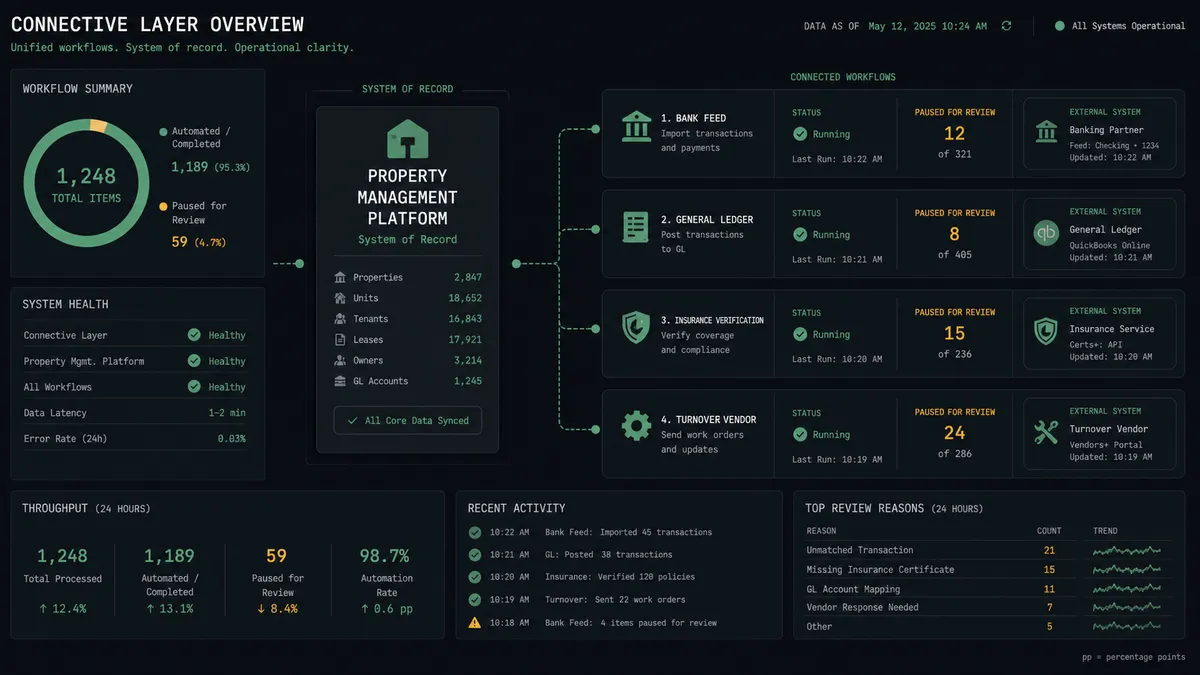
By the time you reach the second layer, the job is well defined. You need something that sits above your property management system of record, reaches into the systems it does not own, and pulls a person in when a decision needs judgment. That is the category. FlowRunner is one platform built for it, not a replacement for your platform of record, and the distinction is the whole point.
[ ]
]
Concretely, the connective layer is what handles the cases the earlier sections named:
- Routing a maintenance escalation to the right regional manager with the full ticket context attached, even though that manager is not a seat in the platform.
- Reconciling rent roll data against the general ledger and surfacing the mismatches a person should review, instead of letting them accumulate until month end.
- Pausing an approval to ask an owner before issuing a credit, then resuming the workflow with the owner’s answer recorded and attached.
In each case an agent does the gathering and the routine work, and a human is invoked as a callable step at the exact moment judgment is required. The response comes back through Slack, email, WhatsApp, or phone, and the workflow resumes from the answer with an audit trail behind it. One operations leader called this pattern a digital andon cord: the pull that stops the line when something is wrong, rather than letting the work plow ahead unwatched. If you are still sorting out where AI handles the routine and where a person stays in control, the difference between AI automation and AI agents draws the line that matters here.
If your operation already runs on AppFolio or Buildium, the layered question gets specific fast, and the platform-by-platform reads cover it directly: FlowRunner versus AppFolio and FlowRunner versus Buildium both walk through what stays in the platform and what crosses into the connective layer. For the full cross-system pattern in one place, the property management automation overview lays it out end to end.
The reason to keep the two layers separate in your head, and in your buying, is the one this article opened with. The platform is not where your team loses its week. The work between the platform and everything else is, and that work will keep falling to a person by hand until something is built to catch it. Decide on the platform first. Then go find the seams, because the seams are the part that was never going to fix itself.
Quick answers
What can you actually automate in property management?
Inside a platform like AppFolio, Buildium, or DoorLoop: rent collection and autopay reconciliation, late notices, maintenance request intake and vendor dispatch, lease document generation and e-signature, renewals, and standard owner statements. These are mature capabilities and the right starting point for most portfolios.
What still needs a human in property management automation?
The work that crosses systems or needs judgment: routing an exception to a regional manager or owner who sits outside the platform, reconciling the platform against your general ledger or bank feed, deciding a resident dispute, and approvals where the answer depends on context from more than one place at once. A common gap operations leaders describe is the inability to tag or route work to people off the system.
How do you start automating property management?
Pick the vertical platform that fits your portfolio first and run it for a full cycle. Then document where work still falls through the cracks, in spreadsheets, email threads, and Slack. Layer connective automation against those specific gaps rather than buying it speculatively, and pilot one exception-routing workflow end to end before expanding.