
How many systems does your property management company actually run? Name them. There is the platform that holds your units, leases, and ledger, which for a lot of operators is AppFolio. Then there is the bank. The insurance verification service. The turnover and maintenance vendors who never made it into your AppFolio vendor list. The owner-reporting tool one of your principals insists on. The portfolio you acquired last year that is still on a different system because the migration keeps slipping. AppFolio runs the first one beautifully. The question that decides whether you need anything beyond it is what happens to the work that has to cross all the others.
That question is the whole comparison, and it is why a FlowRunner-versus-AppFolio article is not really a head-to-head at all.
AppFolio and FlowRunner, side by side
| AppFolio | FlowRunner | |
|---|---|---|
| What it is | A unified property management platform: accounting, leasing, maintenance, resident and owner portals, reporting | A coordination layer for AI agents and human reviewers across the systems you already run |
| Layer | System of record for the property management operation | Sits above and between systems of record, including AppFolio itself |
| Primary job | Run leasing, maintenance, accounting, and communication for a portfolio | Automate processes that span the platform plus banks, insurers, vendors, and other tools |
| AI model | Native Realm-X (Assistant, Flows, Performers); agentic AI inside AppFolio workflows | General-purpose agents configured against any connected system; a human invoked as a callable step on exceptions |
| Property management depth | Years of real estate domain data, templates, and modules purpose-built for the vertical | None out of the box; horizontal infrastructure with no pre-built real estate workflows |
| Human handoff | Tasks and approvals inside AppFolio modules | Agent pauses, routes a decision to a named person via Slack, email, WhatsApp, or phone, resumes on the response |
| Cross-system reach | Deep where AppFolio integrates; bounded by AppFolio’s integration catalog | MCP and an open connector model across tools AppFolio may not integrate with |
| Portfolio coverage | Single-family, multifamily, student, affordable, commercial, HOA, investment management, one platform | Not portfolio-typed; coordinates whatever systems the operator connects |
| Pricing model | Quote-based, tiered Core / Plus / Max, 50-unit minimum on Core | Published tiers from a permanent Free plan and a $5 Starter; core platform (AI agents, human-in-the-loop across email, Slack, WhatsApp, and phone, all integrations, BYOK) on every plan, with Growth at $45/mo for production volume; audit trails and RBAC at $299/mo Professional; SSO at $999/mo Business |
| Best fit | You need a system to run the property management operation itself | You have the platform and need the work between it and everything else coordinated |
The table answers the snippet question. The rest of this article is the part the table flattens: why these two products sit on different layers, and how an operations leader actually tells which problem they have.
Who each product is for
AppFolio is for the company that needs to run a property management operation. That is most property management companies, and AppFolio is one of the strongest answers in the category. Their own positioning frames the product as the “AppFolio Performance Platform” and tells buyers to “Move Beyond Property Management Software,” which is marketing for a real claim: accounting, leasing, marketing, maintenance, resident and owner portals, and reporting all live in one system. AppFolio serves single-family, multifamily, student housing, affordable housing, commercial, community associations, and investment management portfolios from that single platform. If you do not have a system that owns your units, leases, and ledger, you do not need a coordination layer yet. You need a platform, and AppFolio is built to be one.
FlowRunner is for the operations leader who already has that platform and is still doing manual work around it. The buyer here is the VP or director of operations who can name six processes that touch AppFolio plus something AppFolio does not own, and who is tired of being the person who reconciles the difference by hand. FlowRunner does not run a property management operation. It coordinates the work that spans the operation and the rest of the stack, and it pulls a human in when an agent hits something it should not decide alone. Those are different buyers with different problems, even when they work at the same company.
What most of these comparisons get wrong
Here is the thing the category keeps publishing that does not hold up: the side-by-side that lines AppFolio up against an automation tool as if they compete for the same purchase. They do not. AppFolio is a system of record. A coordination layer is a system that sits above records. Comparing them feature-for-feature produces a checklist where AppFolio wins every row that involves running a property, because of course it does, that is what it is for, and the automation tool wins a few rows about connectors, and the reader learns nothing about the decision they actually face.
The honest framing is layered, not lateral. The question is not “AppFolio or FlowRunner.” It is “is my automation problem inside the platform, or between the platform and everything else.” Most property management companies have some of both. The useful comparison is figuring out which kind of work is eating your team’s week.
Axis 1: the AI inside the platform
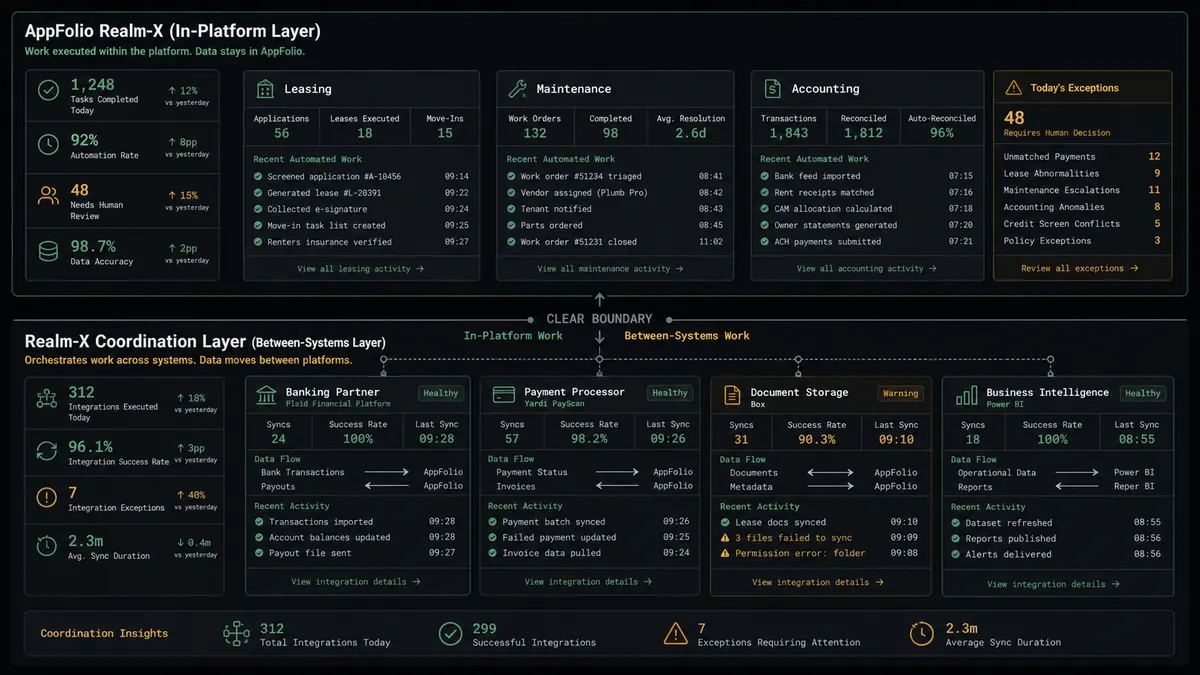
This is the axis where AppFolio is genuinely strong and any honest comparison says so plainly. AppFolio describes its AI as “native agentic AI,” branded Realm-X, and the framing they lead with is “AI Built-In, Not Bolted-On,” with the product “designed from the ground-up with AI as a core building block, not an add-on.” That is not empty. Realm-X ships in three parts. The Assistant “instantly pulls performance insights and reports, executes bulk actions and communication.” Realm-X Flows is an automation engine for standardizing repeated processes so they run “consistently, automatically, and 24/7.” And Realm-X Performers, in AppFolio’s own words, “use agentic AI to independently observe, interpret and act on signals from your data to keep operations flowing.”
[ ]
]
For work that lives inside AppFolio, that is a serious capability, and it is improving. A maintenance request that comes in through AppFolio, gets triaged, dispatched to a vendor in your AppFolio vendor list, and followed up on is a workflow Realm-X is built to own end to end. FlowRunner does not do that better, because FlowRunner does not have the leasing module, the maintenance module, or the resident portal the workflow runs through. On this axis, if your automation need is in-platform, AppFolio is the answer and you should weigh Realm-X heavily.
The boundary worth noticing is the phrase “signals from your data.” Realm-X acts on the data inside AppFolio. The work that involves data AppFolio does not hold is the next axis.
Axis 2: the work between systems
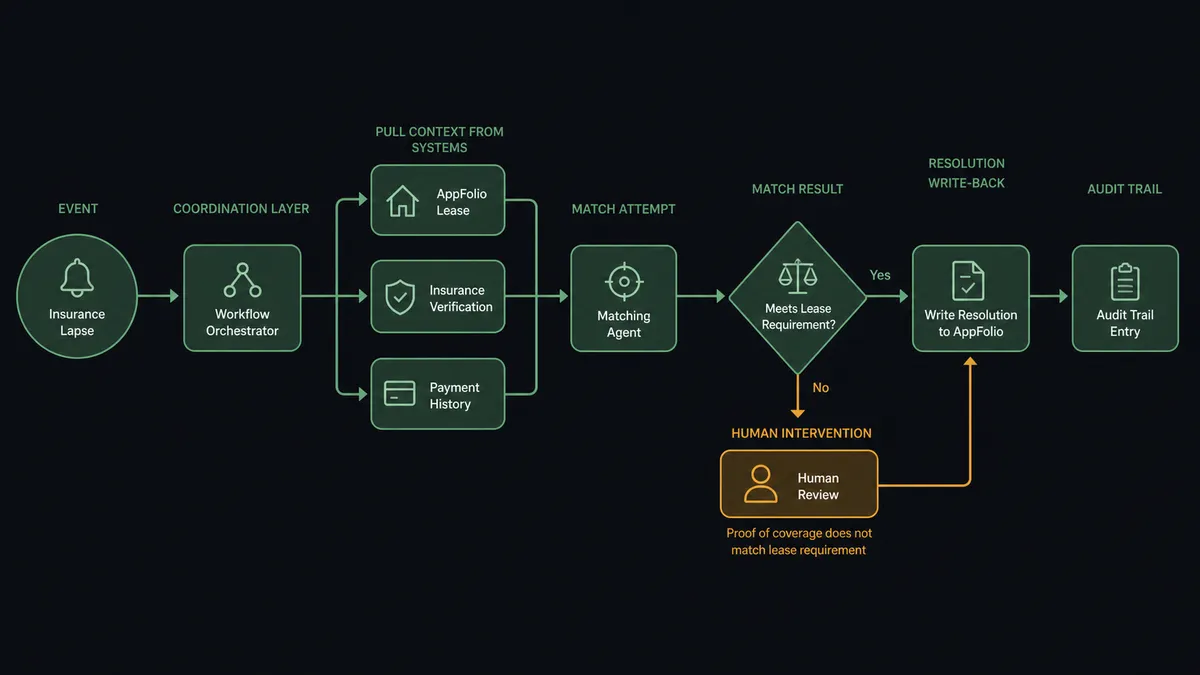
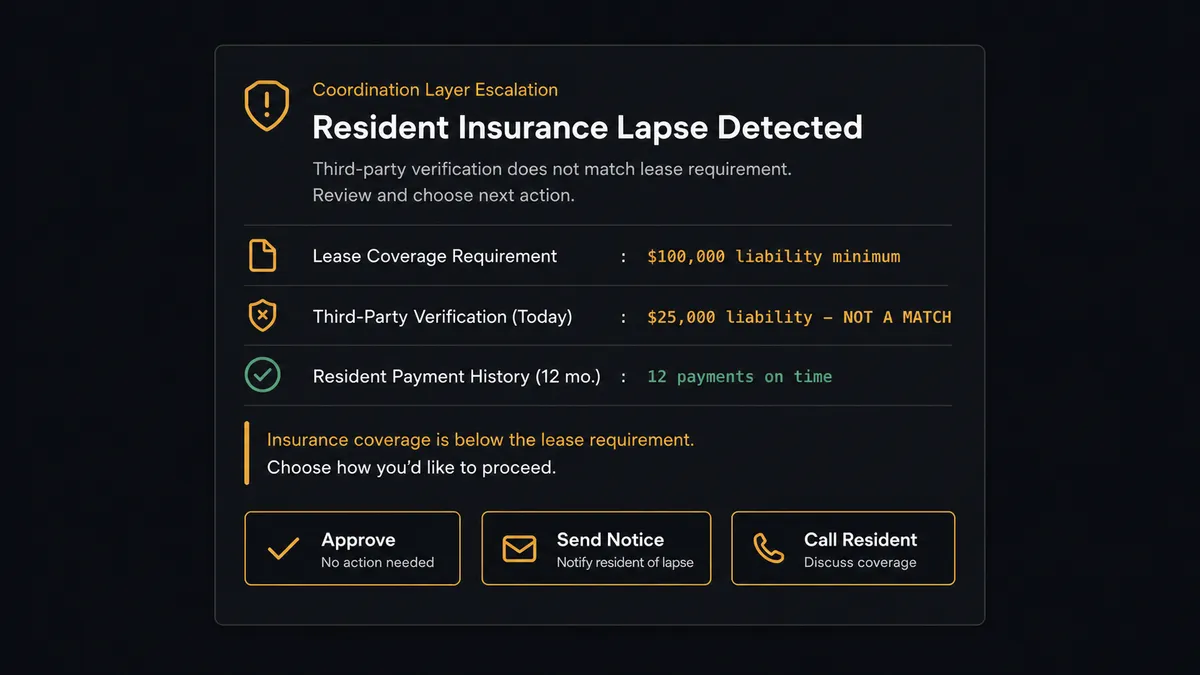
Walk one process that does not fit in a single platform. A resident’s insurance lapses. The proof of coverage lives with a third-party verification service, not in AppFolio. The lease clause that says what happens on a lapse lives in AppFolio. The decision about whether to force-place a policy, send a notice, or call the resident depends on the resident’s payment history, the property’s policy, and a judgment call a human should make. Three systems and a person, for one event.
Or owner reporting at month end, where the numbers come out of AppFolio but a principal wants them reshaped in a separate tool with commentary. Or an acquired portfolio still running on a different platform that has to be reconciled against the AppFolio book until the migration finishes. Or a turnover vendor who invoices through a system that is not in your AppFolio vendor list, where the invoice has to be matched against the work order and the unit condition report before anyone pays it.
[ ]
]
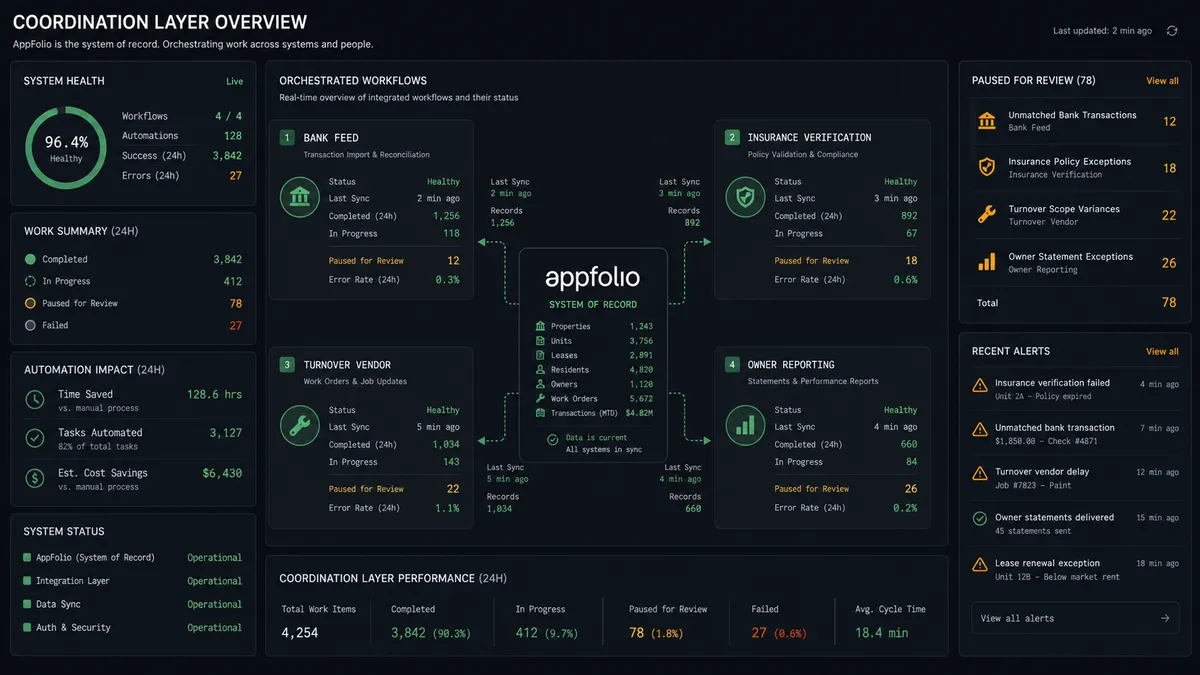
None of these live inside AppFolio, so none of them are jobs for the AI inside AppFolio. They are jobs for a layer that listens to what AppFolio emits, gathers the context AppFolio does not hold, brings a person in when the answer needs judgment, and writes the decision back so the record stays in one place. That layer is a category, not a single product. It sits above the systems of record, coordinates across them, and governs the agents and humans doing the work. FlowRunner is built for that layer. Buying it to automate something that lives entirely inside AppFolio would be a mistake. Buying it because the seams between AppFolio and the other five systems are where your team loses its week is the fit.
Axis 3: the human-in-the-loop, and where it sits
Both products keep humans involved. The difference is architectural. AppFolio’s tasks and approvals are structured handoffs inside AppFolio modules, which is exactly right for in-platform work. FlowRunner’s human-in-the-loop architecture treats a human reviewer as a callable step inside an agent workflow that can span systems. The agent runs, hits something it should not decide on its own, pauses, routes the decision to a named person with the full context attached, captures the response through Slack, email, WhatsApp, or phone, and resumes from that answer. One operations leader called the pattern a digital andon cord, the pull that stops the line when something is wrong rather than letting the work plow ahead.
[ ]
]
The reason this matters for property management specifically is that the exceptions you cannot fully automate are the cross-system ones. An in-platform approval gate handles an in-platform decision. It cannot route a decision that depends on data in your bank feed, your insurance verifier, and a vendor system at the same time, because those are not in the platform. A configurable escalation layer across systems can. That is the capability FlowRunner adds, and it adds it precisely where a single-vendor approval gate runs out of reach.
Axis 4: pricing models that do not line up
AppFolio prices the platform. Their pricing is quote-based, packaged as Core, Plus, and Max, “Flexible Plans That Scale With Your Business,” with a stated 50-unit minimum on Core and minimum spend on every tier. You are buying a property management system priced to your portfolio size, and that is the correct way to price a system of record.
FlowRunner prices coordination. The core platform, with AI agents, human-in-the-loop across email, Slack, WhatsApp, and phone, all integrations, BYOK, unlimited users, and unlimited workflows, is on every plan. The Free plan covers 100 executions a month, Starter is $5 for 300 or $15 for 3,000, and the Growth tier at $45 per month carries 12,000 for production volume. Audit trails and RBAC come in at the Professional tier at $299 per month. SSO and 90-day audit retention come in at the Business tier at $999 per month. The unit being priced across all tiers is execution volume across whatever processes you orchestrate, not units under management. A per-door comparison is meaningless because the two products meter different things. The honest read is that they are not substitutes on a price sheet any more than they are substitutes on a feature sheet. An operator who needs both pays AppFolio for the platform and FlowRunner for the work around it, and the two line items answer different questions.
Where AppFolio is stronger, named explicitly
A comparison where FlowRunner wins every axis would be dishonest, and on the axes that define property management software, AppFolio wins outright. Three of them, in the order an operator should weigh them:
It is an actual property management platform and FlowRunner is not. This is the one that matters most and it is not close. AppFolio has accounting, leasing, maintenance, resident and owner portals, and reporting purpose-built for real estate, refined over years against a large customer base. FlowRunner has none of that. It is horizontal infrastructure with no pre-built property management workflows, no resident portal, no general ledger. A property management company that tried to run on FlowRunner alone would have nothing to run on. If you are choosing a system to operate your portfolio, this axis ends the discussion: you need a platform, and FlowRunner is not one.
Vertical depth and data. Realm-X is trained and tuned against property management data and embedded in the workflows where that data lives. AppFolio’s templates, integrations, and AI reflect years of building specifically for leasing, maintenance, and real estate accounting. FlowRunner’s agents are general-purpose; the operator configures them against their own stack and supplies their own context. For in-platform property management tasks, AppFolio’s domain-specific tuning is a real advantage that FlowRunner does not try to match.
Breadth of portfolio coverage in one system. Single-family, multifamily, student, affordable, commercial, HOA, and investment management, all from one platform with one packaging model. For an operator with a mixed portfolio who wants a single system of record across all of it, that consolidation is genuine value, and FlowRunner is not a system of record at all.
If your evaluation rests on these three surfaces, choose AppFolio, and a coordination layer is a question for later, not now.
Where FlowRunner is the better fit
[ ]
]
Choose FlowRunner, on top of a platform like AppFolio, when:
- The work eating your team’s week is between systems, not inside one: insurance lapses, owner-reporting reshaping, acquired-portfolio reconciliation, off-platform vendor invoices
- You run more than one system that has to agree, and a person currently reconciles the difference by hand
- The exceptions you cannot automate are the cross-system ones, and you want a human pulled in with full context rather than a flat alert
- You connect tools AppFolio does not integrate with natively, and you need an open connector model and MCP support to reach them
- You want operations people, not engineers, to build and change these cross-system workflows
- You need audit trails and RBAC on the coordination work at mid-market pricing (Professional at $299/mo), with SSO available at Business ($999/mo), not just inside the platform
What FlowRunner does not try to be is a property management system. It will not replace AppFolio’s ledger, portals, or vertical AI, and an operator whose problem is in-platform should not buy it expecting that. The configuration that makes sense is the layered one: AppFolio runs the operation, FlowRunner coordinates the seams. We have not built a packaged AppFolio connector to date, and the honest version of that sentence is that the architectural shape, AppFolio as system of record with a coordination layer listening around it, is the same one we already run against ERPs and line-of-business systems.
How to decide
Three questions, in order. They are designed so you reach the answer, not so I reach it for you.
1. Do you have a system that runs the operation? If the honest answer is no, or “we are on spreadsheets and a tool we have outgrown,” stop here. You need a property management platform before you need anything that coordinates one, and AppFolio is one of the category’s strongest answers. Come back to the coordination question once the platform is in.
2. Where does the work that frustrates your team actually live? Walk the last five processes that cost an operations person real hours. If they ran entirely inside one platform, AppFolio’s Realm-X is the place to push, and you may not need a second tool at all. If two or three of them spanned the platform plus a bank, an insurer, a vendor system, or a separate portfolio, that work is between systems, and it is the work a coordination layer is built for.
3. Where do your hardest exceptions sit? Look at the cases nobody could fully automate. If they resolved cleanly inside an in-platform approval, an in-platform tool is enough. If the hard ones needed someone to weigh data from three systems at once, you need an escalation layer that can reach across all three and bring a person in with the whole picture framed.
Most operators find question two splits their answer: some of the week is in-platform and some of it is between systems. That is the normal shape, not a hedge. It is also why the layered configuration is common: the platform for the operation, the coordination layer for the seams. If you want to see how the cross-system pattern looks in practice, our property management automation overview walks through it, and the FlowRunner versus Buildium read covers the same layered question against a different platform. If you are earlier than that and still deciding what is even worth automating, start there instead.
The seams are where it shows. The insurance lapse that needed three systems and a judgment call. The owner statement reshaped by hand every month. The acquired portfolio reconciled in a spreadsheet until the migration lands. The off-platform invoice matched against a work order before anyone pays it. The vendor who falls outside the catalog and so falls to a person. None of those are failures of your property management platform. They are the work that lives between it and everything else, and that is the work a coordination layer exists to stop letting plow ahead unwatched.
Quick answers
Is FlowRunner a replacement for AppFolio?
No. AppFolio is a complete property management platform with accounting, leasing, maintenance, resident and owner portals, and reporting built in. FlowRunner does not provide any of those modules and would need a system like AppFolio to function in a property management context. FlowRunner is a coordination layer that connects AppFolio to the other systems your company runs and pulls a human in on the exceptions. A property management company needs the platform first.
When does FlowRunner add value on top of AppFolio?
When work crosses the boundary of the platform. AppFolio’s Realm-X automates leasing, maintenance, and accounting inside AppFolio. FlowRunner adds value when a process has to span AppFolio plus something AppFolio does not own: a bank feed, an insurance verification service, a turnover vendor outside your AppFolio vendor list, a separate owner-reporting tool, or an acquired portfolio on a different system. It is most useful when a person has to make the call on the exceptions, because the data needed to decide sits in more than one place at once.
Does AppFolio already do AI and automation?
Yes, and the comparison is dishonest if it pretends otherwise. AppFolio ships native agentic AI through Realm-X, with an Assistant, a Flows automation engine, and Performers that, in AppFolio’s words, use agentic AI to independently observe, interpret and act on signals from your data. For a large share of in-platform work, that is all you need on its own. The question FlowRunner answers is what happens to the work that does not live inside AppFolio.