
If you manage residential or commercial property and you are searching for how to automate the work, the first thing worth saying is that Buildium and FlowRunner are not two answers to the same question. Buildium is a property management application. FlowRunner is an orchestration layer that runs above your applications. Comparing them head to head is useful, but only if you understand that the right answer for most readers is not one or the other. It is Buildium for the property management product, and FlowRunner when the work that has to happen between Buildium and the rest of your systems has outgrown what any single product can hold.
Here is the part most comparison posts will not say, because it does not flatter the author: if you do not already run a property management platform, you should buy one, and Buildium is a strong, mature choice. FlowRunner does not replace it and is not trying to. This article is about the seam Buildium does not own, the space between your property management system and your bank, your general ledger, your owners’ inboxes, and the growing pile of other tools your operation runs.
Buildium and FlowRunner side by side
| Buildium | FlowRunner | |
|---|---|---|
| What it is | A purpose-built property management platform, self-described as the “#1 most recommended property management software” | An orchestration layer for work and AI agents across the tools an operation already runs |
| Primary buyer | Property manager, landlord, or community association manager who needs a system of record | VP or director of operations coordinating work across multiple systems, with humans in the loop on exceptions |
| Core scope | Accounting, rent collection, leasing, tenant screening, maintenance, 1099 e-filing, resident and owner portals, all in one product | No property management features; coordinates whatever systems you run, including a property management platform like Buildium |
| Portfolio coverage | Residential, commercial, community association, student housing under one interface | Domain-agnostic; not specific to property at all |
| AI and automation | Agentic AI and automation baked into core features; states AI should be “a trusted extension of our platform, not a replacement for human judgement” | Human-in-the-loop as a callable step the agent invokes at decision points, comparable to a digital andon cord |
| Governance | Role-based controls and compliance features within the product | Available as a step-up: audit trails and RBAC from the $299 a month Professional tier, SSO and longer retention at the $999 Business tier, spanning every system the agent touches |
| Pricing | Published tiers: Essential $62, Growth $192, Premium $400 a month; 14-day free trial | Published tiers from a Free plan and $5 Starter; Growth $45 a month (AI agents, all integrations, human-in-the-loop, unlimited users and workflows); Professional $299, Business $999 |
| Maturity | Established base, Buildium Academy, live phone support, years in residential PM | Newer entrant; horizontal platform, carries adoption risk in any single vertical |
The table sorts the two products. The rest of this article is the part a table cannot carry: which problem you actually have, and which tool is built for it.
What Buildium is genuinely good at
Buildium is a real, mature property management platform, and it describes itself as the “#1 most recommended property management software.” That is the vendor’s own framing, and the product depth behind it is the reason a property manager should take it seriously. A buyer evaluating it should know exactly where it is strong, because none of these strengths are in dispute.
It is a complete property management product in one place. Buildium covers accounting, online rent collection, leasing, tenant screening, maintenance and operations, 1099 e-filing, and resident and owner portals inside a single application. It serves single-family, small multifamily, community association, student housing, and commercial portfolios under one interface. FlowRunner provides none of that. There are no lease templates, no CAM charge tracking, no 1099 filing, no violation management in FlowRunner, because FlowRunner is not a property management system. If what you need is the product that runs the property, this is the column you are shopping in, and FlowRunner is not in it.
It has invested in onboarding and support. Buildium points to Buildium Academy, onboarding specialists, and live phone support, alongside a self-reported 95 percent customer support satisfaction rating. Read the satisfaction number as the vendor’s own marketing claim, because it is. The underlying point still stands: a vertical product with years of customer success investment behind it carries a real advantage when an office manager who does not write software needs the thing to work on Monday. FlowRunner is a newer product, and the maturity gap is a fact to weigh, not a detail to bury.
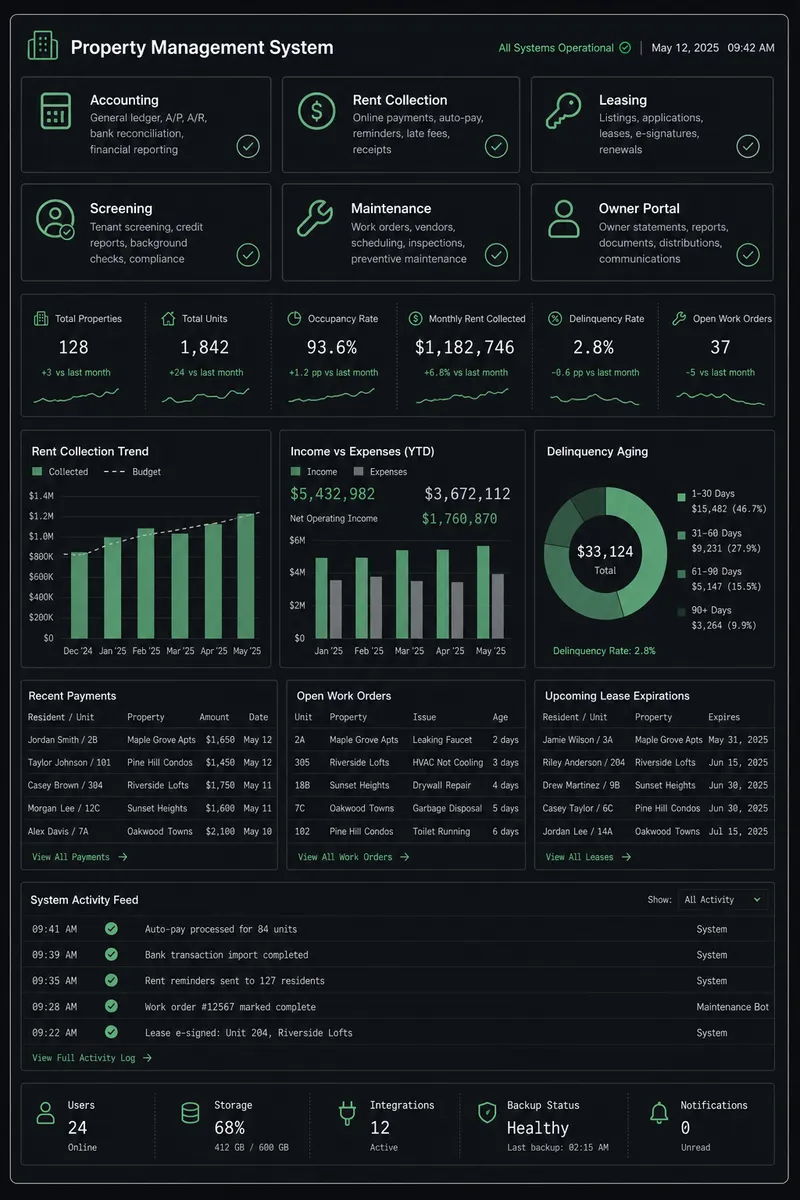
It is building its own automation, and it is honest about the human role. Buildium describes agentic AI and automation as “already baked into many of its core features,” covering tasks like listing syndication, autopay and late-fee handling, owner statements, and maintenance work-order routing. It also states plainly that “AI should be a trusted extension of our platform, not a replacement for human judgement.” That is the right instinct, and it is worth pointing out directly rather than pretending Buildium’s automation is marketing veneer. It is not. The distinction FlowRunner draws is not whether Buildium keeps humans involved. It is about where the automation lives and what it can reach.
That distinction has a name, and it is the rest of this article.
The seam Buildium does not own
Here is what most property management automation comparisons skip past. The hard part of a growing operation is not the work that happens inside any one product. Buildium runs the work that happens inside Buildium very well. The hard part is the work that happens in the gaps between systems.
Think about where the time actually goes in an operation past a certain size:
- A payment lands in the operating bank account that does not match any rent record cleanly, because a resident paid through a channel that did not sync, or paid two months at once, or paid short by a fee.
- An owner emails asking why a distribution looks off, and answering means reconciling the property management ledger against the actual bank statement and the management agreement, three systems that do not talk.
- A maintenance invoice arrives from a vendor by email, needs to be coded to the right property and the right GL account, and needs someone to decide whether it is within the approval threshold before it gets paid.
- A new tool gets adopted, an insurance tracker, a separate accounting system the CPA prefers, a banking portal, and now there is one more island that someone has to ferry data to and from by hand.
None of those are failures of the property management platform. They are the connective tissue between the property management platform and everything else. That is the seam. And the seam is exactly the kind of work that does not fit inside a vertical product, because a vertical product is built to own its own four walls, not to govern the traffic between yours.
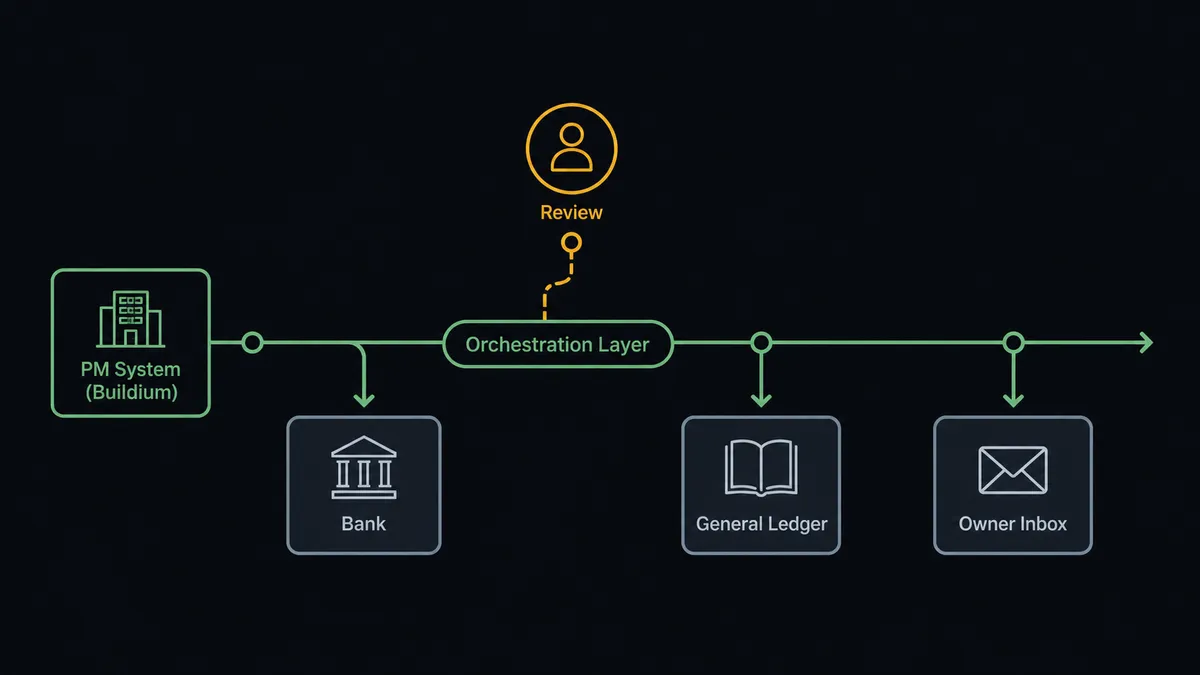
This is the category FlowRunner is built for. Orchestration as a service is a layer above the systems of record. It listens for what those systems emit, gathers the context that no single system holds on its own, attempts the mechanical part of the work, and calls a human in at the moments that need judgment, writing a structured record of who decided what across the whole chain. Buildium is one of the systems of record this layer sits above. It is not a competitor to the layer, any more than your accounting package competes with the person who reconciles it. For the broader framing of why this is a different category from in-product automation, the companion read is the difference between AI automation and AI agents.
How the human moment differs in scope
Both Buildium and FlowRunner believe a human belongs in the loop. Buildium says so directly, and means it. The difference is not philosophy. It is reach.
Buildium’s automation keeps a human involved inside Buildium. A late-fee rule, a maintenance routing rule, an owner-statement schedule: these run inside the product, and when a person needs to weigh in, they weigh in on a Buildium screen about a Buildium object. That is the correct design for work that lives entirely inside the property management system, and it is genuinely useful.
FlowRunner’s human-in-the-loop architecture treats a human as a callable step inside an agent that spans systems. The agent reconciling a bank deposit against the property management ledger does not stop at the edge of one product. It pulls the deposit from the bank feed, the expected charges from the property management system, the management terms from wherever they live, attempts the match, and when something does not reconcile, it pauses and routes a structured request to a named person through the channel they prefer. The person sees the deposit, the expected record, and the specific discrepancy in one message, decides, and the agent resumes with that decision captured in the audit trail.
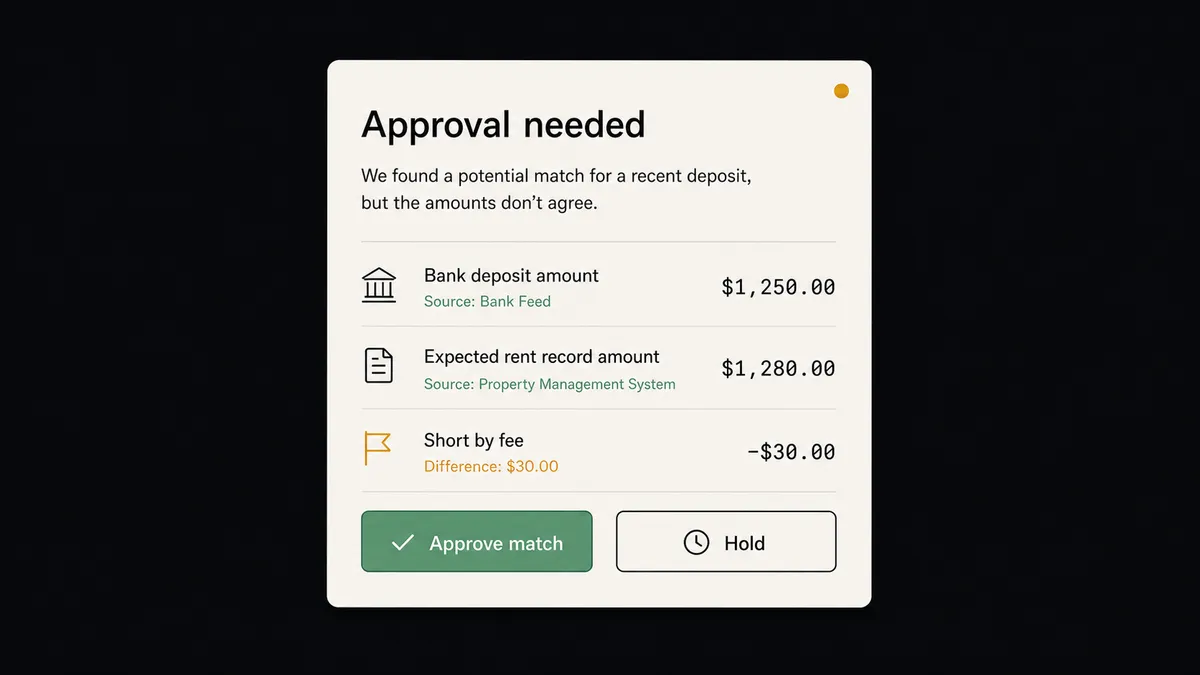
The difference shows up in three concrete places:
- What the agent can see. A human moment inside one product carries that product’s context. A human moment inside a cross-system agent carries context the property management system never had, the bank side, the GL side, the agreement. The reconciliation question is unanswerable from inside any one of those alone.
- What the audit trail records. An in-product action records what happened in that product. An orchestration-step approval records the trigger, the context the agent gathered from every system it touched, the decision it would have made on its own, the person it routed to, the response, and the action taken across systems. That difference matters in an owner dispute or an audit conversation, not in a demo.
- What it can reach next quarter. When you add the next tool, an in-product automation does not extend to it. An orchestration layer was built to add a system to the chain. That is the entire point of sitting above the systems rather than inside one. For more on keeping multi-step work coordinated as it grows, see coordinating parallel workflow branches.
This is not a feature gap with Buildium. Buildium is not trying to be the layer above your bank and your GL. It is trying to be an excellent property management product, and it is one. The two tools are aimed at different altitudes.
Pricing, and who each one is for
A direct dollar comparison is possible here, because both publish pricing. It is also slightly beside the point, because the two are not priced as substitutes.
- Buildium publishes tiered pricing: Essential starting at $62 a month, Growth at $192 a month, and Premium at $400 a month, with a 14-day free trial and no credit card required. The entry tier is built for an individual property manager or a small portfolio that is “taking off.” That low barrier to entry is a genuine strength, and it is the right starting point for a small operator who needs a property management product and nothing more elaborate.
- FlowRunner publishes pricing too. There is a Free plan and a $5 Starter, and the Growth tier at $45 a month is the full core capability set at production volume: AI agents with BYOK, all integrations, human-in-the-loop across email, Slack, WhatsApp, and phone, unlimited users, and unlimited workflows. The Professional tier at $299 a month adds governance (audit trails, RBAC) for operations teams that need formal controls, and the $999 a month Business tier adds SLA tracking, SSO and a longer audit retention window. The right tier is the one whose governance posture matches what the operation actually has to evidence, not the highest tier on the page.
The honest read on price is that an individual landlord choosing a property management product is not the buyer FlowRunner is priced for, even at $45 a month, because FlowRunner is not a property management product. An operations leader who already runs a property management system, plus accounting, plus banking, plus a stack of other tools, and who is spending senior time stitching them together by hand, is. For the question of whether a given process is even worth automating in the first place, this guide on how to decide what is worth automating is the place to start before you price anything.
Where Buildium is the stronger choice
The brief for this article was explicit, and so is this section. There are concrete situations where Buildium is the better choice, and a comparison that hides them is not worth your time.
- You need a property management system and do not have one. This is the most common case, and the answer is unambiguous. Buildium is a complete, purpose-built platform with years of domain-specific features. FlowRunner does not provide accounting, leasing, screening, or any of it. If this is you, buy Buildium or a platform like it, and revisit FlowRunner when the work between systems becomes the bottleneck.
- You are a small operator who wants a low entry price and fast onboarding on a vertical product. Buildium’s $62 a month Essential tier, 14-day trial, and onboarding and support investment are built for exactly this buyer. FlowRunner’s orchestration focus is not, even at the $45 a month Growth tier; the issue is not price, it is that FlowRunner does not run your properties.
- You want the established, lower-risk vertical incumbent. Buildium has brand recognition, a large customer base, and deep property management workflow fit that a newer horizontal platform cannot replicate through agents alone. Switching costs and accumulated trust are real, and for a buyer who weighs maturity heavily, that is a genuine point in Buildium’s column. We will not argue otherwise.
These are not throwaway acknowledgments. They are decision-shaping facts. If your situation matches them, Buildium is the right call, and FlowRunner sits alongside it later, if at all.
Where FlowRunner is the better fit
Choose FlowRunner when the problem is not the property management product but the work around it:
- You already run a property management platform like Buildium as your system of record, and the friction is in the gaps between it and your bank, your general ledger, your owners, and your other tools.
- The work that eats your team’s time is cross-system: reconciling deposits against the ledger, coding and approving vendor invoices, answering owner questions that require pulling from three places, ferrying data to a tool that does not integrate.
- Human approval is the moment the work’s value is decided. You want that approval to be a callable step inside an agent that can see every system involved: pause, route with full context, resume with the decision recorded. Not an alert inside one product, about one product.
- You want governance, audit trails, RBAC, and SSO, that spans the whole chain of systems an agent touches, at a price an operations director can authorize when the governance posture is actually required (Professional $299 a month for audit trails and RBAC, Business $999 a month for SSO and longer retention).
- You expect AI agents to start arriving in your stack from multiple vendors, including from inside your property management platform, and you want a coordination layer above them, with humans in the loop, before that becomes the next integration mess. On why that coordination is harder than it looks, this is what breaks automations in production.
The pattern is the same one FlowRunner runs in any operation: ingest the trigger, gather context across systems, attempt the mechanical match, call a human on the exception, record the decision. Property is just one place the pattern applies. If you are still deciding which vertical product to standardize on, the property management automation software overview frames that choice, and the companion comparison FlowRunner vs AppFolio runs this same fit question against a different incumbent.
How to decide
Two questions settle this, and you can answer both in a few minutes.
Question one: do you already have a property management system? If the answer is no, stop here. You need a property management product first, and Buildium is a strong, complete, well-supported choice with a low entry price. FlowRunner is not a substitute and will not run your properties. Come back to it when the systems around your property management platform start to multiply.
Question two: where do your exceptions live? Look at the last ten things that pulled a senior person off their real work. If they happened inside your property management product, a late fee, a renewal, a maintenance request, then in-product automation, including Buildium’s own, is the right tool, and it is improving. But if they happened in the gaps, a deposit that did not match the ledger, an owner question that needed three systems to answer, an invoice that needed coding and an approval before money moved, that is the seam no single product owns. That is the digital andon cord an operations leader actually wants: the system reaches the deposit it cannot reconcile on its own, pulls up, and asks a named person before anything posts, instead of either guessing or quietly leaving it for a human to find later.
Both tools are real answers to real questions. Buildium is the property management product, and a good one. FlowRunner is the orchestration layer above it, built so the human decision is a first-class step that can see across every system involved. The question is not which is better. It is whether the work that is costing you lives inside one product or in the space between them, and whether you have a system of record yet at all.
Quick answers
Does FlowRunner replace Buildium?
No. FlowRunner is not a property management application and does not provide accounting, leasing, tenant screening, maintenance tracking, 1099 e-filing, or resident and owner portals. Buildium does all of that in one product. If you need a property management system, you need Buildium or a platform like it. FlowRunner is the orchestration layer that sits above your property management system and the rest of your stack, coordinating work across them with a human in the loop on exceptions.
Is FlowRunner cheaper than Buildium?
At entry tiers, FlowRunner is cheaper, but the comparison is not apples to apples. Buildium starts at $62 a month for its Essential plan, built for an individual property manager or small portfolio. FlowRunner has a permanent Free plan and a $5 Starter, and its Growth tier at $45 a month includes AI agents with BYOK, all integrations, human-in-the-loop across email, Slack, WhatsApp, and phone, and unlimited users and workflows. The two are priced for different buyers, not as substitutes for the same job. If you need formal governance (audit trails, RBAC), FlowRunner’s Professional tier is $299 a month.
Can FlowRunner connect to Buildium?
FlowRunner is designed to coordinate work across whatever systems an operation already runs, with a property management platform like Buildium as the system of record. The honest pattern is to keep Buildium as the place property data lives and use FlowRunner to handle cross-system exception routing, reconciliation between Buildium and the bank or general ledger, and human escalation. We do not claim a prebuilt, one-click Buildium connector today; treat integration as a build, not a checkbox.