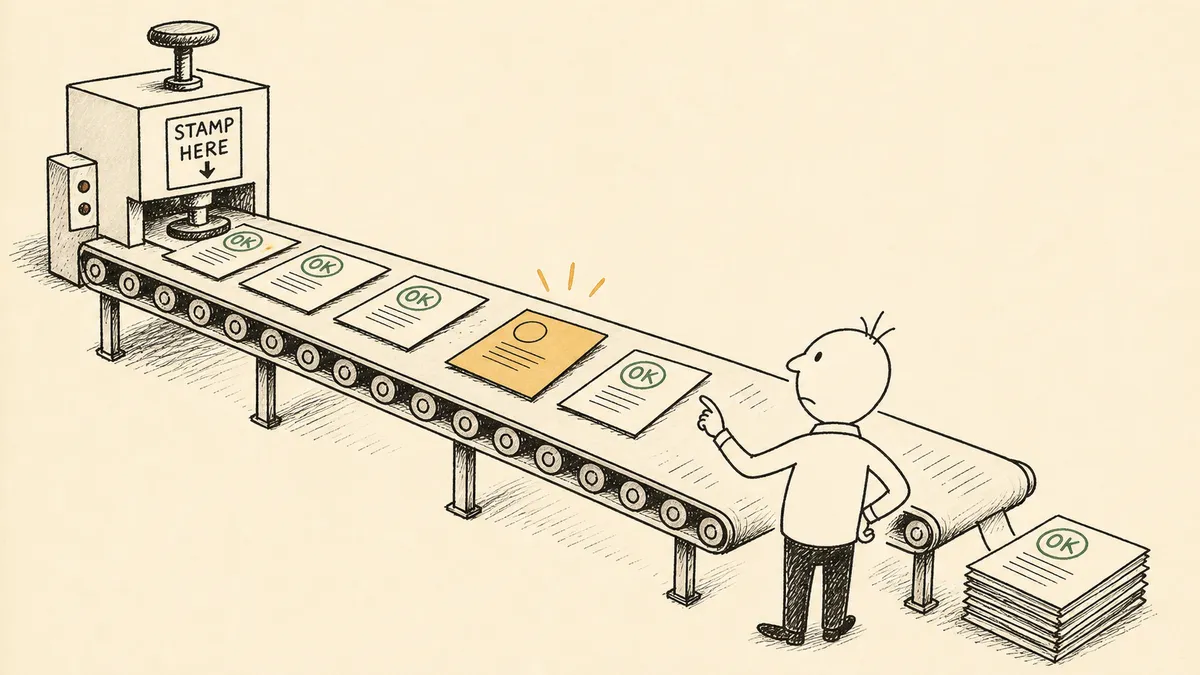
Automated compliance reporting is sold as a dashboard, and the dashboard is the cheapest part of the problem. The report that lists who approved what and when is a query. It is only as defensible as the evidence the query runs against, and that evidence is created somewhere the reporting tool cannot reach: inside the approval, the reconciliation, and the exception, at the moment a person made a call. Finance leaders who buy the reporting layer first are buying a better way to reassemble evidence that should never have been scattered in the first place.
That is the reframe this article is built on. The report is the output. The control point is the input. Almost everything that goes wrong with compliance evidence goes wrong at the input, and no amount of polish on the output fixes an input that was never captured.
What CFOs actually mean by automated compliance reporting
Strip the category language off and the finance version of this need is narrow and concrete. It is a defensible answer to a small set of questions an auditor, a lender, or an acquirer will ask: who approved this transaction, when did they approve it, what did they see when they approved it, and what happened to the items that did not fit the rule. Across accounts payable, reconciliation, and the monthly close, that is most of the job.
The finance leaders we talk to do not describe this as a reporting gap. They describe it in their own words, and the words are telling. One called the automation a consultant had built for them “a little bit of a black box,” because it produced an answer without showing the work. Several describe the recurring failure as things that “fall through the cracks,” noticed after the fact rather than caught in the moment. The evidence exists in pieces. It is just spread across email, chat, the ERP, the bank feed, and someone’s memory, and it has to be reassembled when somebody official asks.
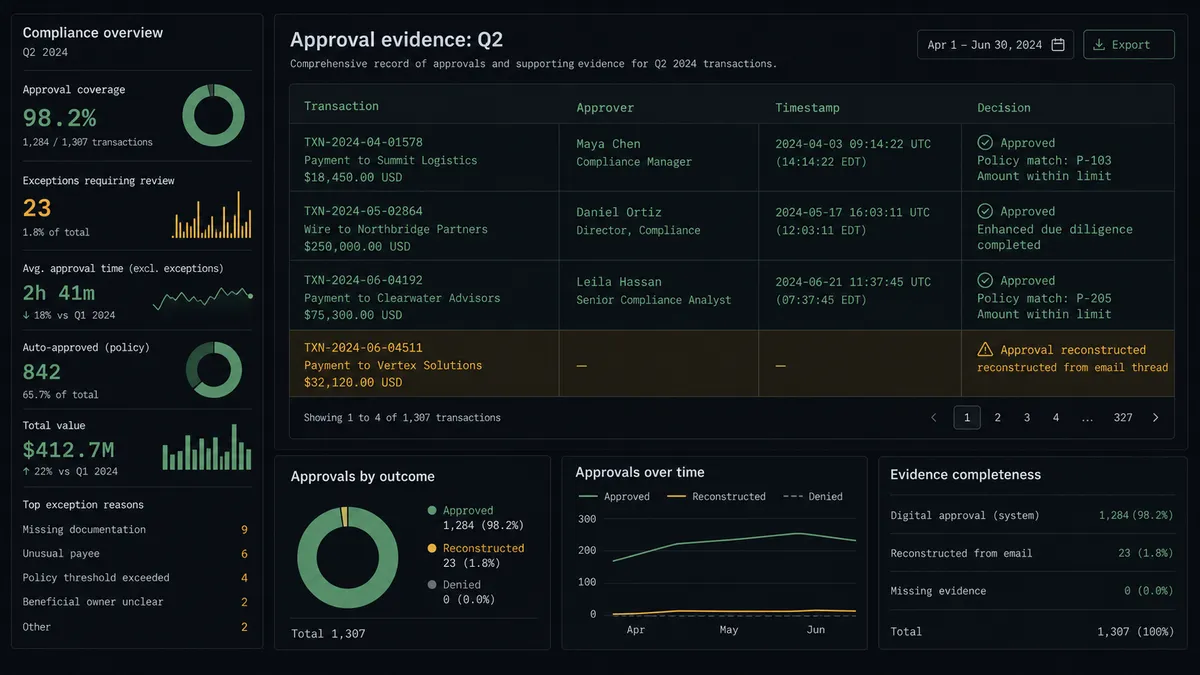
So the honest baseline is not chaos. It is not “finance teams handle this so badly that records are effectively lost.” Records exist. The problem is that they were captured as a byproduct of systems that were never designed to tell an audit narrative, so producing the narrative means stitching the pieces back together under time pressure. That stitching is the cost. It is the controller’s late nights before fieldwork and the back-and-forth on evidence requests, and it recurs every period because the evidence is reassembled rather than retained.
Here is the distinction worth holding onto, because the rest follows from it. Reporting is the output layer. Control points are the input layer. A control point is any moment where a human checks, signs, validates, or decides: the bill approval, the duplicate-payment check, the reconciliation of a line that did not match, the review of a flagged exception. The report is downstream of all of them. If the control points captured their own evidence as they ran, the report is a query. If they did not, the report is a reconstruction project wearing a dashboard.
The control points that need to capture evidence at the moment of action
Walk the finance processes auditors care about and the same pattern repeats. The evidence that holds up is the evidence captured at the instant of the decision, written against the record the decision was about. The evidence that costs you is the evidence inferred later from whatever traces survived.
Four control points carry most of the weight.
- Bill approvals. The defensible record is the named approver and the timestamp captured against the bill itself, at the moment of approval, not the final posted journal entry that shows only that a number landed in the ledger. The posted entry tells you the money moved. It does not tell you who decided it should.
- Vendor validation and duplicate checks. The risk here is the one a finance leader named precisely: that “it would be very easy to double pay on something” if both the company and a distributor paid against the same invoice. The control is the validation that runs before a bill is created. The evidence is the check itself, logged as an event, so you can show not only that the duplicate was caught but that the control was operating.
- Reconciliation steps. The audit-relevant record is the decision history per line, both the matched lines and, more importantly, the unmatched ones. A reconciliation that retains only its final cleared state has thrown away the part the auditor actually probes: what you did with the items that did not reconcile cleanly, and why.
- Exception handling. When an item gets flagged, the evidence is who reviewed it, what they decided, and when. This is the control point most likely to live entirely in a chat thread or a hallway conversation, and the one most likely to be the subject of a pointed question later.
Notice what these have in common. Each is a moment of human judgment, not a system event a monitoring tool can observe from the outside. A duplicate check can fire automatically, but the decision to override it, or to pay anyway because the controller knows something the rule does not, is a person. That judgment is exactly the thing that needs to be captured, and exactly the thing that is hardest to reconstruct after the fact, because it never lived in a system to begin with.
Why workflow-level capture beats bolt-on reporting tools
There are two ways to produce a compliance report. You can reconstruct the evidence after the fact from system logs that were not designed for an audit narrative, or you can write the audit record as part of the operational step so the report is a query against data that already exists. Bolt-on reporting tools do the first. Workflow-level capture does the second.
The reconstruction model is the one most “automated compliance reporting” tools are quietly selling. They connect to your systems, pull what those systems happened to log, and assemble it into a report. This works for evidence that lives cleanly in one system. It struggles with the evidence that matters most, because the most important evidence is the human decision that happened between systems and was never written down anywhere queryable.
That gap is not a product flaw. It is structural, and it points at the real problem. A compliance report is a query. The evidence it queries is produced at the moment a person approves a bill, clears a reconciling item, or resolves a flagged exception. That moment lives in the seam between the systems of record: the bill is in the ERP, the approval happens in chat or email, the supporting document is in a drive, the payment clears in the bank feed. No single system owns the moment, so no single system captures it, and the reporting tool downstream can only report what was captured. That seam, the work between the systems and the human judgment inside it, is a category of its own. An orchestration layer is the name for the system that owns it: a layer that sits above the systems of record and captures the decision the instant it happens. It posts the approval into the channel a person already uses, stamps the named approver and timestamp against the bill at the moment they click, and routes the exception to a reviewer with full context attached. FlowRunner is built for that layer. It does not replace the reporting tool or the ERP. It makes the moment of decision a logged event instead of a thing you reconstruct in October.
The worked examples are concrete. A Slack approval that records the named approver and timestamp on every approval, stamped against the QuickBooks bill at the instant the button is clicked, is a control point capturing its own evidence. The same pattern on a different ERP captures approver identity on every bill approval in Acumatica and routes the exceptions for explicit review. A reconciliation that retains decision history for every reconciliation step keeps the per-item record auditors probe, not just the final cleared state. And the preventive control fires before the damage: vendor validation and duplicate checks before a bill is created, with the check logged as its own audit event.
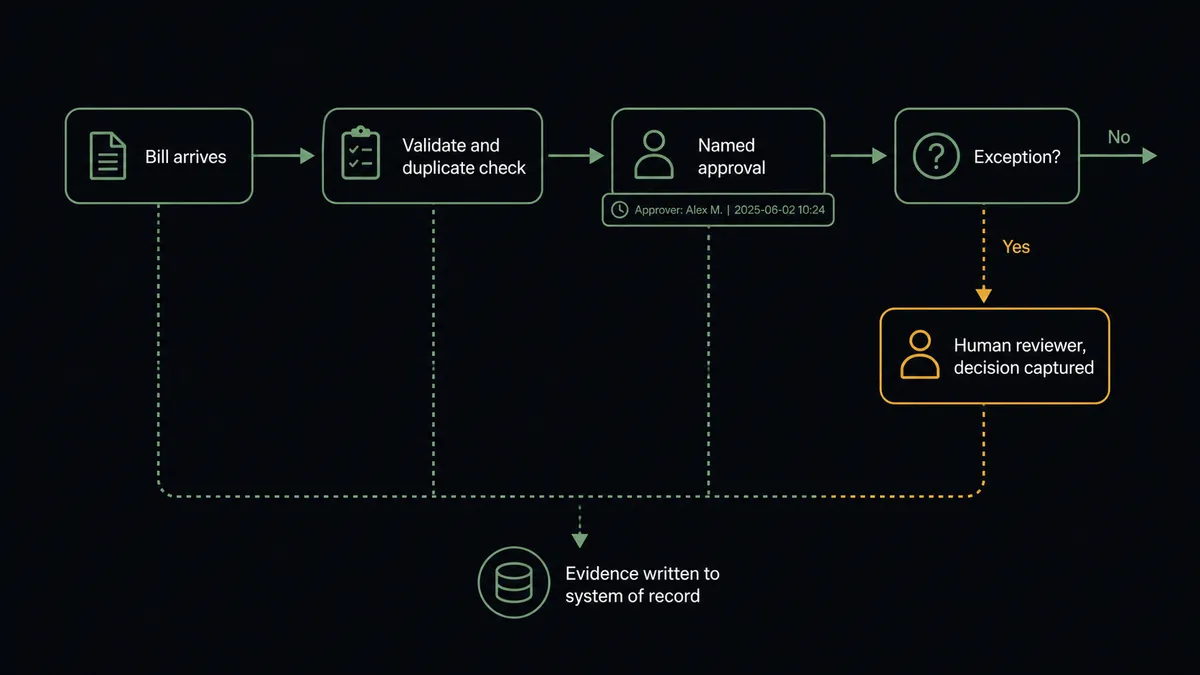
The human-in-the-loop part is not a workaround that pollutes the clean automation. It is the feature. Every pause, every ask, every override is itself an audit event. When the workflow stops and pulls a person in because the data landed on something the rule could not resolve, the record of who was pulled in, what they saw, and what they decided is precisely the evidence the report needs. The automation handles what is not the work. The exceptions are the work, and capturing how they were handled is what makes the report defensible.
What to ask vendors and internal teams when evaluating automated compliance reporting
The reframe turns into a short list of questions. Ask them of any vendor selling you automated compliance reporting, and ask them of your own internal build before you trust it. The answers separate tools that capture evidence from tools that reconstruct it.
- Where is the named approver captured, and at which step? The answer you want names a specific moment in a specific workflow, against a specific record. The answer that should worry you is a description of a report that infers the approver from a posted entry.
- Can you produce the full decision history for one transaction, end to end, without rebuilding it from multiple exports? Pick a real transaction in the demo. If producing its history means pulling three system exports and joining them by hand, that is your audit experience every period, dressed up.
- What happens to exceptions, and is the exception path logged with the same fidelity as the happy path? Most tools instrument the happy path well and the exception path poorly. The exception path is where audit findings live.
- How are overrides and manual entries recorded? Finance reality includes the moment one finance leader described to us: “if someone’s out, I might even enter a bill into the system.” Those off-pattern actions are real, they are legitimate, and they need the same rigor as the routine ones, because they are the ones an auditor will ask about.
- Does the platform expose the workflow logic itself, or is the compliance behavior a black box you have to trust? This is the one the persona names directly. A control you cannot inspect is a control you cannot defend, and “trust us” is not an audit position.
None of these questions are about the report. They are all about the capture. That is the point. The quality of automated compliance reporting is decided upstream of the report, at the control points, and a vendor conversation that stays on dashboard features is a conversation avoiding the part that determines whether the evidence holds up.
For the deeper version of how these control activities map to a specific framework, the SOX compliance checklist walks the control families auditors test and where each one fails. If your evaluation has reached the stage of comparing a governance platform against a workflow layer, the honest read on Vanta versus an orchestration layer for SOX lays out which problem each kind of tool actually solves, because they are not the same problem.
A practical starting point
The mistake is buying a monolithic compliance platform up front to solve a problem you have not yet localized. The better first move costs nothing but attention.
Pick the one process where audit pain is highest. For most finance teams that is AP bill approval, month-end reconciliation, or refund and credit approvals. Map the control points that already exist inside it: every place a human currently checks, signs, validates, or chases. They are already there, mostly implicit, mostly uncaptured. Then make each one an explicit, logged step that records the approver, the timestamp, and the decision against the underlying record as it happens.
Now apply the only test that matters. Pull one real transaction from that process and ask whether you can answer “who approved this, and when” without further investigation. If the answer is a query, the process is producing audit-ready records. If the answer is a project, you have found the gap, and you have found it on your own schedule instead of an auditor’s.
Once the pattern is proven on one process, it extends to the adjacent ones, because the capability is the same: capture at the moment of action, write against the record, log the exceptions with the same fidelity as the happy path. That is a far more defensible path than buying a reporting layer and hoping the evidence underneath it holds.
The report was never the hard part. The question that decides whether your automated compliance reporting is worth anything is whether the report is a query or a reconstruction, and that question is answered long before the auditor asks it, at the moment somebody approved the bill.
Quick answers
What is automated compliance reporting?
It is producing the records auditors and regulators ask for (who approved what, when, and on what basis) without assembling them by hand. The defensible version captures that evidence inside the operational workflow as the work happens, so the report is a query against existing data rather than a reconstruction.
Is automated compliance reporting the same as compliance automation software?
Not quite. Compliance automation software is the reporting and monitoring layer on top. Automated compliance reporting is only as good as whether the underlying control points (approvals, reconciliations, exceptions) captured evidence at the moment of action. The report is the output; the capture is the input that decides whether the output holds up.
Can you automate compliance reporting without buying a dedicated compliance platform?
Yes, when the operational workflows already capture named approver, timestamp, and decision context against the underlying record. Many finance teams get further by making each existing control point a logged step than by buying a reporting layer that reconstructs evidence after the fact.