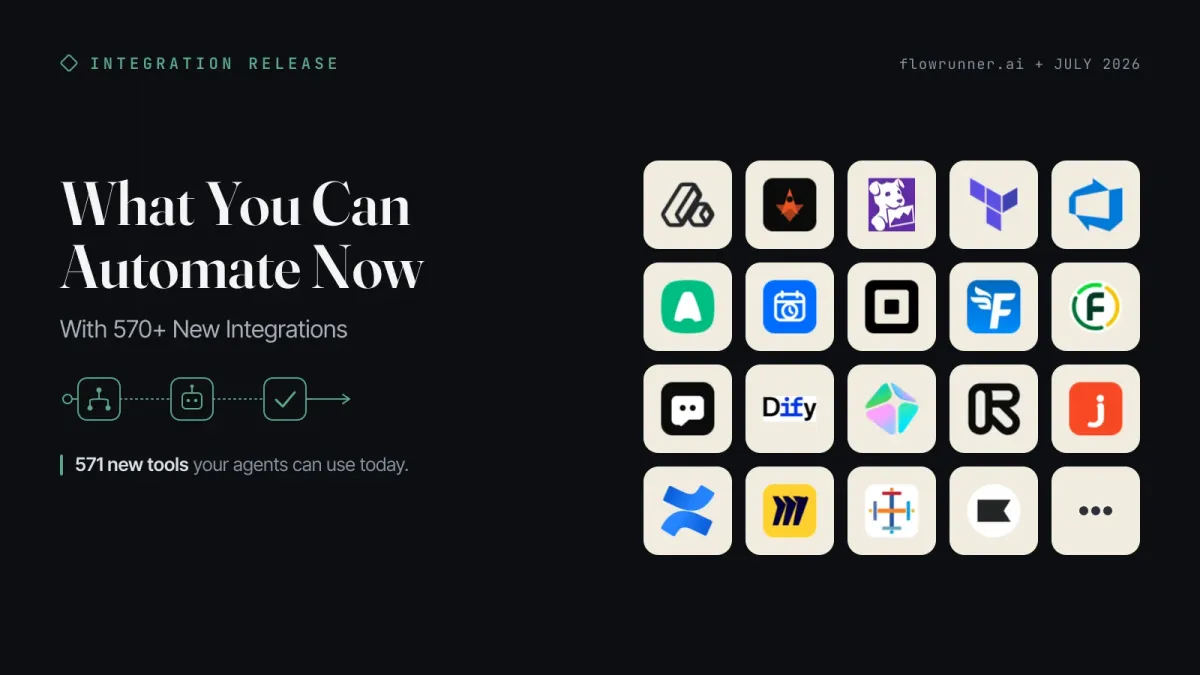
More than 570 new integrations just landed in FlowRunner, taking the catalog past 900 verified connectors. Each one is built and verified against the vendor’s own API, the same way as every connector before it, and now they all sit in the same runtime as your existing flows.
The number is not the point. The point is what a wave this size makes buildable in categories that had no coverage last month. Here are seven flows you can build today. Every tool named is a real FlowRunner connector, and in each flow the step that carries real consequence stays with a human.
Keep your CRM clean without a weekly dedup project
Every morning, pull the prior day’s new signups, enrich each one with a full profile from People Data Labs, and upsert the record into Attio, matched on email so a returning contact updates instead of duplicating. Attio adapts to your workspace schema at runtime, so the same flow works whether you track People and Companies or a set of custom objects. When two records plausibly describe the same account, the agent surfaces both side by side and a person decides which one survives. Merging is fast. Un-merging is not, so that call stays with a human.


Catch access anomalies before they become incidents
Every hour, an agent pulls the latest authentication logs from Auth0 and scans for the pattern that matters: a login from a new country, a spike in failed attempts, a token issued outside business hours. The routine logins get filed and forgotten. A genuine anomaly gets posted to the security channel in Slack with the user, the location, and the log entry attached, and a person decides whether to force a logout or leave it. Revoking a session is reversible. Assuming an anomaly is nothing and being wrong about it is not, so the agent flags and a human confirms.


Turn a monitoring signal into a fix, not just a page
Every few minutes, an agent checks Datadog for monitors sitting in an alert state and pulls the recent metric history for context. For a known, low-risk pattern, like a queue depth that clears itself within a few cycles, the agent logs it and moves on. For anything that would normally page someone at 2am, it posts the monitor, the graph, and a proposed remediation to the on-call channel, and an engineer decides whether to run it. Muting a monitor or restarting a service is a judgment call about what is actually broken, and that judgment stays human.

Ship infrastructure changes without surprises
When a pull request merges to main on GitHub, kick off a Terraform Cloud plan and post the resource diff back to the PR thread, then queue the matching Azure DevOps pipeline so the application deploy is staged and ready. The plan runs itself, and everyone can see exactly what would change before it does. Applying that plan against production, and running the pipeline that ships it, both wait for a named engineer to approve, because a plan is a proposal and an apply is a commitment.


Turn a sales call into a booked next step
Every evening, an agent pulls the day’s completed calls from Aircall, reads the call notes and tags, and finds the ones marked as a live opportunity. For those, it drafts a follow-up meeting through ScheduleOnce with a set of proposed times and drops the draft in the rep’s inbox instead of sending it. The rep picks the times that actually work and the invite goes out under their name. An agent guessing at a prospect’s calendar and sending on a rep’s behalf is exactly the kind of thing that should cost a human one click first.


Run the same order-to-books flow on the tools you actually use
If you read our first roundup, you saw an order-to-books flow built on Shopify, Stripe, and QuickBooks Online. The same pattern now runs on a different toolchain. Every morning, an agent pulls the prior day’s settled payments from Square, matches each one to an order, and posts the corresponding entry in FreeAgent or Fortnox, coded and ready. The books match the till without a nightly export either way. Anything that will not reconcile, an amount that is off by more than a rounding error, still waits for the person who owns the ledger.


Give a chatbot an escalation path instead of a dead end
Every few minutes, an agent checks Botpress or Dify for conversations the bot flagged low-confidence or that contain a phrase like “talk to a person.” It pulls the full conversation history and posts it to the support channel in Slack with the customer’s context attached, so whoever picks it up is not starting from zero. The bot keeps answering everything it actually knows. The moment it does not, a person takes over with the whole exchange already in front of them, instead of the customer repeating themselves.


Build one of these next
None of these needed an engineer to wire an API. They are flows composed from connectors that already speak to each vendor correctly, spanning categories FlowRunner had thin or no coverage in a month ago, with a human on the step that matters. Browse the full library on the integrations directory, see how builders put them together on the developers page, and start with the one closest to a problem you have this week.
This is the third in our weekly roundup of what the newest integrations make possible. Last week was 30+ AI providers, and the week before that was the new core connectors. More soon.