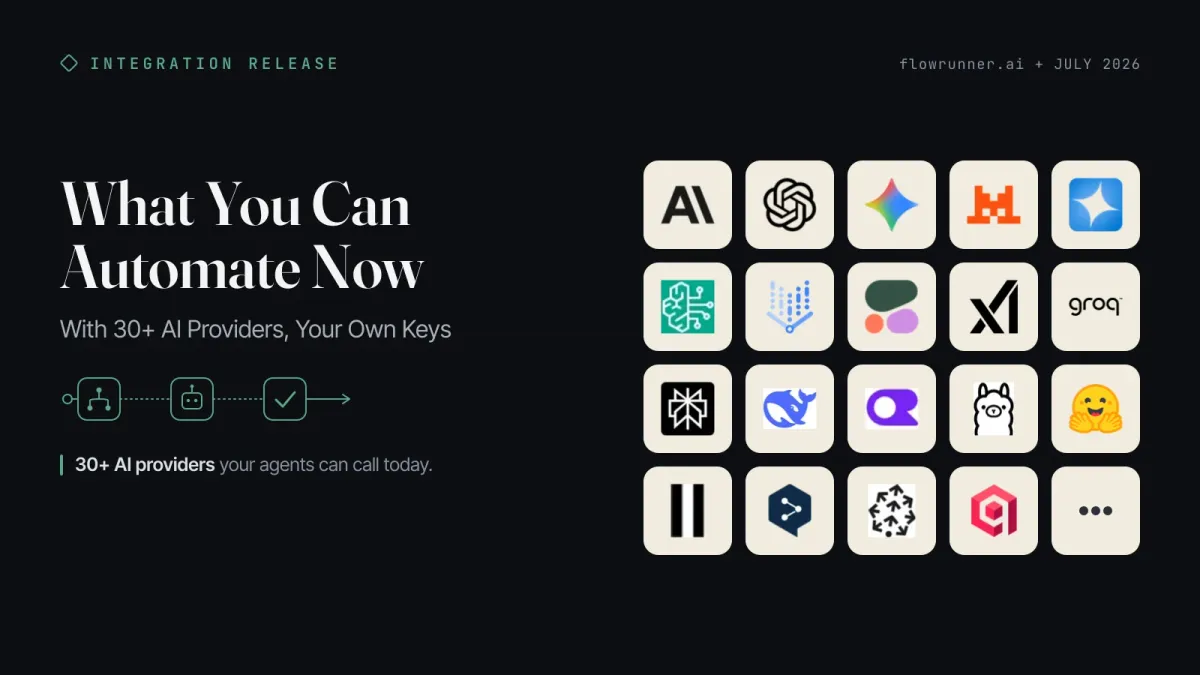
Every AI feature in FlowRunner runs on a model you choose. Not one bundled model, not one vendor’s credit meter. More than 30 AI providers are each a verified connector, from Anthropic Claude and OpenAI to Gemini, Mistral, Cohere, Groq, and xAI Grok, alongside AWS Bedrock, Azure OpenAI, and Google Vertex AI, plus speech, vision, document, and translation models and eight vector stores. You bring your own keys, pay the provider directly at your rate, and FlowRunner takes no markup on inference.
The point is not the length of the list. It is what you can build when any model is one connector away and you compose them per job instead of per vendor. Here are seven flows you can build today. In each, the model does the work and a person owns the step that carries consequence.
Send cheap models the easy work, save the frontier model for the hard part
Most requests do not need your most expensive model. Have a fast, low-cost model like Groq or a small OpenAI model triage every incoming item, and escalate only the genuinely hard cases to a frontier model like Anthropic Claude. Route it through OpenRouter if you want a single endpoint across providers. The routine classification flows straight through; the ambiguous edge case, the one the cheap model flagged as low-confidence, stops for a person.



Cross-check a high-stakes call with a second model
For a decision that matters, one model’s confidence is not enough. Run the same extraction or judgment through two independent providers, OpenAI and Anthropic Claude, and compare. When they agree, proceed. When they disagree, that is precisely the signal to pull in a human, who sees both answers side by side and decides. You get the speed of automation on the easy majority and a genuine second opinion, then a person, on the rest.
Keep AI on the provider your security team already approved
BYOK is not only about price. Point the same agent at Azure OpenAI under your Azure agreement, or AWS Bedrock under your AWS contract, and your prompts and data ride on the processor and data-processing terms your security team already signed. No new vendor in the AI path, no markup on inference, and the model choice is a configuration rather than a rebuild. When the output feeds a regulated system, the write waits for a human.


Answer from your own documents, any embedding model, any store
Embed your documents with the provider you prefer, Cohere or OpenAI, and keep them in the vector store you run: Pinecone, Qdrant, Weaviate, or pgvector. At query time, retrieve the right context and answer with Anthropic Claude, grounded in what you gave it, with citations. Swap the model or the store without rebuilding the flow. Anything the answer sets in motion downstream, a refund, a policy exception, a customer email, waits for a person.


Turn a call into a transcript, action items, and a spoken reply
Transcribe a recorded call with AWS Transcribe, summarize it and pull the action items with Anthropic Claude or OpenAI, and file them where the team already works. For outbound, generate a natural voice message with ElevenLabs. Speech in, text in the middle, speech out, and anything that actually reaches a customer waits for a person to approve it first.


Read a document, classify it, and let a person post it
Parse an incoming invoice, receipt, or form with Mindee or AWS Textract, then have a model classify and route it, coding an invoice to the right account or flagging a contract clause for review. The parsing and the classification run on their own. The consequential post, the entry into the ledger or the CRM, waits for the person who owns those numbers, with the source document attached.


Translate and localize, with a native speaker on anything public
Translate content with DeepL, then have a model like Mistral AI or Gemini AI adapt the tone and localize the phrasing for the market. Machine translation handles the volume; a human who speaks the language reviews and approves anything that will be published or sent to a customer. Fast draft, human polish, and no unreviewed copy going out under your name.


Build one of these next
Every model here is a connector your agents can call as a tool, with your keys, at your rates, and no markup on inference. Pick the provider that fits the job, not the one you happened to standardize on. Browse the full set on the AI integrations hub, see how builders put them together on the developers page, and start with the flow closest to a problem you have this week.
This is the second in our weekly roundup of what the newest integrations make possible. Last week was the new core connectors. More soon.