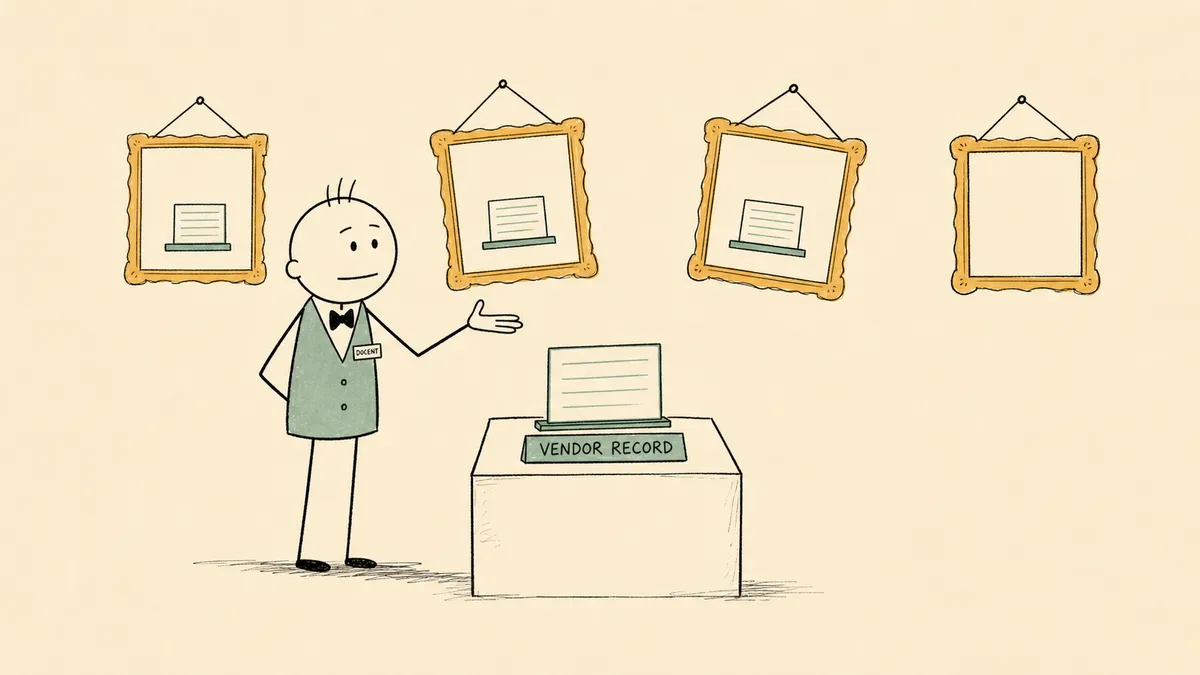
Vendor onboarding gets defined as a checklist, and that definition is the reason it goes wrong. Collect the tax form, collect the banking details, collect the insurance certificate, create the record, done. The checklist is real and it matters, but it is the easy part of the job. The actual definition of vendor onboarding is harder and more useful: it is the work of producing one true vendor record and keeping it true across every system that will ever pay or reference that supplier, including the renewals that have not happened yet.
Hold onto that framing, because it changes what you are actually buying when you decide to fix your onboarding process. If onboarding were a checklist, you would buy a form. It is not a checklist, so a form does not solve it.
What vendor onboarding actually means
Vendor onboarding is the end-to-end process that takes a third party from “we want to work with them” to “we can legally pay them and reference them as an approved supplier.” It begins with a request, generally from a business unit that needs the supplier, and it ends when the vendor exists as a complete, approved record in the systems that issue purchase orders and cut payments.
Three boundaries make the definition precise, because the word “onboarding” gets stretched to cover work that belongs elsewhere.
- It is not sourcing. Sourcing is the work of finding and selecting the supplier. By the time onboarding starts, the choice has already been made. Onboarding does not evaluate whether this is the right vendor. It makes a chosen vendor transactable.
- It is not ongoing vendor management. Performance reviews, scorecards, renewal tracking, and the relationship over time all sit after onboarding. Onboarding hands the vendor off to that work. Where the handoff is clean, vendor management starts with full context. Where it is not, the renewals and expirations that should have been inherited quietly go missing.
- It applies to any third party you will pay, not only strategic suppliers. The one-time contractor, the small SaaS subscription, and the multi-year manufacturing partner all need a vendor record before money can move. Companies that reserve “onboarding” for big suppliers end up with their highest-volume, lowest-scrutiny vendors set up informally, which is exactly where the messy records accumulate.
One more scope note, because teams genuinely split on it. Some organizations fold risk and compliance review into onboarding as a single workstream. Others run risk review as a separate track that gates onboarding without being part of it. Both are defensible. What matters is that the seam between them is owned by someone, because an unowned seam is where a vendor gets activated before its risk review actually finished.
The standard steps in a vendor onboarding process
The arc below is the common structure across procurement organizations. The wording shifts company to company, but the shape holds. For a deeper walk through each step and the failure points inside it, the companion piece on the supplier onboarding process and where it breaks goes further than this definition needs to.
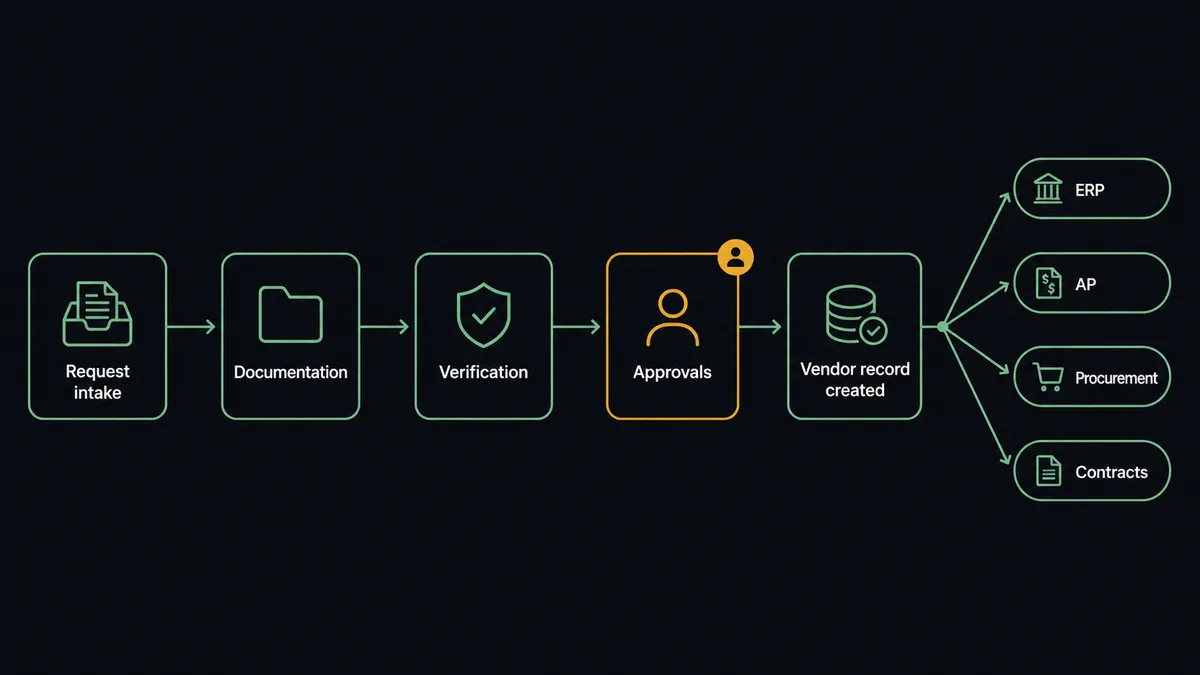
A standard process moves through five stages:
- Request intake. A business unit needs a supplier. Procurement captures the scope, the category, the expected spend, and the business reason. This is the first real decision: which lane does the vendor enter, given its risk and dollar value?
- Documentation collection. The supplier provides what the company needs on file. This is the part most people picture when they hear “vendor onboarding,” and it is covered in the next section.
- Verification. Tax ID validation, sanctions and watchlist screening, bank account verification, and a security or data privacy review for vendors that touch systems or regulated data. The required depth scales with the lane chosen at intake.
- Internal approvals. Procurement, finance, legal, and IT or security sign off on the parts they own, with the set of required approvers determined by category and spend. A low-spend office supplier needs fewer signatures than a vendor with access to customer data.
- Vendor record creation. The approved supplier becomes a record in the ERP or accounting system (NetSuite, Acumatica, SAP, QuickBooks Online), with payment method, tax classification, and approval routing configured. That record then has to propagate to every downstream system that references vendors.
That last clause is where the definition quietly gets hard, and the rest of this article keeps returning to it.
The documentation, specifically
The documentation set is the most concrete part of vendor onboarding, so it deserves a flat answer rather than a hedge. A standard documentation set includes:
- A tax form. A W-9 for US suppliers, or a W-8 series form for non-US suppliers. This drives tax reporting and payment setup.
- Banking details. The remit-to account information needed to actually pay the supplier.
- A certificate of insurance. Proof of coverage at the required limits, with the correct additional-insured language where the engagement calls for it.
- A business license or registration where the category or jurisdiction requires it.
- Category-specific attestations. Security and privacy questionnaires for technology vendors, diversity certifications where relevant, and industry certifications such as PCI DSS, HIPAA, or ISO 27001 when the engagement touches regulated data.
Treat that as a starting set, not a universal one. The exact list varies by category, spend, and jurisdiction, and the variation is the point: a structured onboarding process decides the document list at intake based on the lane, rather than asking for a fixed bundle from every supplier regardless of need.
Who is involved and what each function owns
Vendor onboarding looks like a procurement task and is mostly a coordination task across four or five functions that rarely sit in the same system. Each owns a different slice of the same vendor, at the same time.
| Function | Owns | The question they answer |
|---|---|---|
| Procurement | The process, the policy, and the vendor relationship | Is this vendor approved, and in which lane? |
| Finance and AP | Banking, tax forms, payment terms, and setup in the AP or accounting system | How and when does this vendor get paid? |
| Legal | Contract terms, NDAs, and regulatory exposure | What are we agreeing to, and what is the risk? |
| IT and security | Access reviews and data handling assessment for technology vendors | Should this vendor touch our systems or data? |
| Requesting business unit | The justification and the category context | Why do we need this vendor, and for what? |
Read down that column of owners and the structural reality of onboarding becomes obvious. No single person sees the whole record at once. Procurement holds the relationship, finance holds the payment setup, legal holds the agreement, and IT holds the access decision. The vendor record they are collectively building is one object. The people building it are working from four different desks, in four different tools, on four different clocks.
Where vendor onboarding breaks down
Here is the part most “what is vendor onboarding” explainers will not say, because it complicates the tidy checklist: most teams already have a process. It just lives across email, spreadsheets, and an ERP form rather than in one structured flow. The breakage is not the absence of a process. It is the absence of continuity between the people running it.
Four failure modes show up again and again, and all four are seams, not steps.
Documentation arrives piecemeal, with no single source of truth for what is outstanding. The W-9 comes back as a reply to one email. The insurance certificate arrives forwarded from a broker. The banking confirmation lands in a separate thread a week later. Nobody can answer “what is still missing on this vendor” without reconstructing it from several inboxes, so the answer comes back wrong.
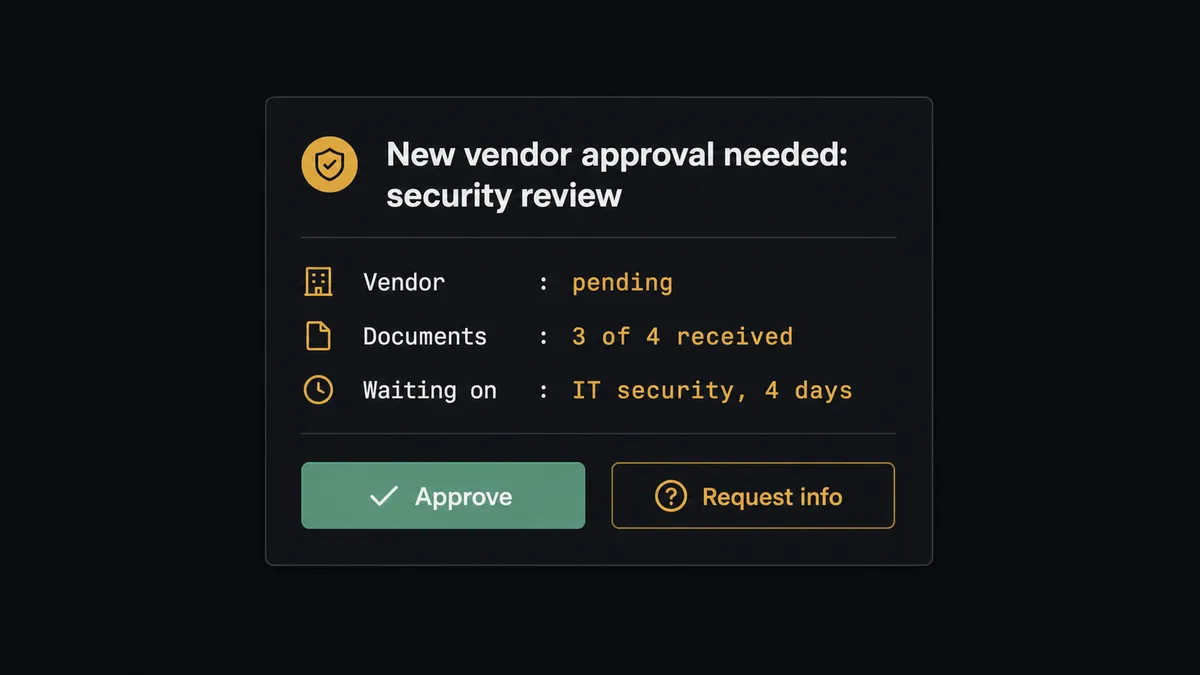
Approvals stall because routing is unclear or the next approver was never told it is their turn. Finance is waiting on legal. Legal assumes procurement is still gathering a document. The security review has been sitting in one person’s queue for four days. No shared view of the request exists, so the delay is invisible until someone asks why the vendor still is not set up.
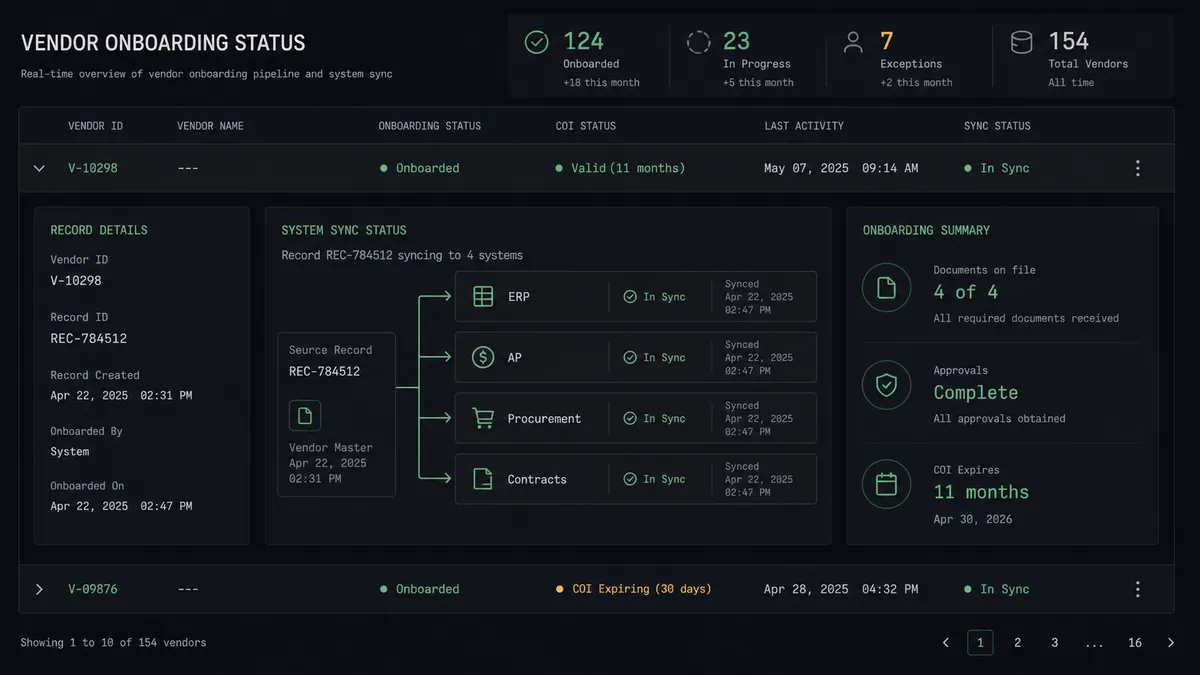
Information collected during onboarding never fully propagates downstream. This is the failure the working definition is built around. The vendor gets created in the ERP, but the procurement system, the AP tool, and the contract repository each hold a slightly different version. One has the old remit-to address. One never got the tax classification. The single true vendor record the company thinks it has is actually four near-copies that drift apart over time.
Renewals surface only when something fails. The insurance certificate expires and nobody notices until a claim or an audit exposes it. The annually refreshed W-9 lapses. The compliance attestation goes stale. Onboarding treated these as one-time collection events instead of recurring obligations, so the expiration dates never landed anywhere that would surface them in time.
The honest baseline here matters, and it is not the strawman version where vendors are set up by whoever opens the email first. Most teams have real people running a real sequence with genuine care. The sequence just loses continuity at every handoff, and the lost continuity is what later looks like a “broken process.”
What good vendor onboarding looks like
A well-run onboarding process is not a longer or more bureaucratic one. It is one where the seams are explicit and the handoffs are observable. Five traits separate it from the email-and-spreadsheet baseline.
- A single intake point that captures the request once and routes it based on category, spend, and risk, so every downstream function knows what it is receiving on day one rather than discovering it through five follow-up threads.
- A defined documentation checklist with clear ownership for each item, set by lane at intake, so “what is outstanding” has one authoritative answer at any moment.
- Approval routing that adapts to vendor type and dollar threshold rather than forcing every supplier through one flat sequence. The office-furniture vendor takes the fast path; the data-processing vendor takes the full path.
- Verification steps that leave an audit trail recording who approved what and when, as a byproduct of the process running, not as a reconstruction assembled later under audit pressure.
- System updates that fan out from one approved record so the ERP, the AP system, the procurement tool, and the contract repository stay aligned to a single source of truth rather than drifting into near-copies.
That last trait is the one that quietly contains the whole definition. “Keep the systems aligned to one record” sounds like a feature. It is not. It is coordination work that no single application in the stack actually owns, and naming that gap is the most useful thing this definition can do.
How automation fits in
Once you accept that vendor onboarding is a continuity problem rather than a checklist, the role of automation gets specific. The job is not to replace the people who make the decisions. The decisions themselves, what documents a lane requires, what dollar threshold triggers which approver, what risk tier a vendor belongs in, are procurement and finance judgment calls and stay there. Automation’s job is the part between the decisions: moving the right document, with the context attached, to the right person, and keeping the one approved record consistent everywhere it has to live.
This is the seam the question “what is vendor onboarding” actually points to once you follow it all the way down. The vendor record is a single object that has to exist identically in the ERP, the AP system, the procurement tool, and the contract repository. Onboarding is the act of creating that object correctly and propagating it without it drifting. No intake form owns that propagation. No ERP owns the steps that happen before the record reaches it. The work lives in the space between the systems, and the space between the systems is precisely what none of them was built to manage.
That space is what an orchestration layer is for. It is a category of system that sits above the tools of record. It listens for what each one emits: a submitted intake form, a signed agreement, an approval response, an ERP write. It carries the context across each handoff, and it pulls a human in at the checkpoints that need judgment rather than at every step by default. The orchestration layer does not become a fifth place the vendor record lives. It is the thing that keeps the four places agreeing. FlowRunner is built for that layer, with a human in the loop at the points where a person should decide and automation everywhere a person should not have to. You can see the shape of it in the reference pattern for validating a new vendor against NetSuite before the record is written and the equivalent duplicate-and-tax-ID check against Acumatica, where the verification and the human approval happen before anything posts, not after.
Keeping this section short is deliberate, because if you are searching “what is vendor onboarding” you are early, and the right next move is to understand the process before evaluating any tool. When you do reach the tooling question, the framing to carry with you is whether a candidate becomes another system the vendor record lives in, or a layer that keeps the existing systems aligned. The deeper treatments live in the supplier onboarding best practices guide and in how supplier relationship management runs across the ERP, contract, and AP systems you already operate, alongside the role a supplier-facing portal plays when the gap is intake from the supplier side. The connectors most procurement teams ask about first (NetSuite for the vendor master, DocuSign for agreements, Slack for approvals and exception routing) are the systems that have to stay aligned, which is the whole point.
Vendor onboarding, defined honestly, is not the form you collect on day one. It is the discipline of producing one true vendor record and keeping it true through every approval, every system, and every renewal that follows. Define it that way and you will recognize the right fix when you see it, because it will be the one that owns the seams instead of adding another.
Quick answers
What is vendor onboarding in simple terms?
It is the process of collecting, verifying, and approving everything needed to pay a new supplier, then creating that supplier’s record in your finance systems so the company can transact with them. It starts when someone requests a new vendor and ends when that vendor can be issued a purchase order and paid.
What documents are required for vendor onboarding?
A standard documentation set includes a tax form (a W-9 for US suppliers or a W-8 series form for non-US suppliers), banking details for payment, and a certificate of insurance. Category-specific items get added when the engagement requires them: security or privacy attestations for technology vendors, diversity certifications, industry certifications. The exact list varies by category, spend, and jurisdiction.
What is the difference between vendor onboarding and supplier sourcing?
Sourcing is choosing the supplier. Onboarding is everything that happens after the choice is made and before the supplier can be paid: documentation, verification, approvals, and system setup. Vendor performance management comes after onboarding. The three are sequential and owned by different parts of procurement.