Supplier Relationship Management Software
Operationalize SRM across the ERP, contract, and AP systems procurement already runs. FlowRunner is the orchestration layer, not a second system of record.
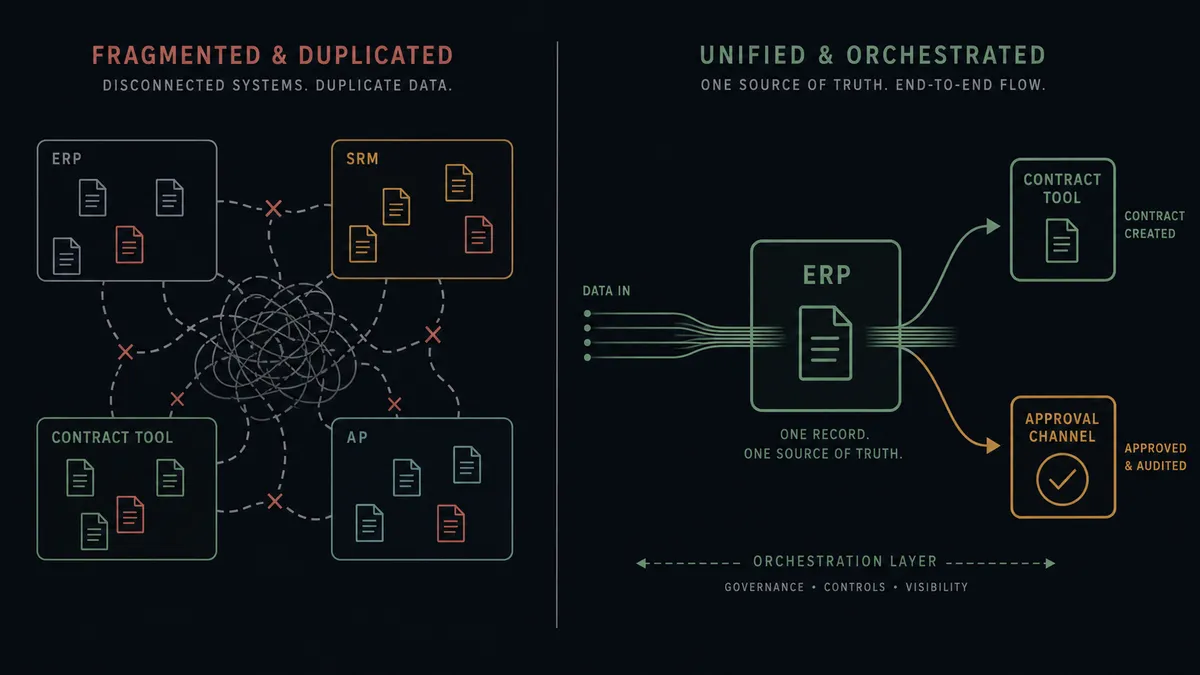
The SRM category has a structural problem that most buyer’s guides do not name: every dedicated supplier relationship management tool becomes a second system of record alongside the ERP, the contract repository, and the AP system. The team installs it to consolidate supplier visibility, and ends up reconciling supplier data across one more application than they started with. Procurement asks for one view of the supplier; the stack now has four.
The honest read on this category, which most SRM comparison posts will not say, is that the gap is not “we need an SRM tool.” The gap is that supplier data already lives in the ERP, contract data already lives in DocuSign or a contract repository, and approval routing already happens in Slack and email. None of those systems talk to each other in the way procurement actually works. Adding a fifth system on top does not close that gap. Coordinating across the four already in place does.
What procurement teams actually need from supplier relationship management software
Procurement leaders consistently ask for four things from an SRM investment: a clean supplier record, controlled onboarding, visible approvals, and an audit trail across the systems where supplier data already lives. The conventional answer is to install an SRM platform that becomes the new master record. That answer triggers a second migration: data moves out of the ERP, into the SRM, and then back into the ERP through a sync connector that becomes its own maintenance surface.
The alternative is to keep the ERP (NetSuite, Acumatica, SAP) as the master and use an orchestration layer to enforce SRM behavior across it. The supplier record stays where finance and AP already trust it. The SRM behaviors (onboarding controls, approval routing, document tracking, exception escalation) run as flows over the top of the systems already in place.
Where standalone SRM platforms create friction for procurement
The friction pattern is consistent across the category. Duplicate supplier records appear between the SRM tool and the ERP the moment the sync connector misses an update, and procurement spends hours each month reconciling which version is correct. Approval routing configured inside the SRM rarely matches how finance actually approves vendors in the ERP, so teams end up running two approval paths in parallel: the one the SRM enforces and the one finance actually trusts. Contract renewal data sits in a separate repository the SRM cannot read without another integration, which means renewal dates surface to procurement late, after the auto-renew clause has already fired.
The honest baseline is that many mid-market teams still run supplier onboarding through shared inboxes and spreadsheets, not because dedicated SRM tools do not exist, but because adopting one means rebuilding processes the ERP already supports. The cost of the rebuild outweighs the value of the new system. The shared-inbox baseline survives because nothing has been faster.
How FlowRunner operationalizes SRM across existing systems
FlowRunner treats supplier relationship management as a coordination problem rather than a destination application. The ERP holds the vendor master. The contract repository holds the agreement. The AP system processes the bill. The messaging channel holds the approval. FlowRunner runs above them.
Vendor onboarding starts from a form submission or an email that arrives in a shared mailbox. The flow validates the submission’s tax ID, checks for duplicates against the ERP’s existing vendor list, and routes approvals through the channels procurement and finance already use. Only after validation and approval does the vendor record land in the ERP. The pattern is documented end to end against NetSuite in the validate vendor data against NetSuite before posting workflow, and runs the same way for vendor validation and duplicate checks in Acumatica and for automating vendor invoice processing end-to-end across mailbox, Parseur, QuickBooks Online, and Slack.
Supplier data integrity works the same way at the change level. When a vendor record changes (a new banking detail, an updated remit-to, a refreshed COI), FlowRunner validates the change against the ERP before posting, with a verification step on the changes that carry fraud risk. Approval routing for POs and vendor onboarding runs through structured flows with a human in the loop at defined checkpoints, and the full document trail is preserved per event. Contract and renewal visibility comes from reading contract metadata out of the existing repository (DocuSign, a contract management tool) and surfacing renewal dates to procurement through Slack or email before the renewal window closes. The orchestration layer is the category that owns this work; FlowRunner is one example of one, built for the layer between the ERP, the contract system, and the channels procurement already runs in.
What this looks like in practice
The reference patterns sit in the workflow library rather than in marketing copy. The vendor validation pattern against NetSuite shows how a vendor submission gets checked for duplicates and tax-ID mismatches before any record is written. The Acumatica pattern shows the same shape against a different ERP, with the AP-side duplicate check running before bill creation. The end-to-end mailbox-to-QuickBooks pattern shows what vendor invoice processing looks like when the orchestration layer handles intake, vendor lookup, exception escalation, and posting as one flow. Each pattern shows orchestration across the procurement stack rather than coordination through a separate SRM database.
The integrations procurement teams ask about most: NetSuite and Acumatica for the vendor master, DocuSign for supplier agreements, and Slack for the approval and exception channels. The flow is built once around the team’s actual approval matrix and actual systems.
Where FlowRunner fits, and where a dedicated SRM platform may still make sense
The honest scoping line: FlowRunner is the right fit when the ERP and the contract systems are already in place and the gap is process orchestration, approvals, and supplier data integrity across them. A dedicated SRM platform is still the better answer when the priority is supplier-facing capability rather than internal coordination. Organizations that need a branded supplier portal as a destination, structured supplier scorecards built into the tool, or formal sourcing event management with bid intake and scoring will get more out of a dedicated SRM product than out of an orchestration layer.
FlowRunner can also complement a dedicated SRM rather than replace it. When the SRM holds supplier scorecards and the sourcing flow, FlowRunner handles the coordination between the SRM, the ERP, and the approval channels: the SRM still owns supplier engagement, and the orchestration layer keeps the supplier data consistent with the system of record. The two categories solve different problems.
Next step
The fastest way to evaluate this approach is a demo built against the team’s real onboarding flow and the systems already in place: the ERP, the approval channel, and one or two of the contract or AP tools the team runs today. The conversation is anchored on those systems rather than on a generic SRM pitch, because that is where the actual coordination work lives.
See how this would work on your stack
A 30-minute walkthrough against your actual setup, or a quick message to scope the fit. No slides, no signup.