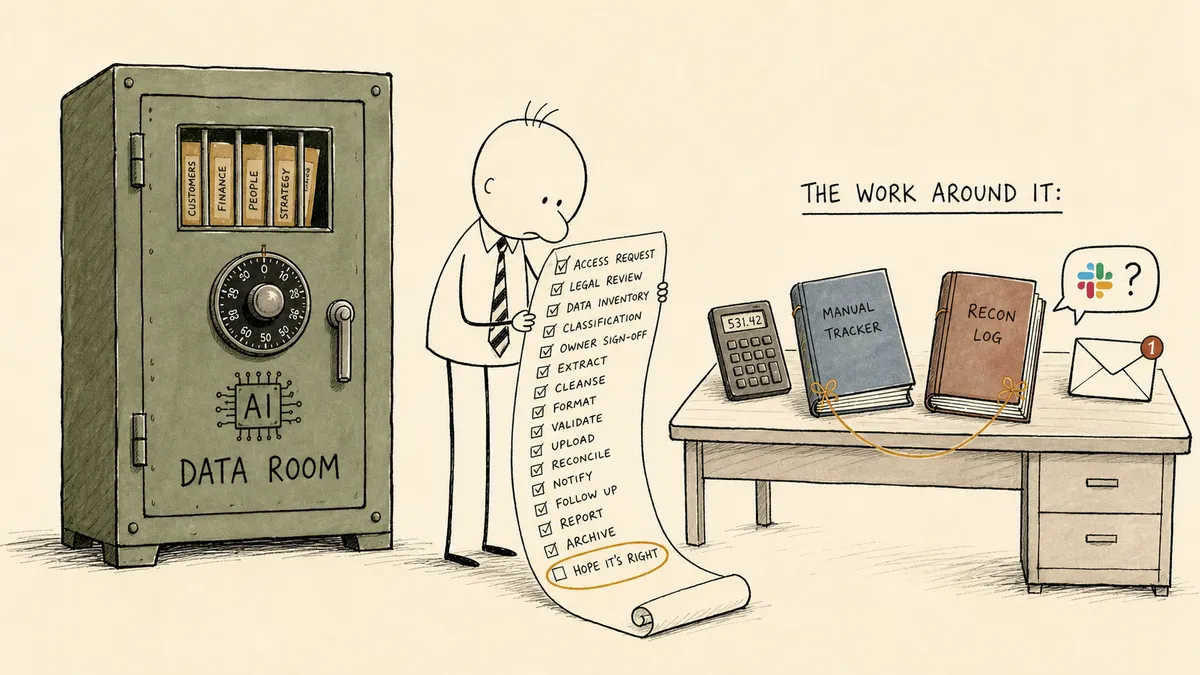
If you are searching “FlowRunner vs Ansarada” for your M&A due diligence, the honest answer is that you are comparing two tools that do not do the same job, and naming that mismatch is more useful than pretending one wins. Ansarada is a virtual data room with twenty years of deal pedigree, built to secure and govern the confidential documents that move through a transaction. FlowRunner is an orchestration layer for the operational work happening around those documents: the reconciliation, the vendor validation, the approval-chasing that has to clear before a diligence item can honestly be marked done. The real decision is not which product is better. It is which of those two jobs is the one actually holding up your close.
Ansarada and FlowRunner, head to head
| Ansarada | FlowRunner | |
|---|---|---|
| Category | Virtual data room for M&A, capital raises, IPOs, and infrastructure procurement | Orchestration layer for work and AI agents across business operations |
| Primary job | Secure the documents, run structured Q&A, govern access across the deal lifecycle | Coordinate the financial reconciliation, vendor and distributor validation, and approval-chasing around the deal |
| Built for | CEOs, dealmakers, investment bankers, law firms, M&A advisors, private equity | Operations and finance leaders running cross-system workflows, including the operational layer of diligence |
| Track record | Founded 2005, twenty years across 170 countries (about) | Newer entrant; no comparable VDR track record |
| Document security | Granular permissions, AI-Redact, remote self-destruct, dynamic watermarking, real-time activity tracking | Not a VDR feature; FlowRunner does not replicate document-level deal controls |
| Structured Q&A | Automated Q&A workflows purpose-built for diligence | Not offered as a deal-room feature |
| AI in the product | AI-Sort, AI-Translate, AI-Redact, AI-Predict, AI-powered risk dashboards inside the room | AI agents that coordinate work across tools, with human-in-the-loop as a callable action when judgment is required |
| Operational diligence work (revenue-to-cash ties, vendor master cleanup, approval routing) | Out of scope by design; the room governs documents, not the reconciliation feeding them | Native fit: workflows trigger across email, ERP, Slack, parsers, and approvals with a per-item audit trail |
| Governance and compliance tiering | ISO 27001 certified, comprehensive audit trail for document activity (about) | Core capability (agents, human-in-the-loop, all integrations, BYOK) on every plan, from Free and the $5 Starter through Growth at $45/mo; audit trails and RBAC at Professional ($299/mo); SSO/SAML, 90-day audit retention, and compliance reporting at Business ($999/mo); not a VDR-grade document-security claim |
| Pricing model | Storage-based, free until the deal goes live, tailored quote (pricing) | Execution-based subscription tiers with a permanent Free plan and a $5 Starter; the full operational diligence workflow runs on any of them, with Growth at $45/mo sized for production volume, governance features layered in at Professional, and compliance posture at Business |
The table carries the surface comparison. The rest of this article is the part the table cannot: why these two tools keep showing up in the same search, and how to tell which one your deal actually needs.
What Ansarada is, in its own words
Ansarada describes its data room as “a secure online workspace used to store and share confidential documents with permission controls, activity tracking, and reporting,” built for “high-stakes transactions where security, speed, and constant oversight aren’t just nice to have, they’re mission-critical.” On its company page it states, “For 20 years we’ve been helping people get their Deals in order,” with a founding year of 2005 and a footprint across 170 countries. That is not framing to argue with. It is an accurate description of a platform built specifically for the dealmaking community over two decades.
The feature depth is real and it is deal-specific. AI-Sort for automatic indexing. AI-Translate for cross-border document sets. AI-Redact for sensitive material. AI-Predict, which Ansarada markets as “AI that predicts deal outcomes with 97% accuracy.” Remote self-destruct to revoke access after download. Dynamic watermarking. Role-based access controls at the folder and document level. Automated Q&A workflows. Real-time activity tracking with comprehensive audit trails. On security, the company states it has been “ISO 27001 certified for over 12 years.” Its pricing is storage-based rather than per-user, and “your data room is completely free until your transaction is live,” which is a genuinely low-friction way to start.
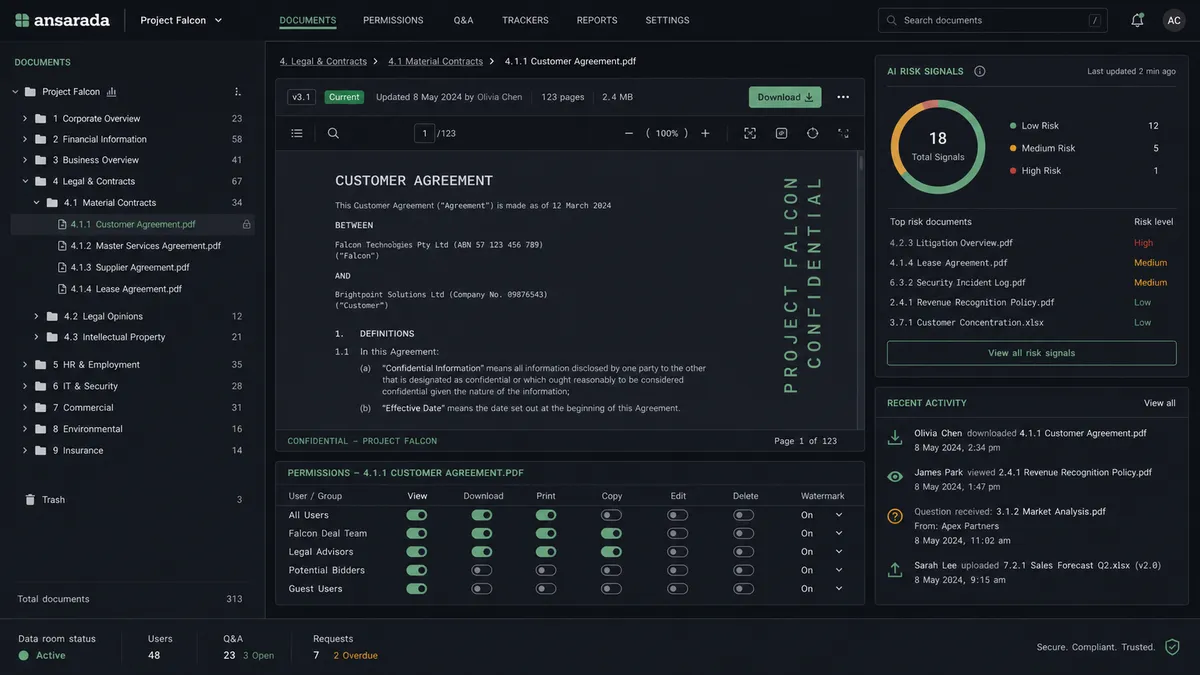
Said plainly: for a deal team running a live sell-side or buy-side transaction, those are not conveniences. They are the product. A general orchestration platform with no data-room primitives is the wrong tool for securing transaction documents, and recommending FlowRunner for that job would be irresponsible. This article does not make that recommendation. FlowRunner is not a virtual data room, does not host confidential deal documents, and does not replace Ansarada for the secure-room function.
The honest reason both names show up in the same search is different, and it is worth saying out loud.
The diligence checklist is two kinds of work wearing one name
Here is what most articles on M&A due diligence will not say plainly. The phrase “due diligence checklist” hides two different kinds of work, and a virtual data room is built for one of them.
The first kind is document work. Hundreds or thousands of line items, each mapped to a document that has to be requested, uploaded, permissioned, reviewed, redlined, redacted, and signed off, with Q&A flowing back and forth between counterparties. The bottleneck is access, version control, redaction, and Q&A turnaround. That is exactly what Ansarada has spent twenty years optimizing, and it does it well.
The second kind is reconciliation work. Tie the trailing-twelve-month revenue to actual customer payments. Validate distributor billbacks against goods shipped. Confirm the AP queue holds no duplicate vendor records across the two entities. Check that the seller has no unregistered sales-tax exposure in states it forgot about. Run client intake on the acquired book before close. Chase the named approvers for sign-off on the closing schedule. None of that is a document-access problem. The document might already be sitting in the room. The question is whether the numbers underneath it actually reconcile, whether the vendor master is clean, and whether the approver who has to confirm a figure has answered the email.
These two checklists share a name and almost nothing else. They live in different systems, get done by different people, and fail in different ways. A data room’s activity log can tell you a document was opened. It cannot tell you whether the reconciliation underneath that document was completed, or whether an exception got routed to the one person who could resolve it. That gap is not a flaw in Ansarada. It is the edge of what a data room is for.
Where Ansarada is genuinely stronger
A comparison that claims FlowRunner wins on every axis would fail your own judgment, so name the axes where Ansarada is plainly the better tool.
- M&A domain depth. Twenty years of deal-specific workflow, structured Q&A management, deal readiness scoring, and a feature set tuned to how transactions actually run. FlowRunner does not match this and is not pursuing it.
- Document-level security purpose-built for transactions. AI-Redact, remote self-destruct, dynamic watermarking, and granular file-level permissions are built for sensitive deal documents in a way a general orchestration platform does not replicate. If your risk is “the wrong party sees the wrong page,” that is Ansarada’s home turf, not FlowRunner’s.
- Established trust and third-party social proof. Ansarada carries a large verified user community on G2 and Capterra and a recognised brand in the VDR category. FlowRunner is newer and less recognised in deal circles, and for a transaction where counterparty confidence in the data room matters, that recognition has real commercial weight.
- Compliance posture for the document workflow. ISO 27001 certification held for over twelve years, with comprehensive activity tracking inside the room. For uploading sensitive transaction materials, that substantiated posture is exactly what a deal team needs to see.
If those axes decide your version of the checklist, the conclusion is simple. Choose Ansarada, or a peer virtual data room. FlowRunner is the wrong shape for that job, and the rest of this article is context rather than a recommendation.
Where FlowRunner is the better fit
The reconciliation side of the checklist is a different problem, and a virtual data room cannot close it by design. In conversations with finance leaders running acquisition programs, the same three gaps surface over and over, and none of them is a document-access problem.
- Diligence items falling through the cracks near close. A partner at one accounting firm put it plainly: there are things that should happen during diligence and simply do not, the items that everybody jumps on to jam through at the last minute. The room knows a document was uploaded. It does not know whether the reconciliation underneath it cleared, or whether the approver answered.
- Double-payment risk during the transition. A CFO described how easy it is to double pay a distributor invoice when both entities are mid-handoff and both AP queues are live. That is a workflow problem between two ERPs that do not yet know each other exist, not a document problem.
- Two finance stacks that have to be made to agree. Charts of accounts, vendor masters, customer masters, and sales-tax setups must reconcile before the diligence numbers can be trusted at all. Most of that work happens in spreadsheets and inboxes, not in the data room.
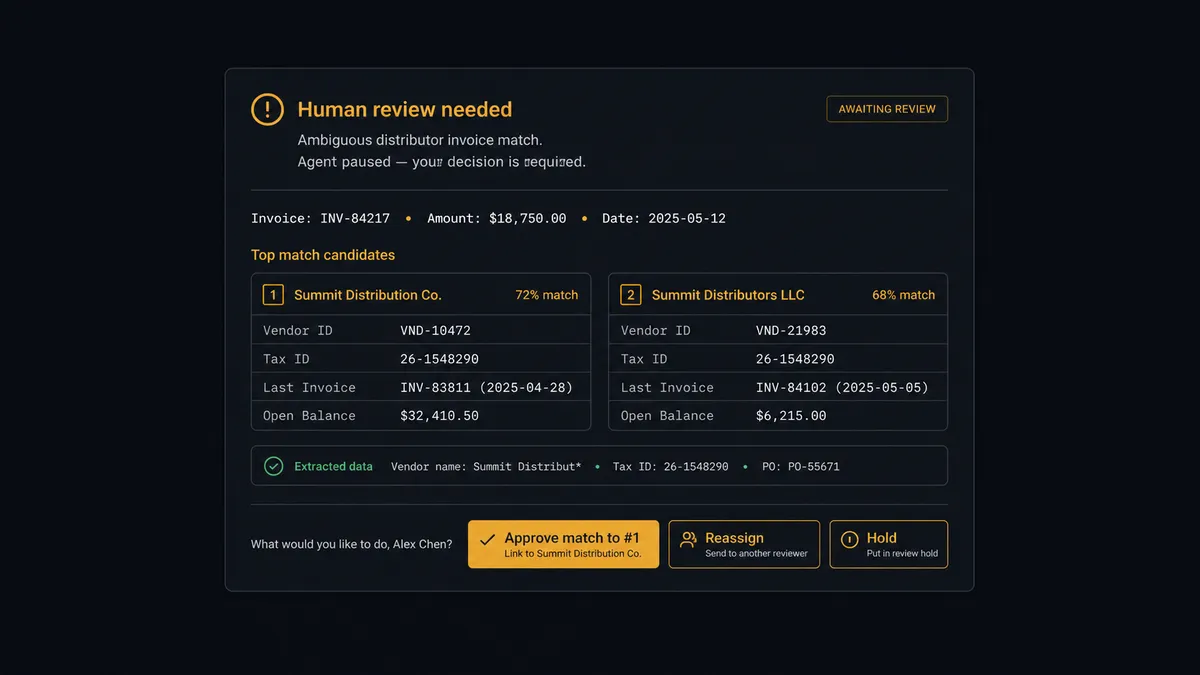
FlowRunner is built for that operational layer. A workflow triggers when a parsed vendor invoice arrives, gathers context across the seller’s ERP and the buyer’s ERP, attempts the mechanical part of the match, and pauses to ask a named reviewer when the result is ambiguous. According to FlowRunner’s feature documentation, agents can invoke humans as callable tools in the workflow when they hit uncertainty, which is the design point that separates this from a notification. The human is a step in the logic, not a passive alert at the end of it.
A second workflow runs the approval chase. The closing schedule lands in front of the CFO, the named approvers get a message through the channel they actually read with the specific question and full context attached, the response is captured against the source record, and the audit trail spans the entire motion. A third handles client intake for the acquired book, parsing the existing client list into the buyer’s onboarding system with incomplete records routed to a human as exceptions.
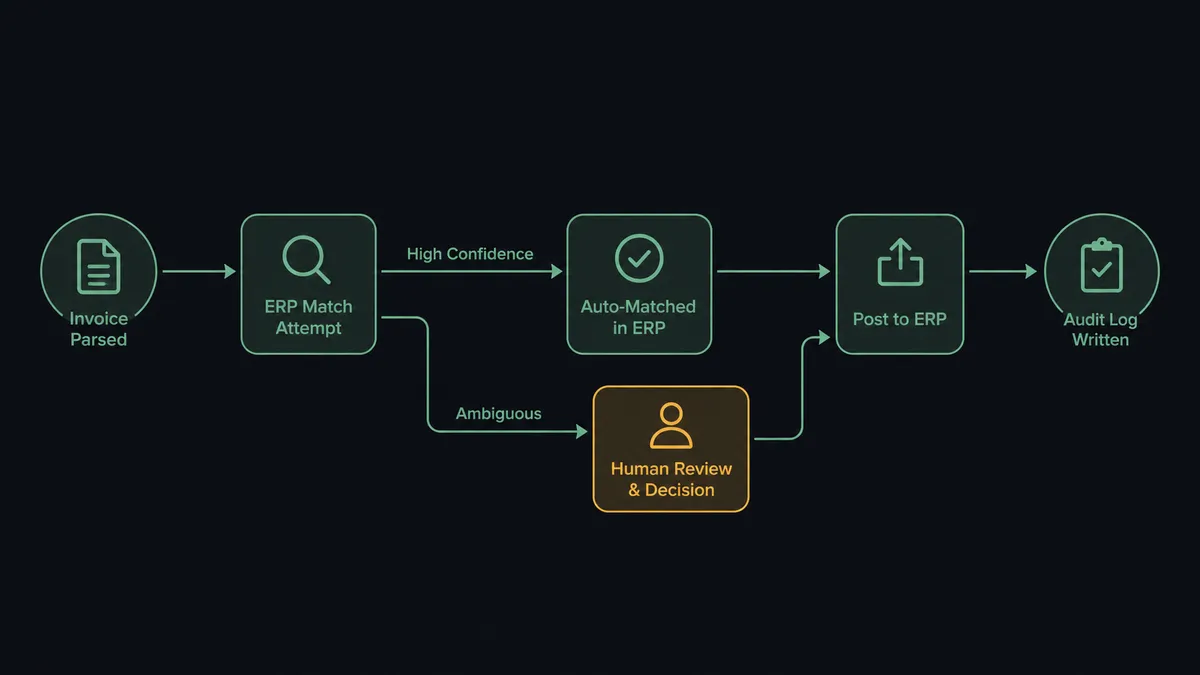
That per-item audit trail is the seam worth dwelling on, because it is exactly where a data room’s logging stops. Ansarada’s activity tracking is comprehensive about the document: who opened it, when, from where. It is silent on the reconciliation work that determines whether the document’s contents are even true. The checklist item “TTM revenue ties to cash” is marked done by a human judgment about numbers across two systems, and nothing in the room records whether that judgment was actually made, by whom, or against what evidence. The category that owns that gap is orchestration as a service: a layer above the systems of record that listens for what they emit, gathers the context a checklist row needs to be true, pulls in a named human when the data alone cannot settle the question, and writes one audit trail across the reconciliation work itself. FlowRunner is built for that layer. Ansarada is built for the document and Q&A workflow inside the room. Different jobs, opposite sides of the same checklist.
This is the same pattern documented in the post-M&A integration checklist for the CFO running the combined finance function. The work shape does not change at close. Before close it shows up as diligence items the room cannot enforce. After close it shows up as integration items the room is no longer part of. On the cost side, the entire operational diligence workflow described above runs on any FlowRunner plan. The Free plan covers 100 executions a month, Starter is $5 for 300 or $15 for 3,000, and Growth at $45 per month is the production-volume tier at 12,000. Every one of them includes the AI agents, the multi-channel human-in-the-loop (email, Slack, WhatsApp, phone), all integrations, BYOK for the model layer, and unlimited users. Executions, concurrency, and log history are the only meters, so there is no technical limitation on the lower plans that would prevent the reconciliation work this article describes. Governance features layer in at Professional ($299/mo) when a CFO needs audit trails and RBAC called out as decision-relevant for diligence work. SSO/SAML, 90-day audit retention, and compliance reporting begin at Business ($999/mo). The honest framing matters here: this is mid-market infrastructure a CFO can authorize without an enterprise procurement cycle, not a VDR-grade document-security claim and not a substitute for ISO-certified deal-room controls.
How to decide
One diagnostic, run honestly, settles most of it. What is your close actually waiting on right now?
Walk the open items on your checklist and name, for each, what the work really is. If the answer is “get the document uploaded, permission it correctly, redact the sensitive pages, turn the Q&A around, sign off,” your bottleneck is document workflow and the question is which data room to run. Ansarada or a peer VDR, and an orchestration layer is the wrong shape for it. If the answer is “tie this number to that system, clean up the vendor master, chase the partner for approval, run intake on the acquired book, get two charts of accounts to agree,” your bottleneck is reconciliation work, and a better data room will not touch it.
Most mid-market deals are waiting on both, run by different people. The deal team’s document index belongs in a VDR. The finance leader’s reconciliation ledger belongs in an orchestration layer. That is not a hedge. It is the structural reality on the buy side of most transactions that are not bulge-bracket M&A, and it is why the better question is not “Ansarada or FlowRunner” but “which of these two jobs is the one slipping.” If your diligence keeps slipping on documents, this comparison points you to Ansarada. If it keeps slipping on numbers and approvals, the orchestration layer is the part you are missing.
If your deal sits closer to the deal-room end of that line, the companion piece comparing FlowRunner and Datasite for the diligence checklist walks the same trade-off against a different VDR. And if you are still deciding whether the reconciliation work is even worth automating, the guide on how to know what is worth automating frames it as a financial calculation, while the piece on building automations that hold up under scrutiny covers the engineering discipline a real deal calendar demands.
Quick answers
Is FlowRunner a replacement for Ansarada?
No. Ansarada is a virtual data room built over 20 years for M&A, capital raises, and IPOs, with document permissions, AI-Redact, remote self-destruct, dynamic watermarking, and structured Q&A. FlowRunner is not a data room and does not host transaction documents. If the job is securing and governing deal documents, that belongs in Ansarada, not FlowRunner.
Where does FlowRunner fit if Ansarada is already running the data room?
FlowRunner orchestrates the operational diligence work that lives outside the data room: tying revenue to actual payments, validating vendor and distributor billing, reconciling two charts of accounts, and chasing named approvers for sign-off, each with human-in-the-loop on the ambiguous items and a per-item audit trail. The data room governs the documents; the orchestration layer governs the reconciliation work feeding them.
Who should choose FlowRunner instead of Ansarada for diligence?
A CFO or VP Finance running an acquisition program where most of the checklist is financial reconciliation, vendor validation, and internal approval-chasing rather than VDR-resident document review. Think accounting roll-ups, family-office acquisitions, and mid-market bolt-ons where items fall through the cracks near close because nothing enforces ownership across systems, not because documents are hard to access.