How to Connect Parseur with Bitrix24 (With or Without an AI Agent)
Connect Parseur document extraction to Bitrix24, optionally as an AI agent that turns parsed inquiries into leads and pauses for a human before a parsed purchase order changes a deal's amount.
How do you connect Parseur to Bitrix24?
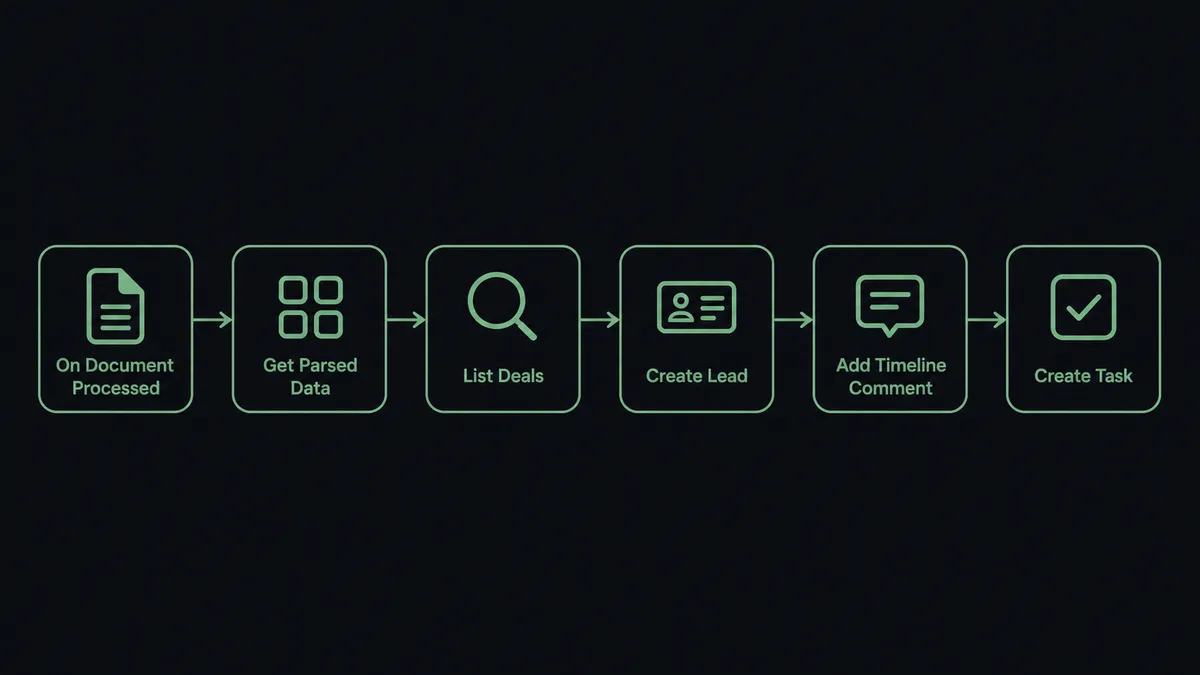
You connect Parseur to Bitrix24 by having Parseur’s On Document Processed (Realtime) trigger drive Bitrix24 actions: the workflow pulls the extracted fields with Get Parsed Data, checks the sender with List Contacts and List Deals, creates new inquiries with Create Lead, and attaches the source excerpt with Add Timeline Comment, so an emailed RFQ or a PDF purchase order becomes a CRM record the moment it finishes parsing. Bitrix24 has no triggers of its own, so the workflow always starts from the Parseur side, which matches reality: the work arrives as documents. FlowRunner is a visual AI-agent orchestration platform where automations run autonomously and pause for human judgment on the steps that carry real consequence. The same connection can run as an AI agent that also matches documents to live deals and pauses for a named human before a parsed number changes a deal’s amount.
The problem it solves
Right now every document your pipeline depends on passes through a person’s hands twice: once to read it, once to retype it. A quote request arrives as a PDF. A purchase order lands in a shared inbox in the customer’s own format. A supplier confirmation comes in as a structured email nobody has time to structure. Someone opens each one, extracts the name, company, items, and totals by eye, and keys them into Bitrix24. On busy weeks the keying waits, the pipeline runs behind the inbox, and the fastest-moving inquiries get answered slowest.
The matched documents are the sharper risk. A purchase order that belongs to a live deal often disagrees with it: quantities changed on a phone call, a discount was promised, a line item was dropped. When a person retypes the PO total straight over the deal amount, the pipeline silently rewrites itself with no record of why. When nobody updates it at all, forecasts run on stale numbers. Either way, the deal history cannot answer the question that matters later: which document changed this number, and who agreed to it?
How it works: the connection
The connection listens to Parseur and writes to Bitrix24. Here is the plain version, grounded in the real connector actions.
- Trigger: Parseur fires On Document Processed (Realtime) the moment an inbound document finishes parsing.
- Read: The workflow calls Get Parsed Data to pull the extracted fields: sender, company, requested items, and totals.
- Check the sender: It calls List Contacts and List Deals in Bitrix24 to see whether this sender already exists and whether an open deal matches the document.
- Create the inquiry: For a new sender, it calls Create Lead with the parsed fields, and Create Contact so the person is on record.
- Attach the source: It calls Add Timeline Comment with the parsed excerpt and a reference to the document in Parseur, so the record carries its own evidence.
- Assign the follow-up: It calls Create Task so the inquiry lands on a named owner’s list with a due date instead of dissolving into a shared inbox.
That is the “just connect them” answer. Documents become leads, senders become contacts, and every record points back at the paper that created it. When a document parses badly, the workflow calls Reprocess Document for another pass instead of pushing a broken record into the pipeline.
Can an AI agent run it? (and why a human stays in the loop)
Yes, and the matching problem is why an agent beats a mapping. Documents do not announce which deal they belong to. An AI agent reads the parsed fields and the candidate records together, and picks the Parseur and Bitrix24 actions it needs as tools. Get Parsed Data, Reprocess Document, List Contacts, List Deals, Get Deal, Create Lead, Update Deal, Add Timeline Comment, Create Task: that is the toolbox, and the agent chooses based on what the document says and what the pipeline already holds.
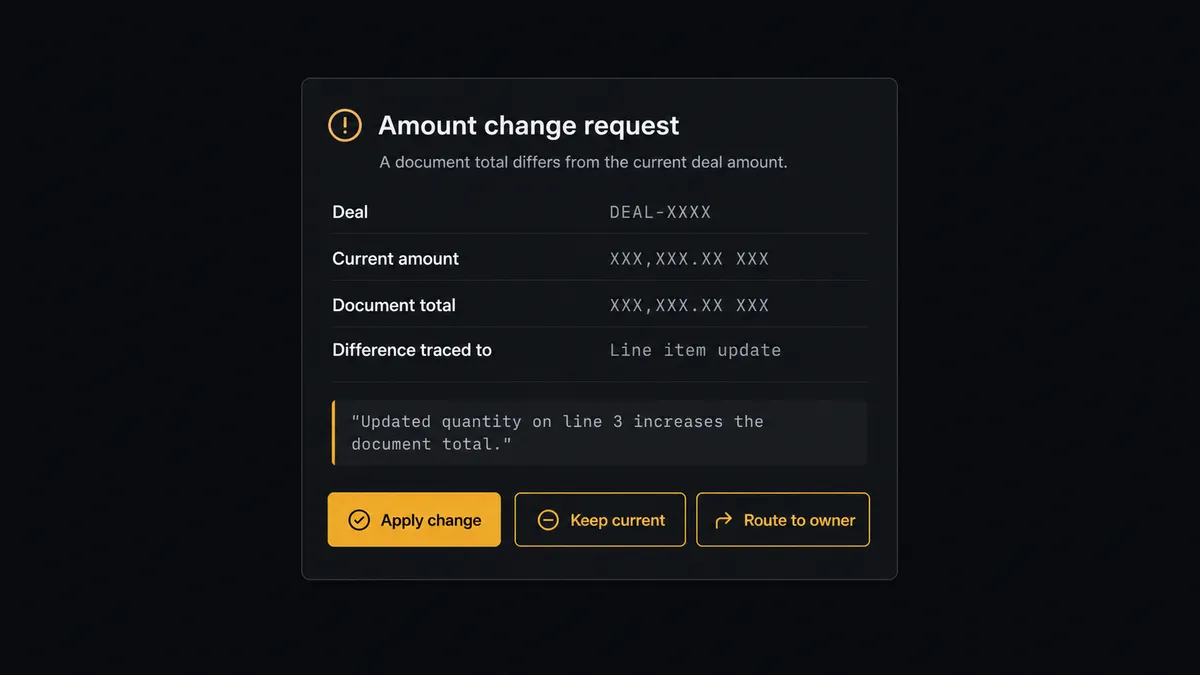
The consequential step is changing a deal’s money. When a parsed purchase order matches an open deal but the totals disagree, the agent does not fire Update Deal and move on. It assembles the case: the deal’s current amount from Get Deal, the total extracted from the document, the line items behind the difference, and the source excerpt. Then it invokes a human-in-loop flow it holds as a callable tool. The workflow pauses and posts to your channel: “PO from [company] matches deal [name]. Deal amount: [current]. Document total: [parsed]. Difference traced to [line items]. Apply the change?” A person approves, keeps the current value, or routes it to the deal owner in one click. Only then does Update Deal run, and the timeline comment records the approver, the source document, and the timestamp.
The same discipline covers extraction quality. When required fields come back empty or garbled, the agent calls Reprocess Document, and if the second pass still fails it routes the document to a person rather than inventing a plausible lead. Prospects call this the digital andon cord: like Toyota’s quality control pull cord, the workflow stops the line the moment it hits uncertainty, and your team pulls it back into motion.
FlowRunner vs Zapier
Most teams wiring Parseur into a CRM reach for Zapier first, and for good reason. Zapier connects to both Parseur and Bitrix24, its editor is quick to learn, and its template gallery covers parsed-document-to-CRM patterns you can clone in minutes. For a straight “parsed document creates a lead” push, it is a fast, proven path.
The difference shows up when documents meet live deals. FlowRunner is built around native human-in-the-loop and AI-agent orchestration, where the agent matches documents to pipeline and a person owns every change to a deal’s numbers.
| What matters for this pair | FlowRunner | Zapier |
|---|---|---|
| Human-in-the-loop on deal amount changes | Native. The agent invokes an approval flow as a callable tool and pauses before Update Deal touches money | Available by adding approval steps, not a native agent decision |
| Who runs the flow | An AI agent reads the document and the pipeline, reasons, and picks actions as tools | Predefined step sequence you configure per Zap |
| Users included | Unlimited users on every tier | Priced by task volume; seats vary by plan |
| Bring your own AI keys | Yes, BYOK | AI features tied to Zapier’s own AI offering |
| Self-hosted option | Yes, cloud-hosted or self-hosted | Cloud only |
| Pricing model | Transparent workflow-based tiers | Per-task pricing that gets harder to predict as document volume grows |
If every document is a fresh inquiry and never touches an existing deal, Zapier will move them fine. If purchase orders and revisions have to reconcile against live pipeline with an audit trail, this pairing is the better fit.
Before and after
| Category | Before | After |
|---|---|---|
| Document intake | Each PDF and emailed request is read and retyped into Bitrix24 by hand | Get Parsed Data and Create Lead build the record the moment parsing finishes |
| Response speed | The fastest inquiries wait behind the data-entry backlog | Create Task puts each inquiry on a named owner’s list within seconds |
| Deal accuracy | PO revisions overwrite deal amounts silently, or never arrive at all | Amount changes pause for a named approver with both figures in view |
| Traceability | Nobody can say which document changed which number | Add Timeline Comment ties every change to its source document |
| Bad extractions | Garbled parses enter the pipeline looking like real inquiries | The agent calls Reprocess Document or routes the document to a person |
What you can build
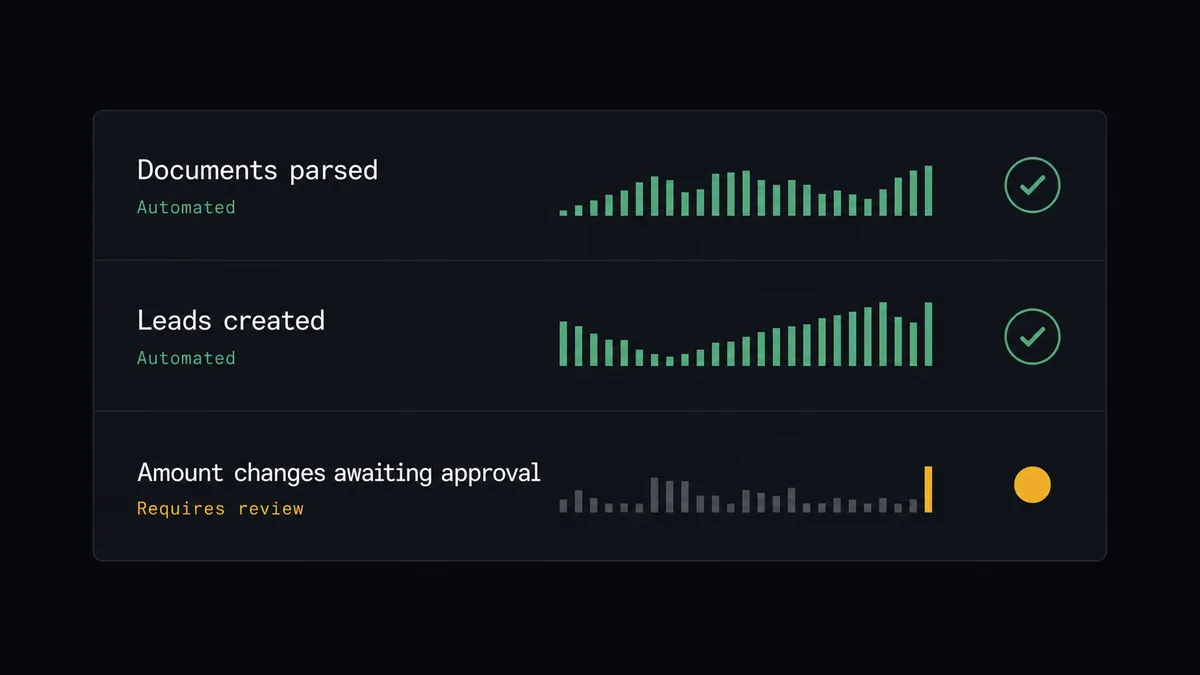
Inquiry to lead, hands off. On Document Processed (Realtime) fires. The agent pulls fields with Get Parsed Data, checks List Contacts, creates the record with Create Lead, and attaches the excerpt with Add Timeline Comment. The pipeline keeps pace with the inbox.
PO revision with named approval. A parsed purchase order matches an open deal at a different total. The agent posts both figures through the human-in-loop tool, and Update Deal only changes the amount after a person approves, with the document referenced on the timeline.
RFQ triage by size. The agent reads each parsed request, sizes it from quantities and stated budget, creates the lead against the right pipeline, and tunes the Create Task due date to how hot the request reads.
Bad-parse quarantine. When required fields come back empty, the agent calls Reprocess Document for a second pass, and routes persistent failures to a person with List Documents context instead of manufacturing a hollow lead.
Repeat-sender routing. When List Deals shows the sender already has an open deal, the agent skips lead creation, posts the new document with Add Timeline Comment on that deal, and notifies the owner with Send Notification, so repeat business lands as context instead of duplicate pipeline.
Common questions
Is it free to connect Parseur and Bitrix24 on FlowRunner? You can build and run the connection on a $100 credit with no credit card, which is roughly 67 days free on the Growth tier at $45/mo. Both connectors are available on every FlowRunner tier, and every tier includes unlimited users and unlimited workflows.
Can I self-host the Parseur to Bitrix24 workflow? Yes. FlowRunner offers a cloud-hosted option and a self-hosted option, so the connection can run inside your own environment.
Does the AI agent need my own OpenAI or Claude key? FlowRunner uses a bring-your-own-keys model, so you connect the AI provider key you already have. You are not locked to one model.
What happens when a parsed purchase order disagrees with the deal it matches? The agent stops and invokes a human-in-loop step. It posts the deal’s current amount, the amount extracted from the document, and the source excerpt, then waits for a person to approve the change, keep the current value, or route it to the deal owner. Update Deal never changes money figures without that approval.
Which Parseur trigger should start the workflow? Parseur offers two triggers: On Document Processed (Realtime) and On Document Processed (Polling). Realtime fires the moment a document finishes parsing and suits inbound inquiries and purchase orders. Polling checks on a schedule and suits batch loads. Bitrix24 has no triggers, so the workflow always starts from the Parseur side.
How do parsed documents stay traceable inside Bitrix24? Every record the workflow touches gets an Add Timeline Comment entry with the parsed excerpt and a reference to the source document in Parseur, so anyone reading the lead or deal can see exactly which document drove which change.
Getting started
Start with a $100 credit on the Growth tier at $45/mo. That is roughly 67 days free, and no credit card is required. Both connectors are available on every tier, and every tier includes unlimited users and unlimited workflows.
Explore the integration details:
- Parseur integration (2 triggers and 6 actions covering parsing, reprocessing, and mailboxes)
- Bitrix24 integration (40 actions covering leads, deals, tasks, and notifications)
Start building free at flowrunner.ai or book a demo to see a live Parseur to Bitrix24 workflow, amount-change approval and all.