The phrase “reconciliation tools” sells two completely different products to two completely different buyers, and the search results treat them as one category. That confusion costs CFOs evaluation cycles they cannot afford.
Open the top results today and you find Trintech, BlackLine, Numeric, HighRadius, Sage, and a Gartner Magic Quadrant. All of them are real products, all of them describe themselves as reconciliation software, and almost all of them are selling the same thing: financial close management for controller teams reconciling GL accounts at month end. That is one definition of the category.
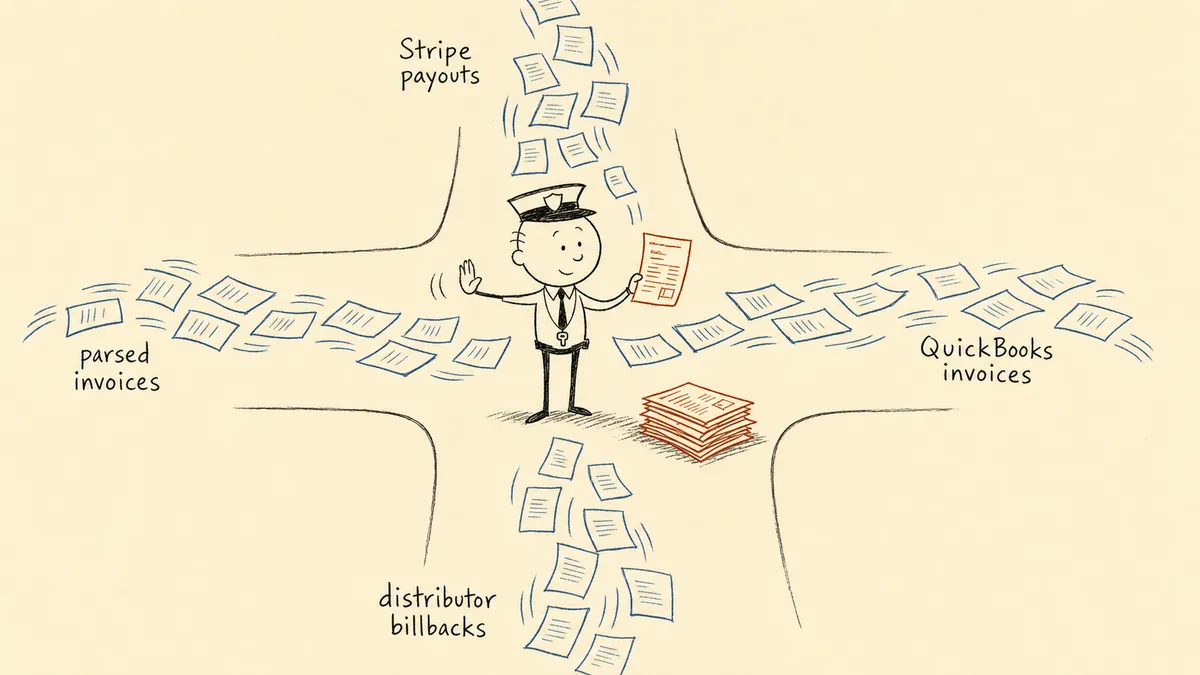
A second definition lives entirely outside that SERP. It is what a CFO or VP of Finance at a 10 to 500 person company means when they say their team “needs better reconciliation tools.” They are not talking about closing the books faster. They are talking about Stripe payouts that do not match QuickBooks invoices, distributor billbacks against shipments that do not tie out, AP bills that arrive in inboxes and post twice, freight cost allocations that someone is still building in a pivot table. That work happens before anything reaches a close calendar, and a close-management product is not built to live inside it.
This article is for the second buyer. If you are buying for the first, the article still tells you where the line is.
What finance leaders actually mean by “reconciliation tools”
Both definitions are legitimate. They just describe different work done by different people on different timelines.
Close-management reconciliation. Standardized account reconciliations, certification workflows, sign-offs, and tie-outs for the monthly close. The buyer is a controller. The user is an accountant. The output is a certified GL account inside a structured close calendar. BlackLine and Trintech have built mature products against this definition for years, and a team that has standardized its close on one of them does not migrate.
Operational reconciliation across systems. Catching mismatches between Stripe and QuickBooks before they become cash problems. Validating distributor billbacks. Detecting duplicate AP entries before a bill posts twice. Allocating freight costs across SKUs. The buyer is a CFO or VP of Finance. The users are AP coordinators, finance analysts, ops leads, and sometimes the CFO directly. The output is not a certified account. It is a clean handoff between systems that should agree but routinely do not.
The buyers and the products in the second category exist, but they are scattered across other categories. AP automation tools. Payment-platform integrations. Custom n8n flows. Spreadsheets. Email chains. None of them shows up in a “reconciliation tools” search result, because the SERP is dominated by the first definition. The result is that the CFO doing the search reads ten close-management vendor pages and concludes either that the category does not solve their actual problem, or worse, that they need to buy a close platform they do not need.
The cleanest framing is to name both definitions up front and let the reader pick which one applies. The rest of this article is mostly about the second.
Where traditional reconciliation tools fit, and where they leave gaps
The close-management category has earned its position. Account-level reconciliation matching, certification, audit-ready sign-offs, and sequenced close tasks are real domain depth, built around how accounting teams actually run a structured close. For a controller team running month-end across multiple entities, a purpose-built close product is the right tool. Nothing in this article is going to convince you otherwise, and any vendor suggesting otherwise is selling against their interest.
The gap most close-management tools have not closed, and arguably are not trying to close, is the work that happens before items reach the close at all. Specifically:
- Real-time exceptions across third-party systems the close platform does not natively integrate with: Stripe webhooks firing seconds after a charge, distributor portals with no public API, payment processors with their own dispute timelines, parser services like Parseur that turn inbox PDFs into structured data
- Routing those exceptions to the person who can actually resolve them, on the channel they live in (Slack, email, sometimes WhatsApp for the account manager who never opens the close calendar)
- Recording what happened to each exception, by whom, with the context attached, in a way that ties back to the workflow that surfaced it
Honest baseline of where most mid-market companies sit today: reconciliation across systems is a mix of spreadsheet exports, ledger pulls, and informal email follow-up, not a fully manual catastrophe and not a fully automated workflow. Finance leaders describe this routine the same way across companies. A CFO running operations at a CPG distributor described the daily reality as exporting from one source system into a CSV, opening a spreadsheet, and reloading the result into the ERP. That is not a process anyone designed. It is a process that emerged because no tool in the stack was built to live in the seam between the systems.
A different evaluation frame: exceptions, routing, audit
Most reconciliation-tool roundups rank by match rate. That is the wrong headline metric for a finance leader whose team already knows that 95 percent of transactions reconcile automatically. The work lives in the remaining 5 percent.
Match rate flatters every vendor in the category. It does not separate them. A 96 percent matcher and a 99 percent matcher look like meaningfully different products in a sales deck and produce identical workdays for the AP coordinator clearing the queue. The only number that matters in the exception queue is how fast a real human resolved an item, and that depends on the things match rate does not measure.
Four questions separate a category-confused reconciliation tool from a useful one:
- Which systems does it connect to natively? A tool that reconciles two of your six systems is not solving your problem. It is solving a fraction of your problem while shifting the rest to email.
- How does it decide an item is an exception? Threshold rules? Configurable logic? Outlier detection on its own? An AI agent that flags items that look like prior duplicates? Each of these produces a very different exception queue.
- Who does it route the exception to, and through what channel? A queue dashboard nobody opens is functionally the same as no routing. The exception has to find the named person who can resolve it, on the channel they already check.
- What does it record for the audit trail? Specifically: who decided what, when, with what context attached, and is that record queryable in the order it actually happened?
That fourth question is where most operational reconciliation breaks down. A spreadsheet does not have an audit trail. A Slack thread is not an audit trail. The exception got resolved, the entry got posted, and three weeks later nobody can tell the auditor or the next CFO who approved which adjustment and why.
The seam where the matcher stops and the human resolution begins is its own category of work. It is not the close. It is not the matching engine. It is the orchestration of context, routing, decision, and record. The category name for the system that lives at that seam is an orchestration layer: a platform above the systems of record that listens for what they emit, gathers context the matcher did not have, pulls a human in at the moments that need judgment, and writes the audit trail of who decided what across the whole workflow. FlowRunner is built for that layer.
That is also why a pause-and-ask pattern beats a batched exception queue for the items that risk actual cash leakage. A batch queue says: here are 47 things to look at tomorrow morning. A pause-and-ask pattern says: this specific Stripe payout does not match this specific QuickBooks invoice by $12.50, here is the customer, here is the fee deduction Stripe took, approve the adjustment or escalate. The reviewer makes one decision with full context, the workflow resumes from the decision, and the audit trail records who decided what at what time.
Common reconciliation patterns CFOs run into
The frame above is useful in the abstract. It is more useful tied to the patterns finance leaders actually run.
- Stripe payments to QuickBooks invoices. Most match cleanly. Mismatches are usually fee deductions, currency conversion, partial refunds, or customer-side payment splits. The pattern is automated reconciliation across Stripe and QuickBooks with Slack escalation when amounts or customers do not tie and Stripe to QuickBooks reconciliation with human-in-the-loop on the mismatches.
- AP and invoice ingestion with duplicate-reference detection. Two AP coordinators open the same inbox on the same morning. Or the same vendor invoice comes in by email and through a portal upload. The pattern is catching duplicate invoices before they post by checking parsed invoice metadata against recent history and pausing on outliers.
- Vendor history lookups against an ERP of record to catch double payments. This is the pattern one CFO described as the place where it would be very easy to double pay if both the company and a distributor made a payment. The orchestration pattern is NetSuite vendor matching with SuiteQL for a cross-reference before any new bill posts.
- AP automation with near-duplicate detection inside an ERP workflow. Near-duplicate detection in AP automation built on Acumatica is the same pattern with the ERP doing the heavy lifting on the matching side.
- Distributor billback validation and freight cost allocation. Almost never fits a close-management tool because the data lives in distributor portals and an account manager’s inbox, not in the GL. The workflow is: pull the billback, check it against the underlying shipment, route to the account manager for validation if anything looks off, post to the ledger only after confirmation.
Each of these is an orchestration pattern, not a close pattern. The work happens before the close, and the close inherits clean entries with the resolution context attached.
How FlowRunner approaches the same problem, honestly
FlowRunner is not a close-management replacement. We do not certify GL accounts and we do not run a structured month-end close. A team running BlackLine or FloQast for close management should keep doing so. We have written that comparison elsewhere (the honest read on FloQast vs FlowRunner), and the conclusion is the same in both directions: the two product categories coexist comfortably for finance teams that need both.
What FlowRunner does is the orchestration layer for the work that lives outside the close. Reconciliation patterns are one application. Specifically:
- A trigger fires (a Stripe webhook, a new bill in QuickBooks, a parsed invoice landing from a mailbox watcher, a webhook from a distributor portal).
- A workflow gathers context from every system it needs. If the match is clean, the workflow writes the entry and moves on.
- If the match has an exception (mismatched amount, missing reference, duplicate risk, unusual fee deduction, billback that does not tie to a shipment), the workflow pauses and calls a human as an action. Not a status gate. An actual pause on a specific transaction, routed to a specific named approver on the channel they live in.
- The reviewer receives a Slack message (or email, WhatsApp, phone for some patterns) with the full context attached and a structured response. Approve, reject, adjust, escalate.
- The workflow resumes from the response, posts the entry with the decision captured, and writes a per-execution record of who decided what at what time.
The audit-trail framing in that last bullet is meant to describe what the workflow records, not to make a compliance claim. FlowRunner is designed to give finance leaders a queryable record of what each workflow saw, what it decided automatically, and which human reviewed which exception. That is not the same thing as audit-ready certification for SOX or SOC 2. If your auditor’s scope requires framework attestation, that conversation is separate, and you should look at our pricing page and the trust pages we publish before assuming any specific bar.
The honest version of FlowRunner’s coverage in this category: we are the orchestration layer between the systems where reconciliation breaks. We are not the close, and we are not pretending to be. For finance teams whose pain is operational reconciliation across multiple systems, the orchestration layer is the right tool. For finance teams whose pain is the close itself, a dedicated close platform like the ones on the SERP today is the right tool. Most growing mid-market finance organizations end up with both, used for different work.
How to choose, given what you actually reconcile
The decision collapses to one diagnostic question, asked honestly:
What are you actually reconciling, and where does the resolution happen today?
If the answer is “GL accounts, certified by my accounting team, inside a structured month-end close,” you are buying close-management software. Close-management software is a real category, with mature vendors, and an orchestration layer is not going to do that job better.
If the answer is “Stripe payouts, distributor billbacks, AP bills, parsed inbox invoices, freight allocations, or anything else that crosses systems before it reaches the GL,” you are buying an orchestration and exception-routing tool. Evaluate it by integration coverage and exception routing, not by match rate. The questions are the four above: which systems, how exceptions are decided, who routing reaches, and what is recorded.
If the answer is both, the realistic stack runs both, used for different work. The clean items hit your close software already tied out. The exceptions arrive with the context already attached, the named reviewer already named, and a record of how each one got resolved before the close team ever opens it.
The reconciliation-tools SERP is not going to make that category split obvious. The category is going to keep selling close-management products under a category name that means two different things to two different buyers. The CFO doing the search has to make the split themselves.
What separates the buyers who get the evaluation right from the ones who waste a quarter is not which product they buy. It is whether they named the work first.
Quick answers
What counts as a reconciliation tool?
The term covers two distinct product categories that share a SERP. Close-management platforms like BlackLine, Trintech, and Numeric reconcile GL accounts during the monthly close. Orchestration and exception-routing tools handle the mismatches between systems before anything reaches the close. Most CFOs at companies between 10 and 500 employees mean the second when they search the term.
Is match rate a useful metric when comparing reconciliation tools?
Not on its own. For finance teams running real volume, 95 percent of items reconcile mechanically and the work lives in the 5 percent that miss. The better questions are which systems the tool connects to natively, how it decides an item is an exception, who it routes that exception to, and what it records for the audit trail.
Do I need a close-management platform and an orchestration layer at the same time?
Often yes. Close-management software certifies the books after exceptions are resolved. Orchestration handles the resolution itself across Stripe, QuickBooks, distributor portals, inboxes, and the other systems the close product was never built to reach. The realistic stack runs both, used for different work.