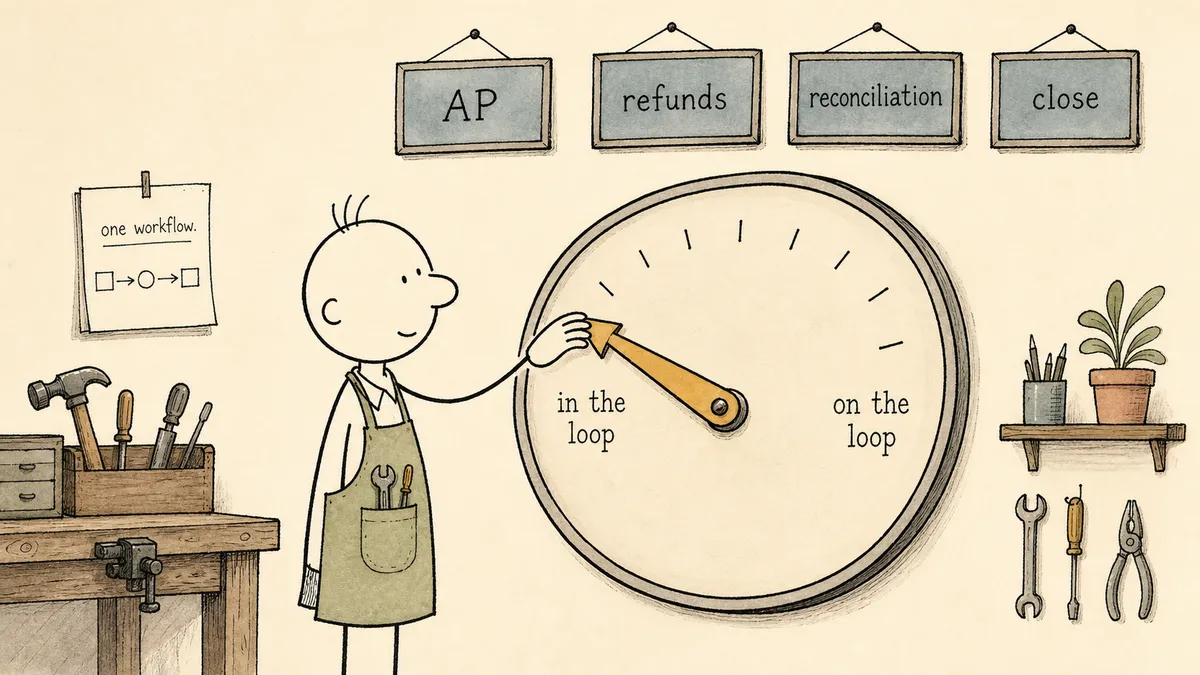
Treating human-in-the-loop and human-on-the-loop as rival philosophies is the single most common reason a finance team’s AI oversight policy looks coherent on a slide and falls apart the first time a controller asks where a specific bill got paid. They are not rival philosophies. They are two settings on the same dial, and the choice is per workflow, not per company.
This is the read for the CFO, VP of Finance, or controller deciding how much oversight to wire into each piece of finance automation. It defines both models, names the three variables that actually decide where each workflow sits between them, and walks the AP, refund, and reconciliation cases where finance leaders already make this call every day, whether they call it that or not.
Two oversight models, one spectrum
Strip the AI safety language away and you are left with two operating modes that finance has actually run for decades, just with different tools.
Human in the loop. The system pauses and waits for a person to approve, edit, or reject before it continues. The action does not happen until the human says yes. The approval gate on a bill above a threshold is human-in-the-loop. The credit memo a billing manager has to sign off on before it issues is human-in-the-loop. The pause-and-ask step in an AP near-duplicate detection flow where a flagged potential duplicate is surfaced to a reviewer before it posts is human-in-the-loop.
Human on the loop. The system acts on its own while a person monitors and can intervene after the fact. The action happens. The human reviews the log, the exceptions report, or the dashboard on a cadence and steps in when something looks wrong. The auto-categorization rule that posts $40 transactions to a GL code without asking is human-on-the-loop, even if nobody has ever called it that. So is the routine fulfillment exception that resolves itself while only high-value cases escalate.
The standard framing on this topic positions these as opposing camps in an AI governance debate, with one camp prioritizing safety and the other prioritizing throughput. That framing is a category error.
Here is what most posts on human-in-the-loop vs human-on-the-loop will not say plainly: the actual variable is not how comfortable you are with AI autonomy. It is reversibility. An unreviewed wire to a new vendor is hard to claw back. An unreviewed Slack ping is not. The same finance leader who insists on a named approver for the wire will happily let the ping go out automatically. Both decisions are correct, and they are correct for the same underlying reason. The work is in naming the reason and applying it consistently.
| Human in the loop | Human on the loop | |
|---|---|---|
| When the human acts | Before the system acts | After the system acts |
| Default state if no human responds | Workflow waits | Workflow proceeds |
| Best fit | High-dollar, irreversible, or audit-exposed | High-volume, reversible, low-confidence-tolerant |
| Failure mode if misapplied | Bottleneck; rubber-stamping | Material loss before review catches it |
| Finance examples | Wire approvals, refunds above threshold, new-vendor onboarding | Routine categorization, low-dollar reconciliation breaks, expected-variance handling |
Why this matters for finance leaders specifically
Finance work is full of just-enough-judgment tasks that block full automation. A pure rule engine cannot make the call. A pure AI cannot make the call confidently. A human can, but if a human has to make every call the team never gets to the work they were hired for.
A CFO running AP at a growing company described the floor of the in-the-loop zone in one sentence: “if someone’s out, I might even enter a bill into the system.” The work has not been delegated to a tool. The judgment to enter is too thin to delegate, but the entering is real. That is exactly the gap human-in-the-loop oversight is designed to close: the system handles the data movement and pre-checks, a person makes the small decision the data movement cannot make on its own, and the bill gets entered without the CFO doing keystrokes.
The same finance leader described why the in-the-loop side of the dial is not optional for AP near-duplicates: “I feel that it would be very easy to double pay on something like that if both we and the distributor made a payment.” That is not an AI safety concern. That is a finance reality. The pause is justified by the cost of reversal, not by ideology.
The cost of getting oversight wrong is asymmetric in both directions. An unreviewed bill payment is harder to claw back than an unreviewed Slack notification. A bottleneck that pauses every routine exception for review is harder to recover from than a missed low-dollar variance. Audit trail and reversibility constraints push different finance workflows toward different points on the spectrum, and the right answer for AP is not the right answer for reconciliation.
There is also a failure mode on the in-the-loop side that finance leaders see and dev teams routinely miss. Approval queues where reviewers rubber-stamp without actually validating are a real risk in finance. The same CFO above put it directly: “a lot of the sales guys, it’s just paperwork. They just want to get it off their desk.” A loop that always asks but never gets a real answer is worse than no loop at all, because it manufactures audit evidence that does not reflect actual review. In-the-loop oversight has to be designed for the cases where review genuinely adds value, not draped over every action as ceremony.
The framework that makes all of this manageable is the same one that separates AI automation from AI agents: the routing decision is not the same kind of decision as the action itself. Routing decides whether and how to pause. The action either runs or waits. Treating both as one undifferentiated “AI doing finance work” is how the policy debate goes off the rails.
When human-in-the-loop is the right call
The pattern that earns an in-the-loop pause:
- High-dollar or irreversible actions. Bills above a dollar threshold, wires, payments to new vendors, refunds above a customer-impact level. The FlowRunner pattern for this in QuickBooks is to pause large bills for a named approver in Slack before payment runs, with the bill context attached so the approver actually has something to approve against.
- Customer-facing financial decisions. Refund and credit decisions where the customer relationship and revenue impact justify a routed review. The companion pattern for Stripe is refund approvals routed to billing managers above a threshold before they execute, with the original charge and customer history surfaced inline.
- Low-confidence document extraction. AP near-duplicate detection, vendor invoice parsing where the model surfaces a likely match but the cost of a wrong post is high. The pattern is to flag, surface to a reviewer with the candidate match alongside the underlying bill, and post only after explicit confirmation.
- Audit-exposed events that the team will need to reconstruct later. Anything that an external auditor, a board member, or a future controller will need to trace back to a named approver. If the question “who approved this” will be asked, the answer needs to be a name attached to the record, not a system action.
- Anything genuinely new. A new vendor, a new payment category, a new bill type the workflow has not seen before. The cost of an in-the-loop pause on an unfamiliar case is low. The cost of an on-the-loop default on an unfamiliar case is whatever the worst plausible outcome of that case is.
When human-on-the-loop is the right call
The pattern that earns autonomous resolution with after-the-fact review:
- High-volume routine automation exceptions where pausing every case re-creates the bottleneck the automation was supposed to fix. Reconciliation breaks under a dollar threshold, expected category mismatches, known-pattern variances. The ShipBob fulfillment workflow above is one example; the reconciliation flow that runs Stripe payments against QuickBooks invoices with selective human review is another.
- Fully reversible actions with complete logging. If the action can be undone and the system writes a clean trail of what it did, a reviewer the next morning can catch and unwind a bad decision without material loss. The on-the-loop bar is reversibility plus reviewability, not absence of risk.
- Escalation-by-threshold patterns. The honest hybrid: the workflow handles the routine ninety percent on its own and routes the outlier ten percent to a human. This is what most well-designed finance automation actually looks like in production, even when the team would describe it as “fully automated.”
- Cases where the realistic baseline is informal approval, not careful review. If the alternative to on-the-loop is a queue where exceptions sit until someone has time, and that someone rubber-stamps because they are behind, on-the-loop with a real log review on a cadence is the more honest control. The control nobody enforces is worse than the control everyone reviews on Friday.
That last point is the honest comparison most articles on this topic skip. The baseline for finance teams today is rarely careful human review of every exception. It is a backlog, an informal approval that bypasses the queue, and a controller checking the bigger items by hand. Measured against that baseline, autonomous resolution with a clean log and a scheduled review is the more defensible control, not the less. Reviewing what the system actually did beats not reviewing what people manually said they did.
Configuring the spectrum across a finance stack
The single most useful mental shift here: this is not a stance you take as a CFO. It is a configuration you set per workflow. AP can be in-the-loop above a threshold and on-the-loop below it. Refunds can be in-the-loop in one product line and on-the-loop in another. Reconciliation can sit between the two with selective review for breaks that exceed a dollar or confidence threshold.
The practical inputs to the per-workflow decision:
- Dollar threshold. Above what amount is the case worth a pause? Set this against actual spend distribution, not a template. If most of your AP is under $2,000 and the threshold for in-the-loop review is $25,000, the workflow treats almost everything as routine and you have effectively delegated the AP control to the rule engine.
- Reversibility. Is this action easy to undo, hard to undo, or impossible to undo? Payments to vendors are hard. GL entries are easy. Wires are impossible without negotiation. The harder the reversal, the further toward in-the-loop the workflow sits.
- Audit exposure. Will an auditor or a controller ask who approved this specific record six months from now? If yes, in-the-loop with named-approver capture is the safer place on the dial. If the action is one of ten thousand routine reconciliations nobody will ever ask about individually, the audit value of pausing each one is near zero.
- Confidence score from the upstream step. Document extraction, near-duplicate detection, and category classification produce a confidence score. A workflow can route high-confidence cases on-the-loop and low-confidence cases in-the-loop on the same flow, using the score as the gate.
- Frequency of true exception. How frequently does the case actually need human judgment versus how frequently does the human just say yes? If true exceptions are rare, pausing every case is mostly ceremony. If they are common, pausing every case is the work.
What both models require to be defensible is the same regardless of where on the dial the workflow sits:
- A complete execution log that captures what the system did, when, and against what data
- Clear ownership of who reviews what, on what cadence
- Approver identity captured against the record for in-the-loop steps
- The ability to change the configuration of any one workflow without rebuilding the others
Native ERP and accounting platforms expose pieces of this. QuickBooks rules handle the routine categorization on-the-loop end. Acumatica’s approval module handles the named-approver in-the-loop end on bills inside the ERP. Neither one owns the seam where exception data comes in from outside, the seam where the routing decision uses context from a different system, or the seam where a human in Slack gets pulled in mid-flow without leaving the channel they already work in.
That seam, between what the systems of record route on their own and what a finance team actually does between them, is where an orchestration layer lives. This is the category we are defining: Orchestration as a Service, a platform category that coordinates, governs, and supervises multi-agent environments while keeping humans in control of the decisions that require judgment. An orchestration layer is a system above the systems of record that listens for what they emit, gathers context the native rules did not have at fire time, pulls a named approver in when the case earns a pause, runs autonomously when the case does not, and captures everything against the record so the audit trail stays in one place. FlowRunner is built for that layer. The pause-and-ask step is the in-the-loop instance. The autonomous run with notifications and a clean log is the on-the-loop instance. The configuration is per workflow, not per platform.
A short decision guide
When you sit down to set the dial for a specific workflow, the question to start with is not “do we want AI to do this.” The question is: if this action is wrong, how hard is it to reverse, and who notices?
- If reversal is hard or the action is high-dollar: route to a named approver in the channel they already use, with the case context attached so the approval is real and not paperwork. This is the in-the-loop end.
- If reversal is easy and volume is high: run it autonomously, write a clean log, and review the log on a cadence the team will actually keep. This is the on-the-loop end.
- If volume is high and a subset is irreversible: use the threshold and the confidence score to split the flow. Most of the population runs on-the-loop. The minority that exceeds the threshold pauses in-the-loop. The split is the point.
- Revisit the configuration as confidence and history accumulate. The right point on the dial moves over time. A workflow that needed in-the-loop oversight for the first three months because the team was uncertain about the routing rules can move toward on-the-loop once the log shows the rules are catching what they need to catch. A workflow that started on-the-loop can move toward in-the-loop if review consistently finds expensive mistakes. The dial is not set once.
The CFOs and VPs of Finance who get the most value from AI oversight are not the ones who pick a side. They are the ones who treat the dial as part of the workflow definition, set it deliberately per case, and revisit it on the same cadence they revisit the rules themselves. The work is not in choosing between human in the loop and human on the loop. The work is in knowing which workflows belong where on the dial today, and being honest about why.
Quick answers
What is the difference between human in the loop and human on the loop?
Human in the loop means the system pauses and waits for a person to approve, edit, or reject before it acts. Human on the loop means the system acts on its own while a person monitors and can intervene after the fact. The first is a gate. The second is a guardrail.
Which one should finance use for accounts payable?
Neither, as a single answer. AP has both. Bills above a dollar threshold or from a new vendor route in the loop to a named approver. Routine matched bills under threshold can run on the loop with the full posting written to the audit log for review. The split is per bill, not per company.
Is human on the loop just AI replacing humans?
No. The person is still accountable for the outcomes and reviews the log on a cadence. The difference is whether the review happens before the action or after it. Reversibility is what makes one or the other defensible.