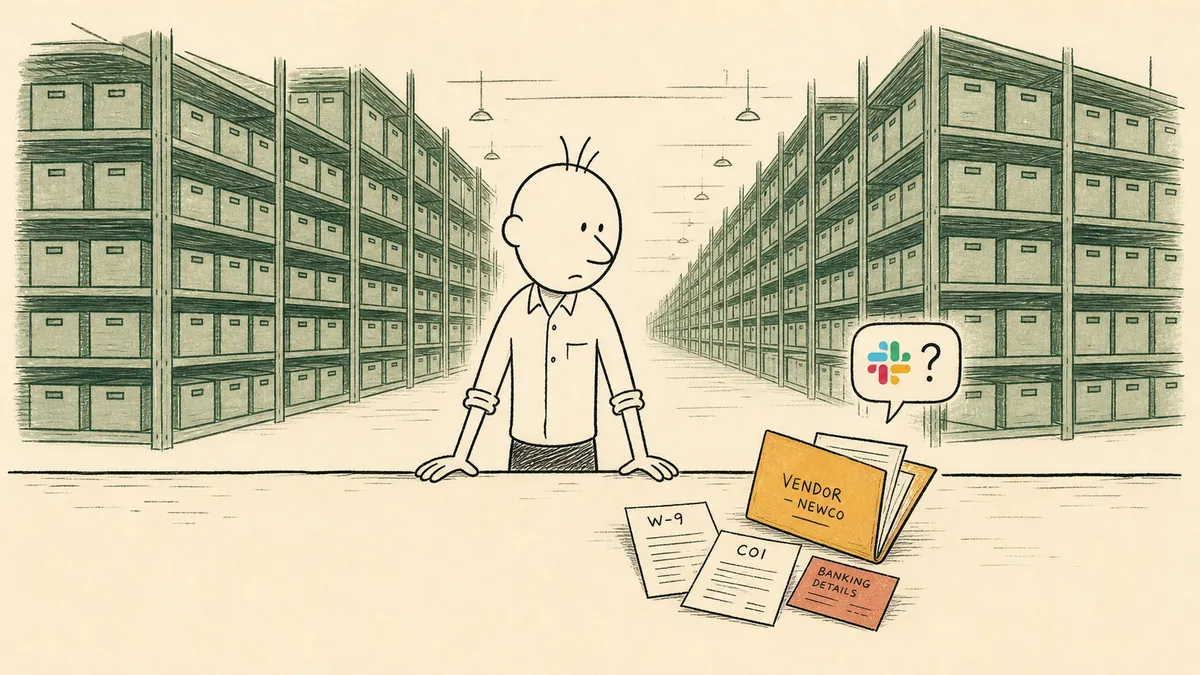
A procurement team that shortlists SAP for vendor onboarding is usually answering a different question than the one they typed into a search bar. The visible question is “what vendor onboarding software should we buy.” The actual question buried underneath is “are we an SAP shop or not, because that decision changes which tool is even on the shortlist.” FlowRunner and SAP are not competing for the same buyer most of the time, and the most useful thing this article can do is tell you which buyer you are before the demos start.
Side by side, at a glance
| SAP (Sales Cloud + SuccessFactors Learning + S/4HANA vendor master) | FlowRunner | |
|---|---|---|
| Category | Enterprise suite spanning CRM, HCM, ERP with vendor-adjacent tooling embedded | Orchestration layer for work and AI agents across the tools a team already runs |
| Primary job | Run the suite-deep enterprise stack with vendor data unified across sales, HR, and finance | Coordinate vendor onboarding, document collection, and exception handling across existing systems |
| Built for | Enterprises already running SAP, or committing to a multi-year SAP suite implementation | Mid-market procurement and ops teams that need a workflow shipped this quarter |
| AI framing | ”Agentic orchestration” with Joule providing contextual guidance to sellers across the sales cycle | Agents invoke humans as callable tools when they hit uncertainty, with the human-in-the-loop step as a first-class workflow component |
| Compliance posture | Validated SaaS environment for strict requirements for highly regulated industries with annual updates and validated testing | Audit trails, RBAC, SSO designed to meet common audit requirements, not a formally validated environment |
| Integration depth | Native suite continuity across CRM, HCM, ERP without custom connectors | Broad orchestration substrate, new connectors built in roughly thirty minutes when the catalog does not already cover the system |
| Content and partner ecosystem | SAP Content Stream by Skillsoft, open content network providers, preconfigured extensions, years of partner depth | Agent Directory is earlier stage; partner network is narrower |
| Mobile | AI-enhanced Android and iOS apps with natural language navigation and dynamic visit planning, built for distributed field teams | No purpose-built mobile interface for procurement |
| Pricing surface | Enterprise procurement cycle, custom pricing | $299 per month at the Professional tier for audit trails, RBAC, and SSO |
| Time to first workflow | Weeks to months as part of suite implementation | Days to weeks, configured visually by non-developers |
The table tells most of the scope story. The rest of this article is the part the table cannot.
Who SAP actually serves, said honestly
SAP positions Sales Cloud as enterprise-grade AI-embedded sales software built around “agentic orchestration” that prepares sellers to execute faster, with Joule embedded across the sales cycle as the contextual guidance layer. SuccessFactors Learning is positioned around skills-driven development and automated compliance training that runs inside a validated SaaS environment. The vendor master sits inside SAP ERP or S/4HANA, and the data continuity across those products is the part of the SAP value proposition that no horizontal automation tool can replicate without custom integration work.
This is real. A buyer already running SAP ERP, S/4HANA, or SuccessFactors HCM does not have a software comparison to make. They have a switching-cost calculation. Vendor records, employee records, contract metadata, and approval matrices already live in the SAP suite; an onboarding workflow built on top of that data lands inside the trust boundary the organization has already drawn. The AI features Joule layers on top arrive against trusted data, which is a different position than an AI feature applied to a clean install at a company that has never had a unified vendor record.
Specific things SAP does that FlowRunner does not:
- Native suite continuity. Vendor master in SAP ERP, employee data in SuccessFactors HCM, customer data in Sales Cloud, contract metadata in SAP Ariba or DocuSign-integrated SAP modules. The data flows through SAP-built connectors, not through reconciliation logic an orchestration layer would have to add.
- Validated SaaS for regulated industries. SuccessFactors Learning operates inside “strict requirements for highly regulated industries with annual updates and validated testing”. For pharma, finance, and healthcare buyers who treat that posture as a hard procurement requirement, that credentialed environment is not a checkbox FlowRunner can replicate with audit trails alone.
- Curated content and partner ecosystem. SAP Content Stream by Skillsoft, open content network providers, and preconfigured extensions represent years of ecosystem investment. The breadth of that catalog is not something a newer platform matches by adding integrations faster.
- Mobile-first field execution. AI-enhanced Android and iOS apps with natural language navigation and dynamic visit planning are built for distributed field sales teams. FlowRunner has no comparable mobile interface.
- Forecast and pipeline intelligence at enterprise scale. Sales Cloud combines projected, target, and best-case modeling with real-time pipeline flow, leakage, and conversion data designed for enterprise revenue operations.
This list is not a backlog of FlowRunner gaps to close. It is the deliberate scope difference between a multi-product enterprise suite and a horizontal orchestration layer. A procurement team inside an SAP-committed enterprise that types “vendor onboarding software” into a search bar usually already knows the answer is SAP. The honest version of the comparison is what happens when the buyer is not that enterprise.
What vendor onboarding actually looks like for a mid-market procurement team
The standard advice on vendor onboarding software is to compare features against a checklist and pick the highest-scoring tool. The honest version is that most mid-market procurement teams have a more concrete problem that the checklist does not surface. The vendor onboarding work that consumes their time does not live inside any single product today. It lives in fragments:
- A vendor sends a W-9, a certificate of insurance, and banking details across three emails over a week
- The team manually checks the submitted tax ID against the ERP vendor list (NetSuite, Acumatica, QuickBooks Online, or yes, SAP) and finds something that looks like a duplicate but is not exactly one
- The contract goes out for signature through DocuSign; the executed PDF lands in a folder somewhere
- Approval routing depends on category, spend threshold, and whether the vendor touches regulated data, and the routing rule does not handle the conditional case gracefully
- The COI expires three weeks after onboarding and nothing notices because the COI lives in a folder and the AP system keeps paying
A buyer searching for vendor onboarding software is usually looking for the system that absorbs all of that. The conventional answer is to install a portal product that owns the front door. The harder question, the one most comparison posts will not say plainly, is that a portal solves intake and creates a new silo procurement still has to reconcile against the ERP, the AP system, and the contract repository. The intake form is the easy part. The coordination across the systems that already hold vendor data is the work.
This is where the buyer decision splits. For an SAP-committed enterprise, the answer is to use the SAP-native pieces (Ariba, SuccessFactors, the S/4HANA vendor master) and accept the implementation timeline because the suite continuity earns it. For everyone else, the answer is a coordination layer over the systems already in place. Adding SAP to a non-SAP stack to solve vendor onboarding is buying the bigger problem.
Where FlowRunner fits: the layer over the ERP and the channels procurement already uses
FlowRunner is an orchestration layer that sits above the systems of record. For vendor onboarding specifically, the shape of the pattern looks like this:
- A trigger fires (a supplier-facing form submission, a vendor email arriving in a shared mailbox routed through a parser, an event in the contract system)
- The workflow gathers context across the systems involved: the ERP’s existing vendor list, the contract repository, the document parser’s output, internal approval matrix metadata
- The mechanical part of validation runs: does this tax ID match an existing vendor with a different name, does the remit-to address look like a known fraud pattern, does the COI date check out, is this banking detail change happening on an existing vendor record
- If everything ties, the workflow writes the vendor record into the ERP and posts the notifications without involving a human
- If anything is ambiguous (probable duplicate, mismatched tax ID, missing certification, banking change on an existing vendor), the workflow pauses and calls a named procurement reviewer in Slack with the full context attached and a structured response
- The reviewer decides, the workflow resumes from the response, the ERP record updates with the decision captured against the audit trail
The shape of step five is the part that matters. FlowRunner’s agents invoke humans as a callable action when they hit uncertainty, not as a status gate that fires on every threshold breach. Concretely, this is the same shape as the patterns documented in vendor validation against Acumatica before bill creation, cross-referencing vendor history in NetSuite, and human-in-the-loop on ERP vendor operations. The full solution shape is documented across the supplier portal software and supplier relationship management software solution pages, which describe the coordination approach in more detail.
A system above the systems of record is the category that owns this work: a layer that listens for what the ERP and the contract system emit, gathers context the approval rule did not have, and pulls a human in at the moments that need judgment. FlowRunner is built for that layer. SAP’s vendor-adjacent tooling sits inside the enterprise suite at a different point in the stack.
The honest version of the human-in-the-loop difference, said without strawmanning SAP: SAP’s agentic orchestration is positioned around seller enablement and contextual guidance for users inside the SAP workflow. That framing is real and it is a legitimate design choice for an enterprise sales product. FlowRunner’s human-in-the-loop is a different shape, suited to a different kind of decision. Where seller enablement is about giving a user better context inside a known workflow, an orchestration-layer escalation fires when an agent or workflow encounters something it cannot resolve on its own (a vendor that looks like a duplicate of an existing record, a tax ID that does not validate, a banking change on an established vendor that should not be approved without a callback verification) and needs a named human to decide. Both are forms of intelligent automation. They are designed for different work at different points in the stack.
Connectors built in thirty minutes, paid for at a price a procurement director can authorize
Two architectural choices distinguish FlowRunner from the enterprise-suite model that SAP defines.
The first is connector velocity. FlowRunner’s Agent Factory is built so operations teams can compose a workflow that combines a parser, an ERP write, a Slack approval, and an audit trail without filing an engineering ticket. When the team needs to reach a system the catalog does not already cover, new connectors are built in roughly thirty minutes. The bar to add a new exception path is low enough that the workflow can evolve as the buying motion evolves. That is the opposite of the suite implementation timeline that an SAP rollout assumes, and it is the right answer for a procurement team that has been told to ship a vendor onboarding workflow this quarter.
The second is pricing transparency at the governance tier. FlowRunner publishes audit trails, RBAC, and SSO at the Professional tier ($299 per month). The framing matters: this article is not claiming auditor acceptance of any specific compliance framework, and SAP’s validated SaaS environment for SuccessFactors Learning remains a real advantage for pharma, finance, and healthcare buyers whose regulatory scope demands that posture. FlowRunner’s compliance surface is designed to meet common audit requirements for mid-market procurement operations. It does not constitute a formally validated environment for highly regulated industries. The distinction is honest and it is important.
What FlowRunner does offer at $299 per month is the governance infrastructure a procurement director can authorize without an enterprise procurement cycle. That price point is paired with the connector velocity above to produce a different shape of buying decision than the SAP suite assumes.
Where SAP is the stronger fit
Buy SAP (and probably nothing else for vendor onboarding) when:
- Your organization already runs SAP ERP, SAP S/4HANA, or SuccessFactors HCM, and the vendor master plus HR data already live inside the suite
- Your regulatory scope requires a validated SaaS environment with annual updates and validated testing, particularly for pharma, finance, healthcare, or other industries where that posture is a hard procurement requirement
- The breadth of SAP’s content and partner ecosystem (SAP Content Stream by Skillsoft, preconfigured extensions, the partner network) is material to your buying decision
- Your sales and procurement teams are distributed and a purpose-built mobile interface with AI-enhanced navigation and dynamic visit planning is a primary requirement
- You operate at enterprise revenue scale where Sales Cloud’s forecast and pipeline intelligence (projected, target, and best-case modeling with real-time pipeline flow, leakage, and conversion data) is the level of revenue operations infrastructure your business actually needs
This set of conditions describes a real and large class of enterprise buyer. If it describes your organization, the rest of this article is interesting but not actionable. SAP is the right answer and an orchestration layer is a question for a later conversation about extending what SAP already does well.
Where FlowRunner is the stronger fit
Choose FlowRunner when:
- Your organization does not already run SAP, and adopting SAP for vendor onboarding would mean buying into a multi-year suite implementation to solve a workflow problem
- The vendor onboarding work that consumes your team’s time lives across email, parsers, Slack, the ERP (NetSuite, Acumatica, QuickBooks Online), and a contract repository, with the coordination across them as the actual bottleneck
- You need a procurement coordinator or ops analyst to configure new exception paths without waiting on engineering capacity or a partner ecosystem release cycle
- You need intelligent human-in-the-loop where agents pause and route to a named reviewer with full context, rather than every threshold breach firing a static approval gate
- You want governance infrastructure (audit trails, RBAC, SSO) at mid-market pricing that a procurement or finance director can authorize without an enterprise procurement cycle
- You see AI agents arriving in your stack from multiple vendors (extraction agents, supplier-side AI, approval bots) and want a coordination layer above them before that becomes its own problem
The two products coexist comfortably in the same procurement stack when the organization is mid-transition. SAP holds the vendor master for the regulated parts of the business; FlowRunner handles the coordination layer for the workflows that touch supplier documents, parsed inbox data, conditional approvals, and exception routing across the channels procurement actually uses. The structured parts of the buying motion flow through SAP. The unstructured coordination flows through FlowRunner with the context already attached.
How to decide, given where you are on the clock
Three questions, in this order.
1. Are you already on SAP? If the vendor master lives in SAP ERP or S/4HANA and the HR data lives in SuccessFactors, the answer to “what vendor onboarding software” is the SAP-native pieces and the orchestration question is a separate conversation about extending them. If you are not on SAP, adding SAP to solve vendor onboarding is buying a much larger problem than the one you have.
2. What is the regulatory scope? If your organization operates in pharma, finance, healthcare, or another vertical where a formally validated SaaS environment is a hard procurement requirement, SAP SuccessFactors Learning’s validated posture is a real advantage that an orchestration layer with audit trails does not replicate. If your scope is “common audit requirements” rather than “validated environment,” FlowRunner’s $299-per-month governance tier sits at the right price point for the requirement.
3. Where does the actual onboarding work live today? Walk through the last three vendor onboardings that consumed your team’s time. For each one, name where the work happened. If the answer is “inside our SAP modules,” extending SAP is the right move. If the answer is “across email, a parser, two Slack threads, a DocuSign envelope, and three exports from the ERP before anyone could approve the record,” that is the work an orchestration layer is built to absorb, and the question is which orchestration product to buy. A separate framework on how to evaluate which procurement workflows are worth automating handles the financial side of that decision.
Most mid-market procurement teams will answer question one with “no, we are not on SAP” and question three with “across systems.” For those teams, the comparison this article is staged around resolves to FlowRunner, not because FlowRunner wins on every axis (it does not, and SAP’s validated environment, ecosystem breadth, and mobile depth are real advantages where they apply), but because the buying decision is a scope decision before it is a feature decision.
Quick answers
Is FlowRunner a replacement for SAP for vendor onboarding?
Not for an organization already running SAP ERP, SAP S/4HANA, or SuccessFactors HCM. Those buyers get native vendor and HR data continuity from the SAP suite that an orchestration layer cannot replicate without custom integration work. FlowRunner is the better fit when the organization does not already run SAP and the goal is to ship a vendor onboarding workflow with intelligent human-in-the-loop checkpoints in weeks rather than after a suite implementation.
Does FlowRunner offer a validated SaaS environment for regulated industries?
No. SAP SuccessFactors Learning carries a validated SaaS posture with annual updates and validated testing for pharma, finance, and healthcare. FlowRunner provides audit trails, RBAC, and SSO starting at $299 per month, which are designed to meet common audit requirements but do not constitute a formally validated environment. If your regulatory scope requires that posture, SAP retains a real edge.
Can FlowRunner sit alongside SAP rather than replace it?
Yes. The most common pattern with SAP customers is to keep SAP as the system of record for vendor master and HR data, and use FlowRunner as the coordination layer that pulls in supplier documents, routes approvals through Slack or email, validates submissions against the SAP vendor record, and escalates exceptions to a named procurement reviewer before the SAP record updates.