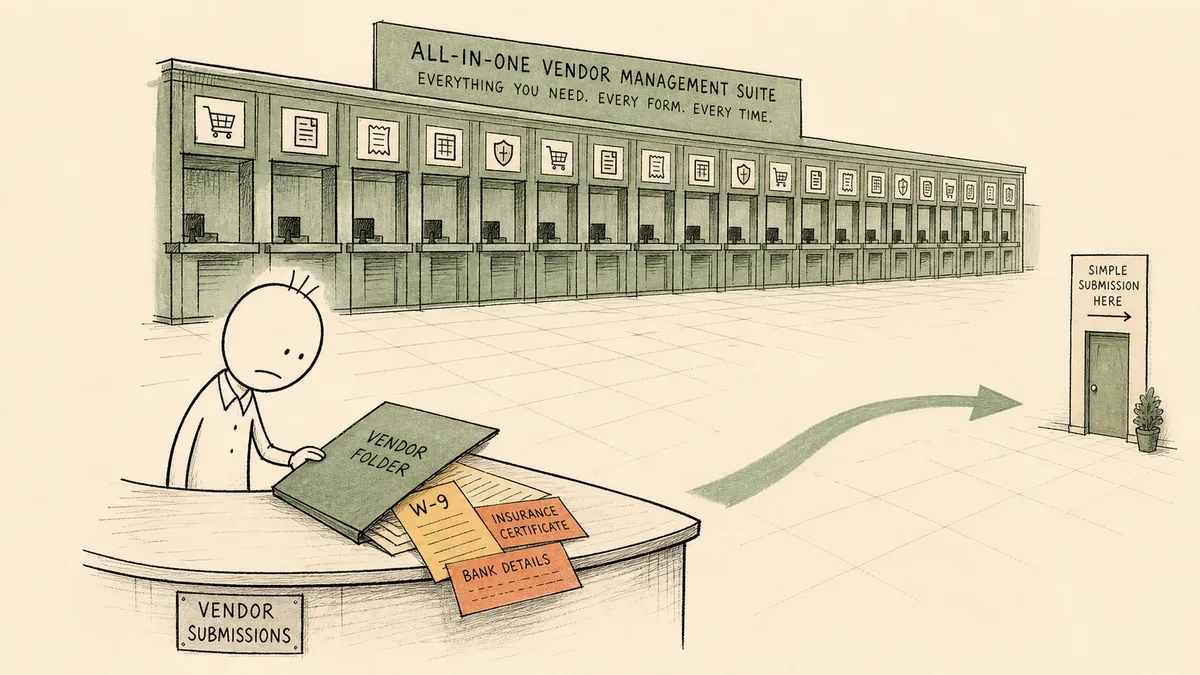
When a procurement team shortlists Coupa for vendor onboarding, they are rarely buying vendor onboarding. They are buying a spend management suite, and onboarding is the wedge that gets it in the door. That is not a criticism of Coupa. It is the entire logic of the product, and for a large procurement organization it is often the correct logic. The mistake is treating “what onboarding tool should we buy” and “should we standardize our entire spend stack on one vendor” as the same question. They are not, and the answer to the second one decides the first.
The two products at a glance
| Coupa | FlowRunner | |
|---|---|---|
| Category | AI Total Spend Management suite, longstanding Business Spend Management (BSM) platform | Orchestration layer for work and AI agents across the systems a team already runs |
| Primary job | Unify sourcing, procurement, invoicing, expenses, payments, and supplier risk in one platform | Coordinate vendor onboarding, document collection, validation, and exception handling across existing systems |
| Vendor onboarding role | One capability inside Supplier and Risk Management, “the original entry point for engaging with a supplier” | The whole job: orchestrate intake, validation, screening, enrichment, and approval routing across the tools that hold vendor data |
| Built for | Enterprises standardizing their spend stack on a single suite | Mid-market procurement and ops teams orchestrating across the systems they keep |
| Supplier risk and sanctions screening | Native, inside the suite (OFAC, InfoSec, ABAC, GDPR, ESG monitoring) | Orchestrated by calling the screening source you choose, then routing flagged hits to a human |
| AI framing | AI-native spend management, touchless processing and fraud detection across source-to-pay | Agents as first-class workflow nodes that invoke humans as callable tools when they hit uncertainty |
| Integration model | App Marketplace of pre-certified partner apps, connects to up to 160 ERPs | Agent Factory builds new connectors in roughly thirty minutes; broad orchestration substrate |
| Ecosystem maturity | Deep and curated, years of partner investment | Agent Directory is earlier stage, partner network narrower |
| Enterprise credibility | Leader in the 2026 Gartner Magic Quadrant for Source-to-Pay Suites, network of 10M+ buyers and suppliers | Newer platform, carries the adoption risk that comes with that |
| Pricing surface | Enterprise, quoted through sales, scoped to modules and spend volume | Core platform (AI agents, all integrations, human-in-the-loop, unlimited users/workflows) at Growth ($45/mo); governance tooling (audit trails and RBAC) at Professional ($299/mo); SSO at Business ($999/mo) |
| Time to first workflow | Weeks to months as part of a suite deployment | Days to weeks, configured visually by non-developers |
The table covers the scope difference. The rest of this article is the part the table cannot: which buyer you are, and where the actual onboarding work lives once the demo is over. (For the same comparison against a different incumbent, see the sibling piece FlowRunner vs SAP for vendor onboarding software.)
Who Coupa actually serves, said honestly
Coupa describes itself as the #1 AI Total Spend Management platform, an AI-native ecosystem spanning procurement, finance, and supply chain operations. The longer-standing category term for what Coupa built is Business Spend Management: one suite that unifies sourcing, procurement, invoicing, expenses, payments, and supplier management rather than stitching point tools together. Vendor onboarding lives inside that suite, specifically inside Coupa Supplier and Risk Management, which Coupa frames as “the original entry point for engaging with a supplier.”
This is a credible and well-earned position. Coupa was named a Leader in the 2026 Gartner Magic Quadrant for Source-to-Pay Suites for the third consecutive year, and it brings a network of more than 10 million buyers and suppliers onto one platform. For a CFO or a head of procurement at a large enterprise, that track record is not marketing noise. It is exactly the kind of signal that de-risks a nine-figure spend decision. Buyers consolidating their spend stack onto a single suite are doing something deliberate, and Coupa is one of the strongest answers to that specific goal.
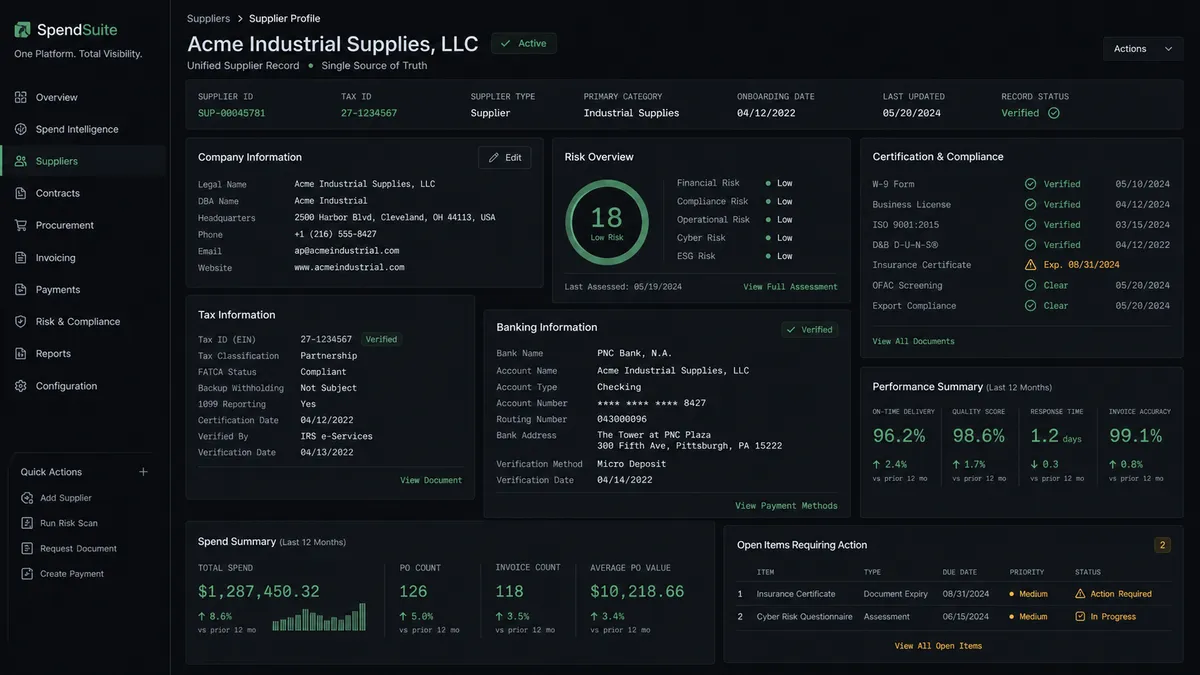
Inside the suite, the onboarding capability is genuinely deep. Coupa’s supplier management centralizes supplier information (tax IDs, certifications, insurance, banking details) and automates compliance checks across domains like OFAC sanctions, InfoSec, anti-bribery and anti-corruption, GDPR, and ESG monitoring, with a self-service portal where suppliers upload documents and maintain their own profiles. The decisive part is that risk and performance monitoring sit in the same platform as purchasing and invoice management. The vendor you onboard is the vendor you transact with, scored against the spend data the suite already holds.
That data continuity is the part no horizontal tool replicates for free, and it deserves to be named plainly rather than waved past.
The honest case for Coupa, before the contrast
A comparison that only lists where FlowRunner wins is marketing, not analysis. Here is where Coupa is the stronger choice, stated without hedging.
- Native supplier risk and sanctions screening. Coupa ships third-party risk scoring and sanctions screening inside the suite. If your selection criteria require turnkey OFAC, InfoSec, and ABAC screening with monitoring built in, Coupa delivers that natively. FlowRunner orchestrates screening by calling an external source; it does not ship a native risk engine.
- Suite depth FlowRunner does not have. Coupa is a full Business Spend Management platform. Sourcing, procurement, invoicing, expenses, payments, treasury. FlowRunner is not a spend management suite and does not pretend to be one. It has no native invoicing, sourcing, or expense modules.
- A mature, curated integration ecosystem. Coupa’s App Marketplace offers pre-certified partner apps and connects to existing IT landscapes including up to 160 ERPs. That is years of ecosystem investment. FlowRunner’s Agent Directory is earlier stage and its partner network is narrower today.
- Enterprise brand trust. Coupa carries the analyst recognition and the install base that large procurement and finance buyers weight heavily. FlowRunner is a newer platform and carries the adoption risk that comes with being newer. A buyer who ranks vendor maturity as a top criterion should weigh that honestly.
If those four points describe your buying criteria, the rest of this article is interesting but not decisive. Coupa is a real answer to a real goal. The comparison gets useful when the goal is different.
The part most vendor onboarding comparisons skip: the form is not the work
The standard way to evaluate vendor onboarding software is to score intake portals and screening checklists against each other and pick the highest total. That framing quietly assumes the hard part is collecting the documents. It is not. The hard part is everything that happens when a submission does not cleanly pass.
Walk through a real onboarding rather than a feature grid:
- A vendor sends a W-9, a certificate of insurance, and banking details across three emails over a week, none of them in the format the portal expected.
- The submitted tax ID looks like a near-match to an existing vendor in the ERP, same legal entity, different DBA, so it is probably a duplicate but not certainly one.
- The remit-to bank account on the form differs from the account already on file for what might be the same supplier, which is either a legitimate update or the exact signature of payment fraud.
- The category and spend threshold push approval routing down a conditional path the rule was never quite built to handle gracefully.
- The COI expires three weeks after go-live, the AP system keeps paying, and nothing notices because the certificate is sitting in a folder.
A clean intake form handles none of that. Screening flags some of it. What none of the checklist tooling resolves is the judgment call: is this a duplicate, is this banking change safe, who decides, and with what context in front of them. Coupa handles a great deal of the mechanical and screening work well, inside its suite, against its data. The judgment calls still land on a procurement coordinator’s desk regardless of which vendor you buy.
Here is what most comparison posts on this topic will not say: exceptions are not the failure case of vendor onboarding. Exceptions are the work. The automation handles what is not the work. So the question that actually separates these two products is not whose intake form is nicer. It is what each one does at the moment a submission stops being routine.
How the suite handles exceptions versus how an orchestration layer handles them
Inside a suite, an exception is typically a status. The record stalls in a state, a queue, an approval step, and a human is notified that something needs attention. They open the platform, navigate to the record, reconstruct what tripped, and decide. That model is coherent and it works. It also assumes the human lives inside the suite and that everything the decision needs already lives there too.
FlowRunner treats the exception differently, because it sits at a different point in the stack. FlowRunner is an orchestration layer above the systems of record, and it treats AI agents as first-class workflow nodes rather than features bolted onto a platform. For vendor onboarding, the shape looks like this:
- A trigger fires: a supplier form submission, a vendor email landing in a shared mailbox routed through a parser, an event in the contract system.
- The workflow gathers context across the systems involved: the ERP’s existing vendor list, the contract repository, the parser’s output, the internal approval matrix.
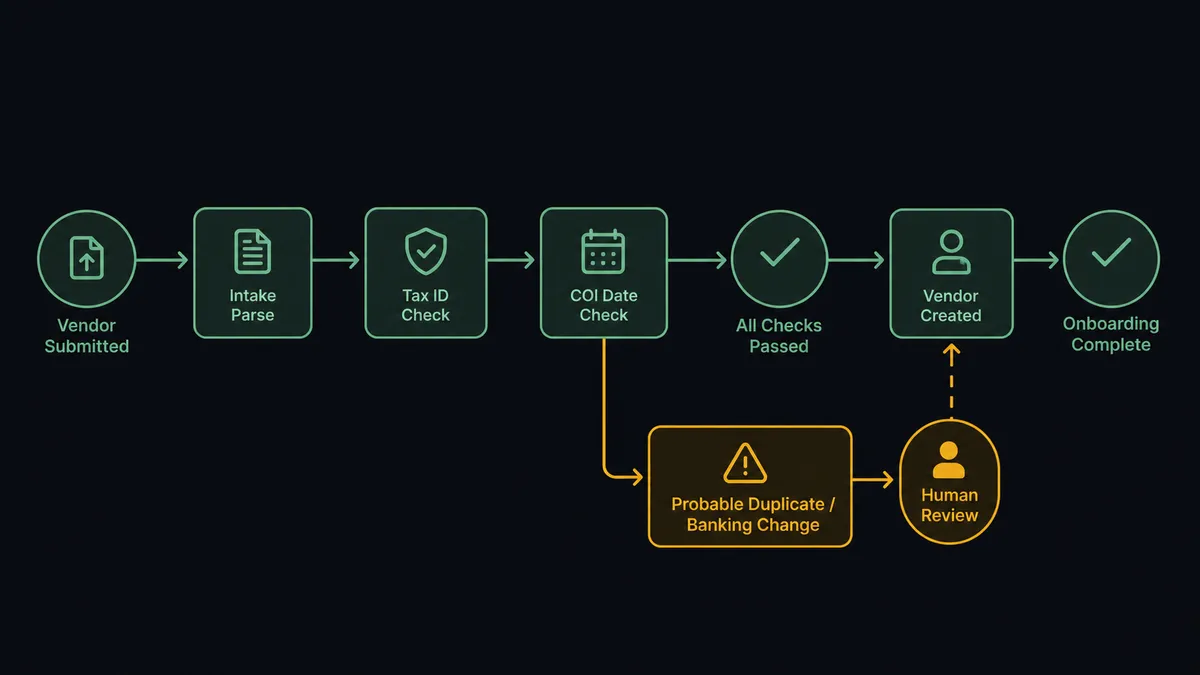
- The mechanical validation runs: does this tax ID match an existing vendor under a different name, does the COI date check out, is this a banking change on an existing record, does the remit-to address match a known-bad pattern.
- If everything ties, the workflow writes the vendor into the ERP and posts notifications with no human involved.
- If anything is ambiguous, the workflow pauses and calls a named procurement reviewer in Slack with the full context attached and a structured response, then resumes from their answer with the decision captured against the audit trail.
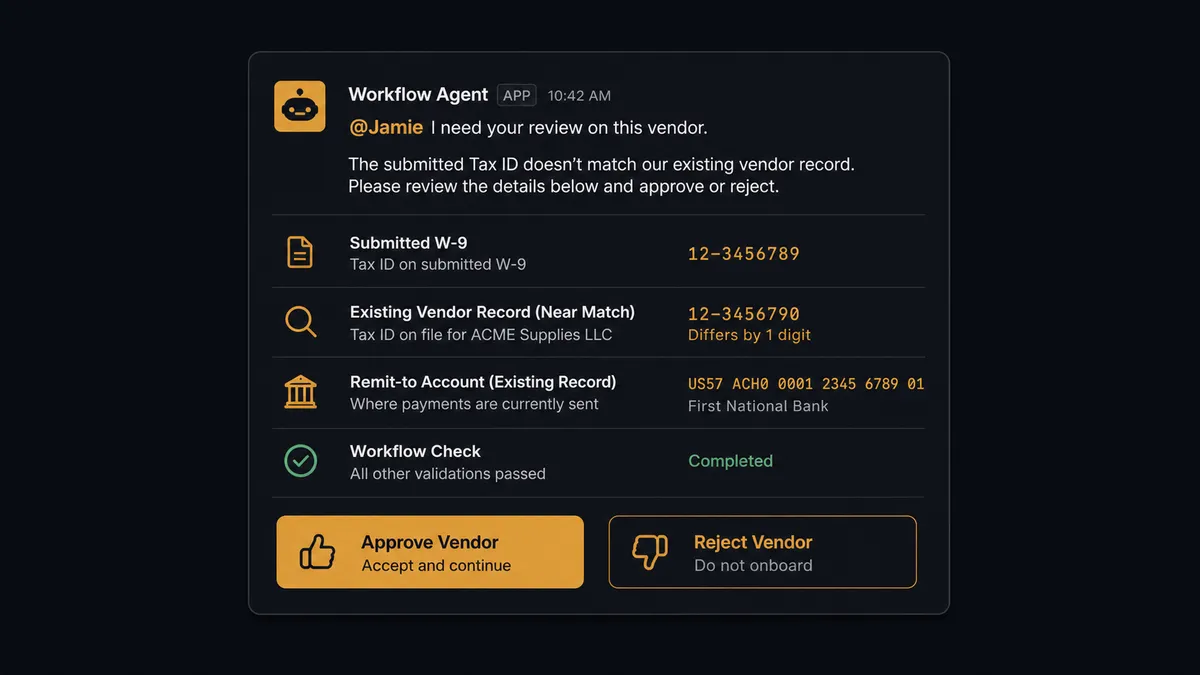
Step five is the whole point. FlowRunner’s agents invoke a human as a callable tool when they hit uncertainty, not as a status that fires on every threshold breach. The human does not go to the work. The work, with its context already assembled, comes to the human in the channel they already use. This is the same shape documented in vendor validation against Acumatica before bill creation and cross-referencing vendor history in NetSuite, and it is the difference our prospects describe as a digital andon cord: the line stops itself when the agent hits something it should not decide alone.
The seam this exposes is the one worth naming. A suite owns the front door and asks the rest of your stack to come inside. But vendor data does not live in one place for most teams. It lives in the ERP, the AP system, a parser, a contract tool, and a shared inbox, and the onboarding decision has to reconcile across all of them. That reconciliation, and the human judgment threaded through it, is not a feature any single system of record will ever fully own. It is a layer above them. A system that listens for what those tools emit, assembles the context a static approval rule never had, and pulls a named human in at the moments that need a decision. That layer is the category. FlowRunner is built for it. Coupa, by design, is built to be the system you bring the work into, not the layer that coordinates the systems you keep.
Connectors in thirty minutes, governance a procurement director can authorize
Two practical choices separate FlowRunner from the suite model, and both matter to a team that has been told to ship an onboarding workflow this quarter.
The first is connector velocity. FlowRunner’s Agent Factory lets an operations person compose a workflow that combines a parser, an ERP write, a screening call, a Slack approval, and an audit trail without filing an engineering ticket. When the workflow needs to reach a system the catalog does not already cover, a new connector is built in roughly thirty minutes. The bar to add a new exception path is low enough that the process evolves as your vendor mix evolves, instead of waiting on a partner-ecosystem release cycle or an implementation milestone. Coupa’s App Marketplace is broad and pre-certified, which is a real strength for teams that want partner-supported integrations they do not maintain. FlowRunner’s bet is different: build the exact connector you need, fast, and own it.
The second is published pricing across the stack. FlowRunner’s core platform (AI agents, all integrations, human-in-the-loop across email, Slack, WhatsApp, and phone, unlimited users and workflows) is available from the Free plan up, with the Growth tier at $45 per month as the production anchor. Teams that need governance tooling step up to the Professional tier at $299 per month for audit trails and role-based access control. SSO and SAML sit one tier up at Business ($999 per month). The framing matters and I will keep it honest: $45 buys the platform that does the onboarding job, $299 adds the governance overlay a mid-market procurement operation typically wants when audit trails become a real requirement, and SSO is a Business-tier line item. None of this buys a native supplier risk engine, and none of it is a claim of certification against any named compliance framework. Coupa’s pricing is enterprise, quoted through sales, scoped to the modules and spend volume you license. These are not the same kind of purchase, and a buyer should not pretend they are. What FlowRunner offers is a platform a director can start using directly, and a governance step they can authorize directly when they need it, neither requiring an enterprise procurement cycle.
Where FlowRunner is the stronger fit
Choose FlowRunner when:
- Your vendor onboarding work lives across email, a parser, Slack, the ERP (NetSuite, Acumatica, QuickBooks Online, or others), and a contract repository, and the coordination across those systems is the actual bottleneck.
- You are not trying to consolidate your entire spend stack onto one suite, and adopting a full BSM platform to fix an onboarding workflow would mean buying a much larger problem than the one you have.
- You need a procurement coordinator or ops analyst to build and adjust exception paths without waiting on engineering or a partner release cycle.
- You want intelligent human-in-the-loop where agents pause and route to a named reviewer with full context, rather than every threshold breach surfacing as a status in a queue someone has to go check.
- You want a published-pricing path you can authorize directly: the core platform at Growth ($45/mo) for the onboarding workflow itself, with the option to step up to Professional ($299/mo) for audit trails and RBAC when governance becomes a real requirement, and Business ($999/mo) for SSO and SAML, rather than an enterprise contract.
- You see AI agents arriving in your stack from multiple vendors (extraction agents, supplier-side AI, approval bots) and you want a coordination layer above them before that fragmentation becomes its own problem.
The two products can also coexist. A team standardizing the regulated core of its spend on Coupa can still use an orchestration layer for the onboarding edges that touch systems outside the suite: a niche parser, a legacy ERP Coupa is not the system of record for, a Slack-based approval the procurement team actually lives in. The structured spend management flows through Coupa. The cross-system coordination flows through FlowRunner with the context already attached.
How to decide: walk your last three exceptions
Skip the feature grid. Do this instead.
Pull the last three vendor onboardings that actually consumed your team’s time. Not the clean ones. The ones that stalled. For each, answer two things.
Where did the work happen? If the honest answer is “inside one platform, against data that platform already held,” you are describing the suite case, and a unified spend management platform like Coupa is the natural home for it. If the answer is “across a shared inbox, a parser, two Slack threads, a contract envelope, and three exports from the ERP before anyone could approve the record,” you are describing the orchestration case, and the question becomes which orchestration product to buy.
What did the exception actually need? If it needed turnkey sanctions and third-party risk screening inside one suite, Coupa’s native risk module is a real advantage and you should weight it. If it needed a named human pulled into the decision with the full context assembled, fast, in the channel they already work in, that is the work an orchestration layer is built to absorb.
Most mid-market procurement teams will find their painful onboardings lived across systems and their exceptions needed judgment more than they needed another screening checkbox. For those teams the comparison resolves toward FlowRunner, not because it wins on every axis (it does not, and Coupa’s suite depth, native risk screening, and ecosystem maturity are genuine advantages where they apply) but because the decision is a scope decision before it is a feature decision. A separate framework on how to evaluate which procurement workflows are worth automating handles the financial side once you know which case you are in.
Quick answers
Is FlowRunner a replacement for Coupa?
No, and we do not position it that way. Coupa is a Business Spend Management suite that spans sourcing, procurement, invoicing, expenses, payments, and supplier risk. FlowRunner is an orchestration layer that coordinates work across the systems you already run. They overlap only on the vendor onboarding workflow. If you need a unified spend management platform, Coupa is the right shortlist. If you want to orchestrate onboarding across an ERP, a parser, a contract tool, and Slack without consolidating onto a new suite, that is the FlowRunner case.
Does FlowRunner do sanctions screening and supplier risk scoring like Coupa?
Coupa has native third-party risk and sanctions screening built into its supplier management module, covering domains like OFAC, InfoSec, and ABAC inside one platform. FlowRunner does not ship a native risk-scoring engine. It orchestrates screening by calling the screening service or data source you choose as a step in the workflow, then routes a flagged hit to a named human with the context attached. If turnkey native risk scoring inside one suite is a hard requirement, Coupa has the edge there today.
How is FlowRunner priced compared to Coupa?
Coupa pricing is enterprise and quoted through sales, scoped to the modules and spend volume you license. FlowRunner publishes its tiers: the core platform (AI agents, all integrations, human-in-the-loop, unlimited users and workflows) is available from the Free plan up, with the Growth tier at $45 per month as the production anchor. Teams that need governance tooling step up to the Professional tier at $299 per month for audit trails and RBAC, with SSO and SAML at the Business tier ($999 per month). No enterprise procurement cycle is required to access either the platform or the governance overlay. The two are not the same kind of purchase, which is the point of the comparison.