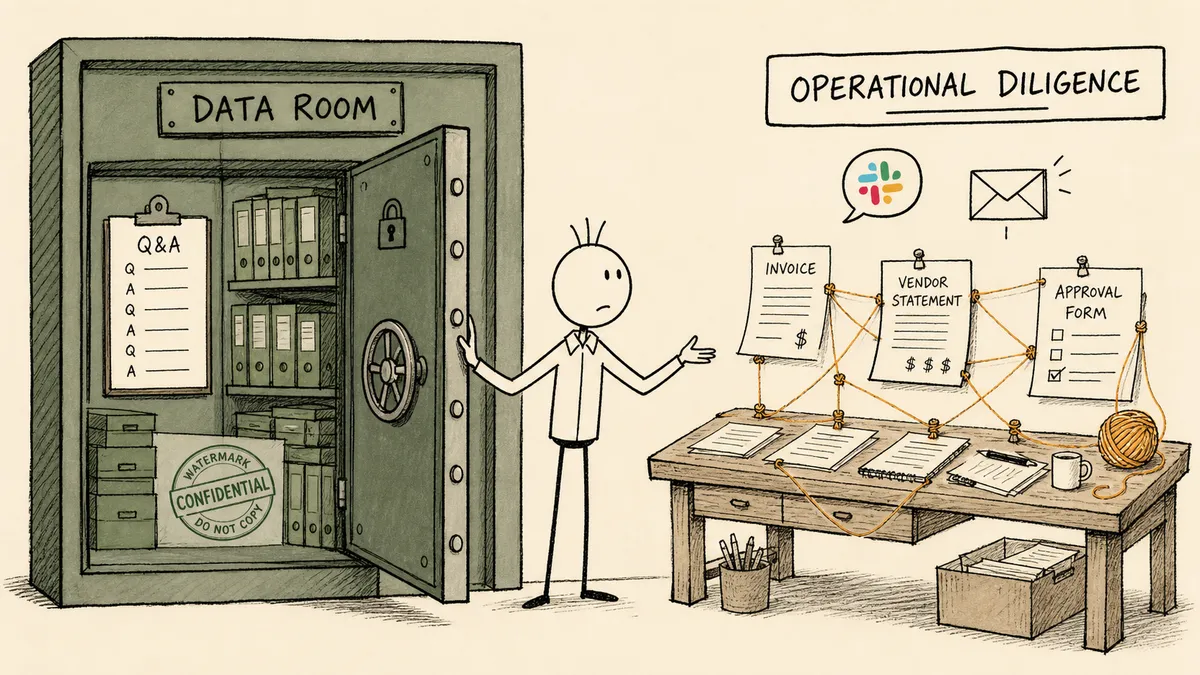
The M&A due diligence checklist is two different documents pretending to be one, and which one you are reading determines whether Datasite or FlowRunner belongs in the answer. If your checklist is the deal team’s diligence index, governing document review across a live sell-side or buy-side transaction, Datasite is the right home for it and FlowRunner is not trying to replace that. If your checklist is the CFO’s operational diligence ledger, governing the financial reconciliation, vendor billing validation, and internal approval-chasing that has to clear before the deal team’s items can be marked done, that work lives outside the data room entirely and a general-purpose orchestration layer fits it better than a VDR ever will.
Most articles on the M&A due diligence checklist do not distinguish between those two documents. This one does.
Side by side, at a glance
| Datasite | FlowRunner | |
|---|---|---|
| Category | Virtual data room for M&A dealmaking | Orchestration layer for work and AI agents across business operations |
| Primary job | Secure the documents, manage Q&A, govern access across the deal lifecycle | Coordinate the financial reconciliation, vendor billing validation, and approval-chasing happening around the deal |
| Built for | Investment banks, law firms, private equity, corporate dev teams running M&A transactions | Operations and finance leaders running cross-system workflows (including the operational layer of diligence) |
| Document permissioning and redaction | Granular permissioning, AI-powered redaction, watermarking, all native to the product | Not a VDR feature; FlowRunner does not replicate this |
| Q&A management | Structured Q&A workflow purpose-built for diligence | Not offered as a deal-room feature |
| AI inside the workflow | Embedded AI for redaction, summarization, semantic search, citation-backed answers; MCP server with Claude, ChatGPT, Copilot, and Blueflame AI working directly inside the deal | AI agents that coordinate work across tools, with human-in-the-loop as a callable action when judgment is required |
| Deal lifecycle coverage | Pipeline, Outreach, Prepare, Diligence, Acquire, Archive | Out of scope; FlowRunner does not address the deal lifecycle as a domain |
| Operational diligence work (financial reconciliation, vendor reconciliation, internal approval-chasing) | Out of scope by design; the data room governs documents, not the reconciliation work feeding them | Native fit: workflows trigger across email, ERP, Slack, parsers, and approvals with full audit trail |
| Track record in regulated financial transactions | Established over many completed deals with investment banks, law firms, and private equity | None comparable; FlowRunner is not the right venue for a live transaction |
| Mobile and offline | Full mobile app, offline document access, translation across 17 languages | No mobile-first deal interface; designed as a coordination layer for back-office work |
| Governance pricing | Enterprise pricing; not publicly listed | Audit trails, RBAC, and SSO at the Professional tier ($299/mo) |
The table tells most of the story. The rest of this article is the part the table cannot.
What Datasite is, said in their words
Datasite describes itself as “the digital home of M&A” and positions the platform as “today’s data room, tomorrow’s deal platform.” The product line maps to the full deal arc: Pipeline for opportunity capture, Outreach for deal marketing, Prepare for transaction readiness, Diligence as the premier sell-side data room, Acquire as the buy-side data room, and Archive for post-close preservation. That is not marketing framing for FlowRunner to argue with. It is an accurate description of what Datasite has built over years of serving the dealmaking community.
The depth that comes with that scope is real. Granular document permissioning. AI-powered redaction. Structured Q&A management with role-based visibility. Watermarking and access logging built into the core product. A SOC 2 Type II posture and a policy that deal data is not used to train external AI models. Embedded AI capabilities including document summarization, semantic search, and citation-backed answers inside the room. A continuous-delivery release model that ships new features without downtime. A mobile app that handles deal work in the field, with translation across 17 languages and an App Marketplace for deal-specific extensions.
Datasite recently announced an MCP server that, in their own words, “lets Claude, ChatGPT, Microsoft Copilot, and Blueflame AI work directly inside the deal, setting up rooms, drafting Q&A, and surfacing diligence answers, all without a single document leaving the most trusted environment in M&A.” That is a serious product announcement, and it is not a feature gap on FlowRunner’s side. It is a category Datasite owns and FlowRunner is not competing for.
Said honestly: for a deal team running a live sell-side or buy-side transaction, those capabilities are not nice-to-have. They are the product. A general-purpose orchestration layer with no VDR primitives is the wrong tool for that job, and recommending FlowRunner for it would be irresponsible.
This article is not making that recommendation.
The seam: the M&A due diligence checklist is two documents
Here is what most posts on the M&A due diligence checklist will not say plainly: the document hiding behind that phrase looks different depending on who is holding it.
For the deal team (investment banker, M&A lawyer, PE associate), the checklist is a diligence index. Hundreds or thousands of line items mapped to documents that need to be requested, uploaded, reviewed, redlined, and signed off. The work shape is document-centric. The bottleneck is access, permissions, redaction, Q&A turnaround, and version control. That is a data room problem, and Datasite has spent years optimizing for it.
For the operating finance leader (CFO, VP Finance, fractional CFO, head of an accounting roll-up), the checklist is something else. It is a reconciliation ledger. The line items are: tie the trailing-twelve-month revenue figure to actual customer payments, validate distributor billbacks against shipped goods, confirm the AP queue has no duplicate vendor records, verify there is no outstanding tax exposure in states the seller forgot to register in, run client onboarding for the acquired book before close, chase internal approvers for sign-off on the closing schedule. The work shape is data-centric and people-centric, not document-centric. The bottleneck is rarely document access. The bottleneck is that the systems do not agree, the vendor master is dirty, the approver is on a plane, and the email chain has scattered across four inboxes.
The deal team’s checklist and the finance leader’s checklist nominally share a name. They live in different work, get done by different people, run on different systems, and fail in different ways. The article that crowns a single product as “the answer for the M&A due diligence checklist” has skipped that distinction. Most do.
Where Datasite is the right home for the checklist
If your version of the checklist is the deal team’s diligence index, choose Datasite (and probably not FlowRunner as a substitute for it) when:
- The transaction is a live sell-side or buy-side deal where multiple bidders, advisors, or counterparties need governed access to the same document set
- Document permissioning, watermarking, redaction, and structured Q&A are core to how the diligence runs
- Investment banks, law firms, or private equity counterparties are involved and the brand recognition of the data room matters to them
- The deal team needs AI capabilities purpose-built for diligence (summarization, semantic search, citation-backed answers) operating directly on the document set without data leaving the environment
- The transaction will eventually move to archival and the same vendor handling diligence should preserve the project record post-close
- Mobile access, offline document review, or multi-language translation across deal participants is part of the workflow
- The full deal lifecycle (sourcing, outreach, prepare, diligence, acquire, archive) is in scope and a single integrated platform is the right shape for it
That set of conditions describes a real and common M&A engagement. If it describes yours, the right answer is Datasite or a peer VDR, and an orchestration layer is the wrong shape for that work. FlowRunner is not asking deal teams to bet a live transaction on a platform without a track record in regulated financial transactions, and it would be dishonest of this article to suggest otherwise.
Where FlowRunner is the right home for the checklist
For the operating finance leader’s version, the calculus is different. If your version of the checklist is a reconciliation ledger where the line items are financial and operational rather than document-centric, the data room is the wrong center of gravity. Most of the work is happening before any document gets uploaded, or after it has already cleared the room.
This is the version of the checklist that finance leaders we have talked to describe most often. The CFO running diligence on an acquired accounting practice, where the work is verifying client-by-client revenue, sorting out duplicate vendor records between the two AP queues, and chasing partners for approvals on closing schedules. The fractional CFO running diligence on a family office acquisition, where the checklist is mostly verifying the books and there is no investment bank involved. The accounting roll-up doing its fifth bolt-on, where the diligence checklist is a known template and the work is execution against it, not negotiation of it. The mid-market operating buyer doing a small-bolt-on where the deal team is a partner at a regional law firm and a CFO running point, not a bulge bracket and a Big Four.
In conversations with finance leaders, three operational gaps surface over and over during a live deal, and a virtual data room cannot fix any of them by design:
- Diligence items falling through the cracks near close. The partner at one accounting firm described it plainly in a recent conversation: there are probably things that should happen during the diligence process that just plain do not, that fall through the cracks. The data room knows whether a document was uploaded. It does not know whether the financial reconciliation underneath that document was actually completed, or whether an approver answered the email asking them to confirm a number.
- Vendor or distributor billing errors creating double-payment risk during the transition. A CFO in a recent conversation said it would be very easy to double pay on a distributor invoice when both parties were mid-handoff and both AP queues were live. That is not a document problem. It is a workflow problem between two ERPs that do not know each other exist yet.
- Manual reconciliation between systems that should agree but don’t. The two finance stacks (charts of accounts, vendor masters, customer masters, sales tax setups) have to be made to agree before the diligence numbers can even be trusted. Most of that work is happening in spreadsheets and inboxes, not in the deal room.
FlowRunner is built for that operational layer. A workflow triggers when a parsed vendor invoice arrives, gathers context across the seller’s ERP and the buyer’s ERP, attempts the mechanical part of the reconciliation, and pauses to ask a human reviewer when the match is ambiguous. A different workflow runs the approval chase: the closing schedule lands in front of the CFO, the named approvers get a Slack message with the specific question and full context attached, the response is captured against the source record, and the audit trail spans the whole motion. A third workflow handles client intake for the acquired book, parsing the existing client list into the buyer’s onboarding system with exceptions routed to the operator when records are incomplete.
This is the same pattern documented in the post-M&A integration checklist for the CFO running the combined finance function, and the vendor reconciliation work that surfaces in distributor billback management. The work shape is the same on both sides of close. Pre-close it shows up as diligence items the data room cannot enforce. Post-close it shows up as integration items the data room is no longer part of.
The category that owns the operational layer of diligence is orchestration as a service: a system above the systems of record that listens for what they emit, gathers the context a checklist row needs to be true, asks a named human when the data alone cannot resolve the question, and writes a single audit trail across the financial reconciliation work that the data room was never designed to own. FlowRunner is built for that layer. Datasite is built for the document and Q&A workflow that sits inside the deal room itself. They are different jobs on opposite sides of the same checklist.
Where Datasite is stronger and FlowRunner is not trying to compete
This section names the axes plainly. The depth here is real and the comparison is only honest if FlowRunner’s limitations get the same plain treatment Datasite’s strengths do.
- M&A domain depth. Datasite has built years of deal-specific workflow logic, structured Q&A management, granular document permissioning, AI-powered redaction, and watermarking into the core product. FlowRunner does not match this depth for live deal teams and is not pursuing it. Recommending FlowRunner as a substitute for the data room is the wrong recommendation.
- Brand recognition and track record in regulated financial transactions. Datasite has accumulated trust with investment banks, law firms, and private equity firms over many completed deals. That trust has commercial weight. FlowRunner has no comparable track record in this category and is not asking buyers to take it on faith.
- Deal-specific feature breadth. A full mobile app with offline capabilities, document translation across 17 languages, the App Marketplace, and the embedded AI feature set built specifically for M&A (Blueflame AI Q&A, citation-backed answers, semantic search across the deal corpus). These are scope choices that reflect Datasite serving the dealmaking community as its primary buyer. FlowRunner does not offer them and does not intend to compete on them.
- Compliance posture for live transactions. Datasite’s SOC 2 Type II attestation and the explicit policy that deal data is not used to train external AI models are the kind of substantiated compliance claims a deal team needs to see before uploading sensitive materials. FlowRunner has audit-trail, RBAC, and SSO infrastructure at mid-market pricing, but does not currently make the specific compliance-framework claims appropriate for sell-side dealmaking. Use the right tool for the right level of regulated exposure.
If those axes are decisive for your version of the checklist, the conclusion is straightforward. Use Datasite. The rest of this article is interesting context but not actionable.
Where FlowRunner is the better fit and Datasite is not the right shape
Symmetrically, on the operational side of the same checklist:
- Coordination across the seller’s and buyer’s systems that touch the diligence work. Vendor master reconciliation, distributor billback validation, customer-credit inventory, approval routing, manual reconciliation steps that should be running once and ending up in an audit trail. FlowRunner’s orchestration substrate is broad and extensible (Stripe, QuickBooks Online, Acumatica, NetSuite, Slack, email, WhatsApp, parser services, and most of what a mid-market finance stack runs). New connectors take 30 minutes or less when the catalog does not already cover what the team needs.
- Human-in-the-loop as a callable action, not an approval gate at the end of a workflow. When an agent encounters an ambiguous vendor match or a closing-schedule line that does not tie, it pauses, asks a named reviewer via the channel they actually read (Slack, email, WhatsApp, phone) with full context attached, and resumes when the response is captured. This is the difference between AI automation and AI agents made operational. The data room’s approval mechanism is a legitimate control for document workflow; it is not built for ambiguous reconciliation decisions on data the room does not own.
- A visual builder for non-developers. A controller or operations analyst can compose a diligence-period workflow that combines a parser, an ERP read, a Slack approval, and an audit-trail entry without filing an engineering ticket. The article on building automations that hold up in production covers the engineering discipline this needs to actually survive contact with a real deal calendar.
- Mid-market governance pricing. Audit trails, RBAC, and SSO at $299 per month on the Professional tier. The framing matters: this article is not claiming auditor acceptance of any specific compliance framework. It is claiming the governance infrastructure for operational diligence work exists at a price a CFO or fractional CFO can authorize without an enterprise procurement cycle. Specific framework attestations are separate conversations and would be misleading to claim here.
- Audience fit for the operating finance leader. The fractional CFO running diligence on an accounting bolt-on. The CFO at a roll-up doing its fifth acquisition this year. The mid-market operating buyer whose checklist is mostly financial and operational. The family office CFO doing diligence in-house. None of those buyers are running a Datasite-scale deal room, and most of them never will. The work they have is real, and the orchestration layer is the shape that fits it.
How to decide
Two questions, with the order intentional.
1. Whose checklist are you actually running? Walk through the last five line items on your version of the M&A due diligence checklist. For each one, name what the work actually is. If the answer is “request a document, get it uploaded, review it for redlines, send a Q&A back, sign off,” that is data room work and the question is which VDR to choose. Datasite or a peer. If the answer is “tie this number to that system, validate the vendor master, chase the partner for approval, run client intake on the acquired book, reconcile the closing schedule,” that is operational work and the question is which orchestration layer to choose. FlowRunner or a peer. Most live transactions in the mid-market have both. The deal team’s checklist runs in the VDR. The finance leader’s checklist runs around it.
2. Where is the work falling through today? If items are slipping because documents are not getting uploaded, getting redacted incorrectly, or getting answered in Q&A out of sequence, the gap is in the data room workflow and a better VDR will close it. If items are slipping because numbers are not getting reconciled, approvers are not responding, vendor records are not getting cleaned up, and the closing schedule is held together by a spreadsheet and a partner’s memory, the gap is in the operational layer and a better data room will not touch it. The honest read is that the second kind of gap is what finance leaders bring up most often when asked what consumed their last deal cycle.
Most mid-market M&A engagements will end up using both kinds of tool, in different work, run by different people. Datasite (or a peer VDR) for the document side, including the diligence index, the Q&A workflow, and the deal-team artifacts. An orchestration layer for the financial reconciliation, vendor master cleanup, internal approval chase, and the integration work that begins the moment the deal closes. That is not a hedged answer. It is the honest one, and it is the structural reality on the buyer side of most deals that are not bulge-bracket M&A.
Quick answers
Is FlowRunner a replacement for Datasite?
No. Datasite is a virtual data room purpose-built for M&A dealmaking, with document permissioning, AI-powered redaction, Q&A management, and a track record across many completed transactions. FlowRunner is an orchestration layer for general business operations. A live sell-side or buy-side transaction belongs in a data room, not in FlowRunner.
Where does FlowRunner fit if the diligence checklist still has Datasite running the deal room?
FlowRunner handles the operational diligence work that lives outside the data room: vendor billing validation, distributor billback reconciliation, internal approval-chasing, and the financial reconciliations that need to clear before the checklist can mark items done. The data room owns the documents; the orchestration layer owns the work around them.
Who is FlowRunner the right answer for instead of Datasite?
Finance leaders running diligence as part of an accounting roll-up, family office acquisition, or mid-market deal where most of the checklist is financial reconciliation, vendor reconciliation, client intake, and chasing internal approvals rather than VDR-resident document review. The deal is real; the document load is not what’s holding up close.