How to Connect Typeform with Canny (With or Without an AI Agent)
Connect Typeform survey responses to Canny boards, optionally as an AI agent that turns open-text answers into deduped votes and comments and pauses for a human before a new post reaches the public board.
How do you connect Typeform to Canny?
You connect Typeform to Canny by running a scheduled workflow that pulls new submissions with Get Form Responses, reads the open-text answers, searches Canny for a matching request with List Posts, and then either records the respondent’s voice on an existing post with Create Vote and Create Comment or raises a new request with Create Post. FlowRunner is a visual AI-agent orchestration platform where automations run autonomously and pause for human judgment on the steps that carry real consequence. Run as an AI agent, the connection reads what each respondent actually meant, consolidates duplicates on its own, and stops for a product owner before anything new is published on the customer-visible board.
The problem it solves
Surveys are where product feedback goes to pile up. The NPS survey has a “what would make this better” box. The churn survey asks “what was missing.” The in-app feedback form collects everything else. Each of those Typeforms fills with open-text answers, and the plan is that someone will read the export and move the real requests into Canny. That someone is a product ops person with a CSV, a second monitor showing Canny search, and an afternoon that was supposed to be spent on the roadmap.
What breaks is not the happy path, it is the texture of real answers. “Honestly the reporting is weak” is a feature request wearing a complaint’s clothes. Three respondents describe the same export limitation in three vocabularies, and manual triage files them as three thin requests instead of one strong one. Low-signal answers (“all good!”) waste triage time, while the one paragraph that explains exactly why a segment churns gets skimmed at 4pm on a Friday. The result is a Canny board that undercounts demand and a survey program whose best content never reaches the people prioritizing the roadmap.
How it works: the connection
Typeform exposes no event triggers, so the workflow opens on a schedule rather than a submission event. Here is the plain version, grounded in the real connector actions.
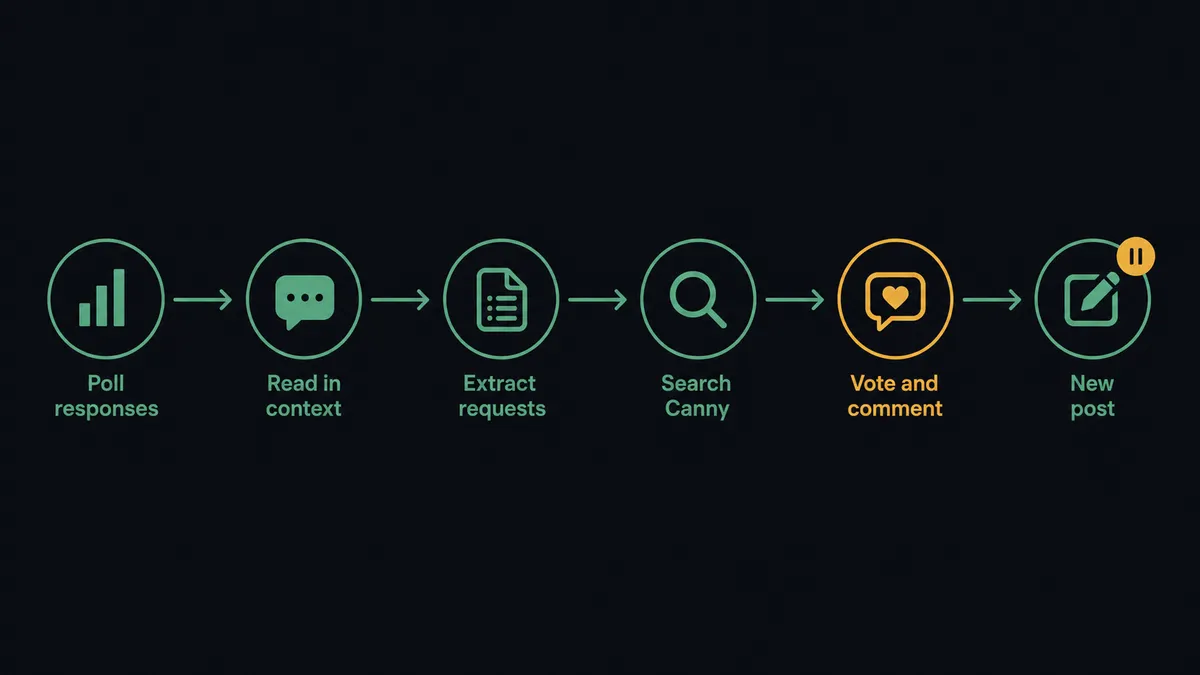
- Trigger: On a schedule, the workflow calls Get Form Responses for each feedback form, every 15 minutes.
- Read: Get Form supplies the question structure so each answer is read in context, not as a bare string.
- Extract: The workflow identifies which answers contain actual product requests and which are sentiment-only.
- Search: List Boards and List Posts search Canny for an existing post that covers the same request.
- Log the match: List Users resolves the respondent, then Create Vote and Create Comment record their vote and their exact words on the existing post.
- Raise the new ones: When nothing matches, Create Post opens a new request on the right board, quoting the answer as the detail.
That is the “just connect them” answer. Every survey cycle feeds the board within minutes of submission, votes consolidate instead of fragmenting, and nobody reads a CSV again.
Can an AI agent run it? (and why a human stays in the loop)
Yes, and open-text answers are precisely where an agent earns its keep. A rules engine can move structured fields; it cannot tell that “I gave up trying to get data out of this thing” and “please add scheduled CSV exports” belong on the same Canny post. The agent reads each response, extracts the request from around the sentiment, and holds List Posts, Create Vote, Create Comment, and Create Post as tools, choosing per answer. Voting and commenting on existing posts runs autonomously, because adding a respondent’s voice to an existing thread is low-consequence.
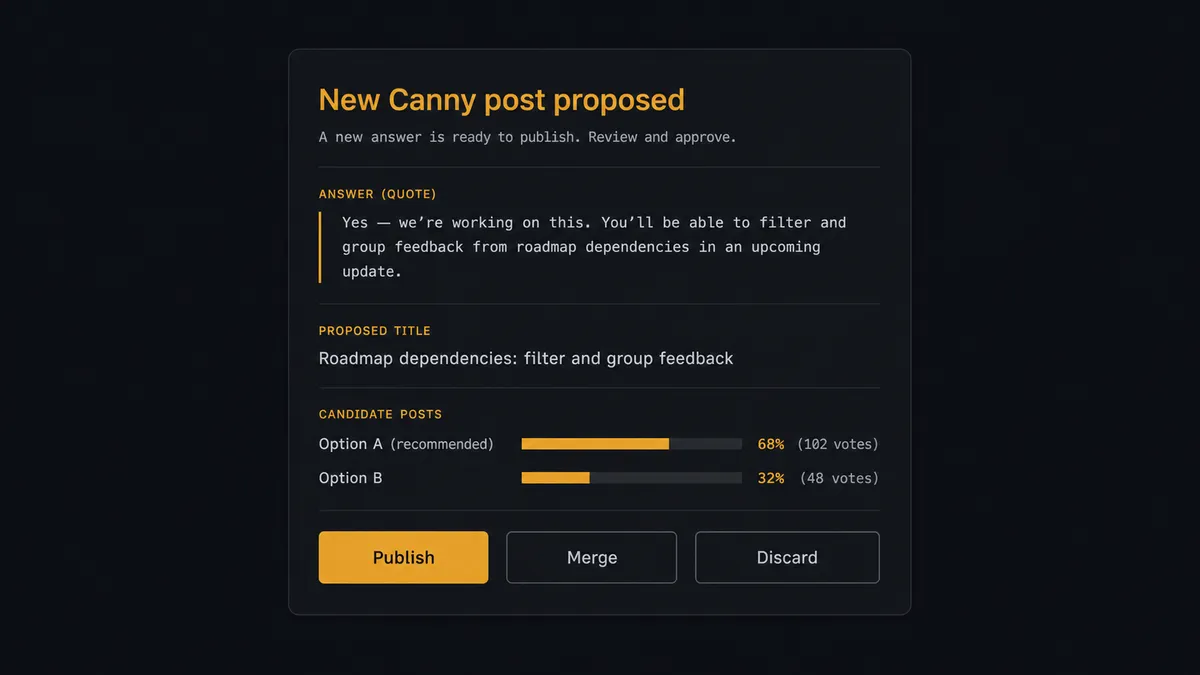
Create Post is the consequential step. A new post is public, customer-visible content that shapes what every other customer votes on, and it is about to be built from a stranger’s raw wording. So the agent invokes a human-in-loop flow it holds as a callable tool. The workflow pauses and posts to the product channel: “Response from [respondent] on [form name] does not match any existing post. Raw answer: [quote]. Proposed title: [title]. Closest posts: [two candidates]. Publish, merge, or discard?” A product owner clicks once, and only then does Create Post run. The decision, the owner’s name, and the timestamp land in the audit trail.
The escalation is contextual, not threshold-based. A vague answer that resembles an existing post gets merged without ceremony. A detailed answer from a churned enterprise respondent that matches nothing gets pulled to a human even though a keyword filter would have dropped it. Prospects call this a digital andon cord: like Toyota’s quality control pull cord, the workflow stops the line the moment it hits uncertainty, and your team pulls it back into motion.
FlowRunner vs n8n
Engineering-led teams often look at n8n for this, with reason. n8n’s node library and raw HTTP flexibility can reach every corner of the Typeform and Canny APIs, its community has thousands of templates, and its self-hosting model is genuinely strong for teams that want the workflow on their own infrastructure and have the developers to run it.
The gap shows up in who owns the pipeline. In n8n, the extraction logic, the dedupe matching, and any approval step are engineering artifacts: a developer builds them, and a developer is on the hook when a form changes. In FlowRunner, the agent’s reasoning and the pre-publish human gate are native, and the person who owns the survey program can own the automation too.
| What matters for this pair | FlowRunner | n8n |
|---|---|---|
| Human-in-the-loop on Create Post | Native. The agent pauses and invokes an approval flow as a callable tool before publishing | Buildable with wait nodes and webhooks a developer wires and maintains |
| Who runs the flow | An AI agent reads answers, reasons, picks actions as tools | A node graph a technical user designs and maintains |
| Users included | Unlimited users on every tier | Cloud plans price by executions; collaboration varies by plan |
| Bring your own AI keys | Yes, BYOK | Yes, via its AI nodes |
| Self-hosted option | Yes, cloud-hosted or self-hosted | Yes, a core strength |
| Pricing model | Transparent workflow-based tiers | Execution-based cloud pricing, or self-host infrastructure you operate |
If your automation stack is developer-owned and you want maximum API-level control, n8n is a credible choice. If you want product ops to run survey-to-board triage themselves, with a named approver on every public post, this pairing on FlowRunner is the better fit.
Before and after
| Category | Before | After |
|---|---|---|
| Response triage | Someone reads a CSV export and re-keys requests into Canny | Every submission is read, extracted, and routed within minutes of arrival |
| Duplicate requests | The same limitation appears as several thin posts with split votes | The agent consolidates matching answers onto one post via Create Vote |
| Signal vs noise | Sentiment-only answers consume the same triage time as detailed requests | Low-signal answers are filtered; detailed requests surface with full context |
| Board integrity | Raw survey wording lands on the public board unreviewed, or not at all | New posts publish only after a product owner approves title and content |
| Roadmap input | Vote counts reflect whoever had time to transfer feedback | Vote counts reflect the full survey volume, so demand is measured, not sampled |
What you can build
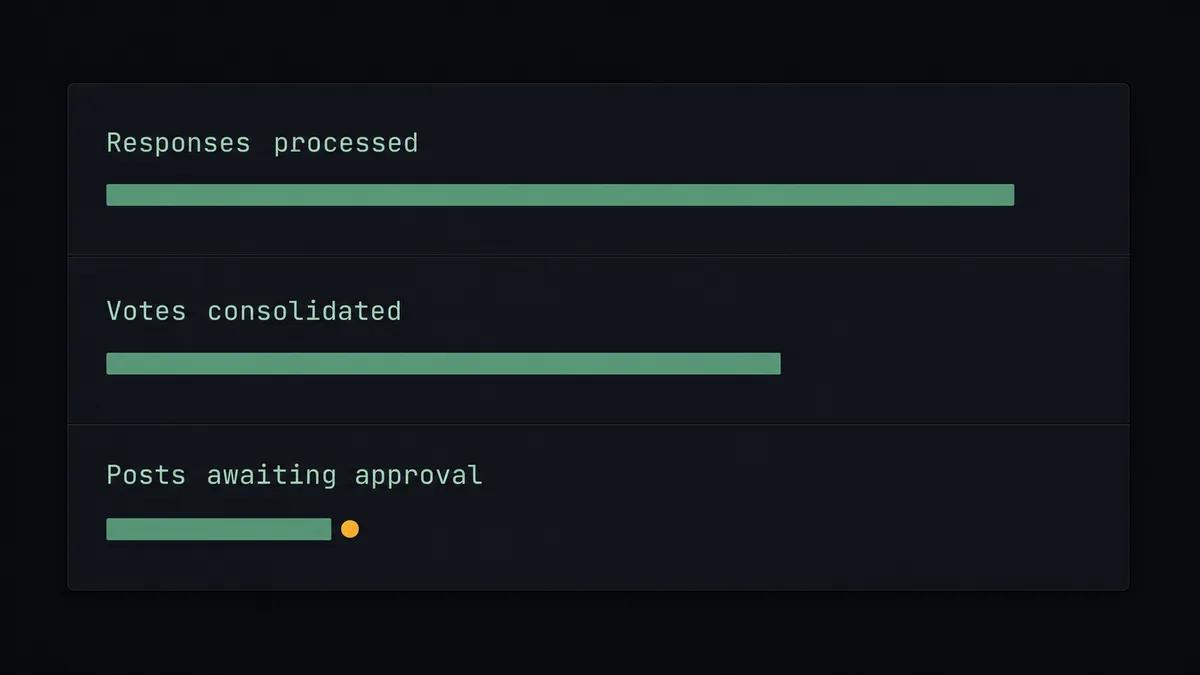
Survey to board, deduped. The scheduled run pulls Get Form Responses, the agent extracts requests from open text, logs matches with Create Vote and Create Comment, and holds new posts for approval before Create Post publishes.
Churn survey escalation lane. Answers from the churn Typeform get priority treatment: the agent quotes the full answer in Create Comment so the product team sees why accounts leave, attached to the exact feature post that would have kept them.
Multi-form feedback router. Get List Forms enumerates every active survey, and one workflow polls them all, routing answers to the right Canny board per product area instead of one catch-all board.
Insight-driven form tuning. The agent reviews Get Form Insights alongside response quality, flags questions with high drop-off that produce low-signal answers, and proposes wording changes a form owner applies with Update Question Options.
Localized feedback intake. For international audiences, Auto-Translate Form produces localized versions of the feedback form, and the agent normalizes responses back to one language before matching them against Canny posts, so votes consolidate across markets.
Common questions
Is it free to connect Typeform and Canny on FlowRunner? You can build and run the connection on FlowRunner’s free plan, which includes 100 executions a month and every integration with no credit card required, and new accounts also get 14 days of Professional. Both connectors are available on every FlowRunner tier, and every tier includes unlimited users and unlimited workflows.
Can I self-host the Typeform to Canny workflow? Yes. FlowRunner offers a cloud-hosted option and a self-hosted option, so the connection can run inside your own environment.
Does the AI agent need my own OpenAI or Claude key? FlowRunner uses a bring-your-own-keys model, so you connect the AI provider key you already have. You are not locked to one model.
What happens when a survey answer does not match any existing Canny post? The agent pauses instead of publishing. It packages the respondent’s raw answer, a proposed post title, and the closest existing posts found with List Posts, then asks a product owner to publish, merge, or discard. Create Post only runs after that approval, because the board is customer-visible.
Which Typeform and Canny actions does this connection use? Typeform has no event triggers, so the workflow runs on a schedule and pulls new submissions with Get Form Responses. It then searches Canny with List Boards and List Posts, and writes with Create Vote, Create Comment, and Create Post, resolving respondents with List Users.
Can it handle multiple feedback forms at once? Yes. Get List Forms enumerates your forms, and the workflow polls Get Form Responses per form, so an NPS survey, a churn survey, and an in-app feedback form all feed the same deduped Canny boards.
Getting started
Start on the free plan: 100 executions a month, every integration included, no credit card required, plus 14 days of Professional for new accounts. Both connectors are available on every tier, and every tier includes unlimited users and unlimited workflows.
Explore the integration details:
- Typeform integration (36 actions covering forms, responses, themes, and workspaces)
- Canny integration (11 actions covering posts, boards, comments, and votes)
Start building free at flowrunner.ai or book a demo to see a live Typeform to Canny workflow, new-post approval and all.
Frequently asked questions
Is it free to connect Typeform and Canny on FlowRunner?
You can build and run the connection on FlowRunner's free plan, which includes 100 executions a month and every integration with no credit card required, and new accounts also get 14 days of Professional. Both connectors are available on every FlowRunner tier, and every tier includes unlimited users and unlimited workflows.
Can I self-host the Typeform to Canny workflow?
Yes. FlowRunner offers a cloud-hosted option and a self-hosted option, so the connection can run inside your own environment.
Does the AI agent need my own OpenAI or Claude key?
FlowRunner uses a bring-your-own-keys model, so you connect the AI provider key you already have. You are not locked to one model.
What happens when a survey answer does not match any existing Canny post?
The agent pauses instead of publishing. It packages the respondent's raw answer, a proposed post title, and the closest existing posts found with List Posts, then asks a product owner to publish, merge, or discard. Create Post only runs after that approval, because the board is customer-visible.
Which Typeform and Canny actions does this connection use?
Typeform has no event triggers, so the workflow runs on a schedule and pulls new submissions with Get Form Responses. It then searches Canny with List Boards and List Posts, and writes with Create Vote, Create Comment, and Create Post, resolving respondents with List Users.
Can it handle multiple feedback forms at once?
Yes. Get List Forms enumerates your forms, and the workflow polls Get Form Responses per form, so an NPS survey, a churn survey, and an in-app feedback form all feed the same deduped Canny boards.