How to Connect HubSpot with Adobe Acrobat Sign (With or Without an AI Agent)
Connect HubSpot deals to Adobe Acrobat Sign so contracts go out the moment a deal reaches the contract stage, with an AI agent that prepares every agreement automatically and pauses for a human before a binding document reaches the customer.
How do you connect HubSpot to Adobe Acrobat Sign?
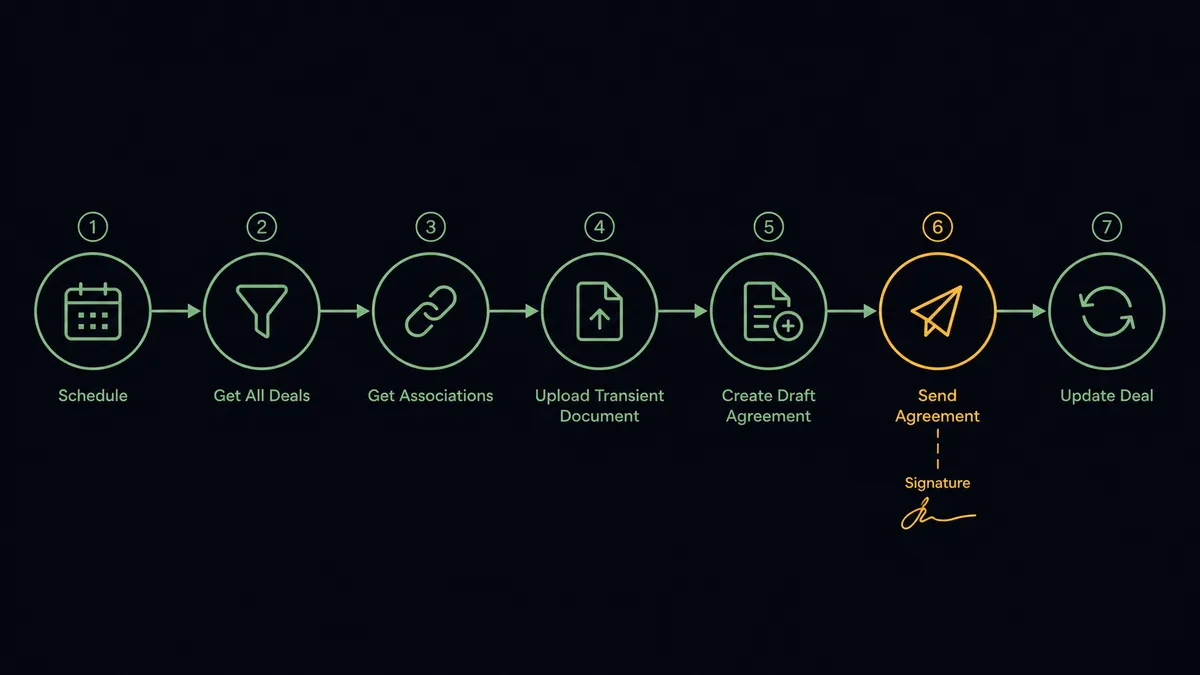
You connect HubSpot to Adobe Acrobat Sign by having a scheduled workflow watch HubSpot with Get All Deals for deals that reached the contract stage, then drive Adobe Acrobat Sign actions: Upload Transient Document stages the contract file, Create Draft Agreement attaches the signers pulled from Get Associations, and Send Agreement puts it in front of the customer, with Update Deal closing the loop when the signature lands. FlowRunner is a visual AI-agent orchestration platform where automations run autonomously and pause for human judgment on the steps that carry real consequence. The same connection can run as an AI agent that prepares every agreement on its own and pauses for a named human before Send Agreement makes it binding.
The problem it solves
Right now the contract step is where deal momentum goes to die. The deal reaches the contract stage in HubSpot, and then someone has to build the actual agreement: find the right template, fill in the entity name and amount from the deal, figure out who signs and in what order, upload it to Adobe Acrobat Sign, and send it. Every hour that takes is an hour the buyer’s enthusiasm cools, and the person doing it is usually juggling five other closing deals.
The edges are legal, not just operational. A contract sent with last quarter’s pricing is not a typo, it is an offer. An agreement addressed to the wrong legal entity has to be cancelled and re-sent, and the buyer’s procurement team notices. A signer list missing the person who actually has authority adds a week of dead time. And after signing, the executed PDF lives in someone’s downloads folder while the HubSpot deal still says “contract sent.” The paper trail that matters most in the whole sales cycle is the one assembled most haphazardly.
How it works: the connection
The connection polls HubSpot and writes to Adobe Acrobat Sign. Here is the plain version, grounded in the real connector actions.
- Trigger: On a schedule, the workflow calls Get All Deals and picks out deals that reached the contract stage since the last run.
- Read: It calls Get Deal By ID for the full deal, then Get Associations, Get Company By ID, and Get Contact By ID to gather the entity and the signers.
- Stage the document: It calls Upload Transient Document to load the contract file into Adobe Acrobat Sign.
- Prepare the agreement: It calls Create Draft Agreement with the document, signer list, and signing order.
- Send: It calls Send Agreement, and the customer receives the signing request.
- Track: It calls Get Agreement and Get Agreement Events to follow progress, and Send Reminder when a signer stalls.
- Close the loop: On completion, it calls Get Form Data, Download Agreement PDF, and Download Audit Trail, then Update Deal so HubSpot reflects the executed contract.
That is the “just connect them” answer. Contract prep stops being an afternoon of copy-paste, reminders send themselves, and the executed document lands where the record lives.
Can an AI agent run it? (and why a human stays in the loop)
Yes, and the agent’s value is that it reads before it sends. A template-filler puts deal fields into slots. An AI agent holds the actions as tools, Upload Transient Document, Create Draft Agreement, Send Agreement, Send Reminder, Cancel Agreement, Get Agreement Events, and reasons about the package as a whole: does the entity on the document match the company on the deal, does the amount match the deal amount, are the signers from Get Associations the people with authority, is the signing order right for this buyer’s procurement process.
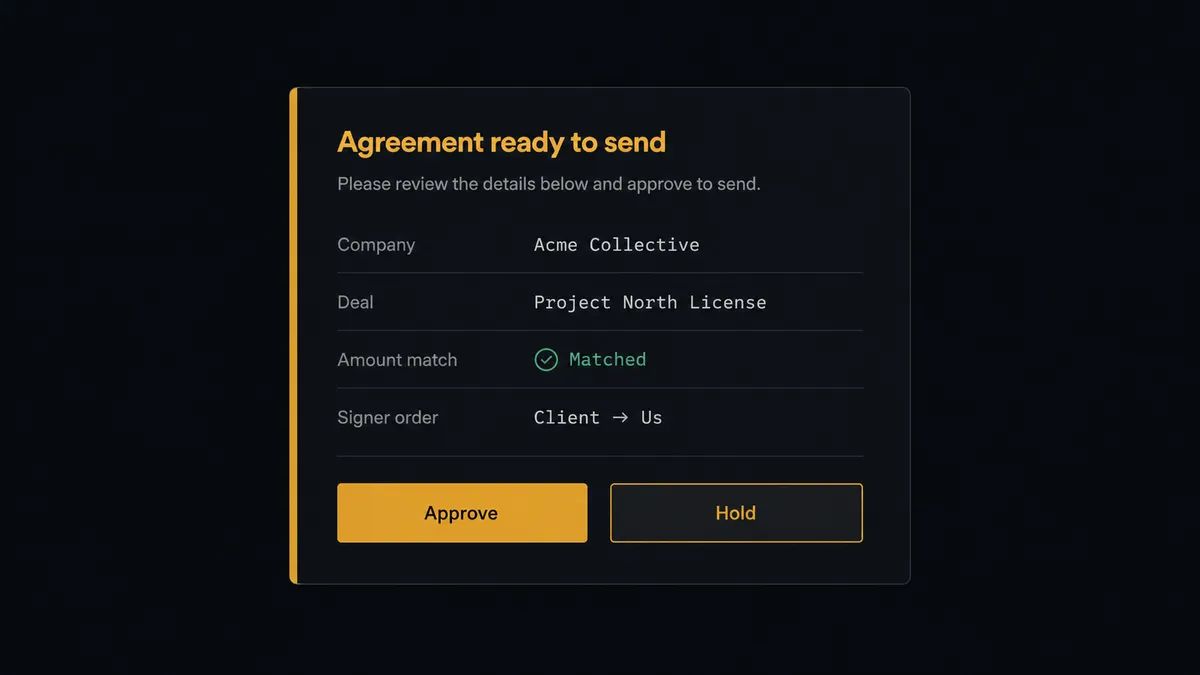
The consequential step is Send Agreement, because a sent contract is an offer you cannot quietly retract. Before it runs, the agent invokes a human-in-loop flow it holds as a callable tool. The workflow pauses and posts to the deal desk channel: “Agreement prepared for [company] on deal [name]. Amount matches the deal record. Signers: [list], in order. Approve to send?” And when something does not reconcile, the message changes: “The document amount differs from the deal amount. Holding until resolved.” A named person approves, edits, or escalates. Only after approval does Send Agreement run, and the decision lands in the audit trail alongside the one Adobe Acrobat Sign itself produces, which the workflow captures with Download Audit Trail once the signature completes.
Prospects call this a digital andon cord: like Toyota’s quality control pull cord, the workflow stops the line the moment the document and the deal disagree, and a person pulls it back into motion. Contract prep runs at machine speed. The binding moment stays human, every time, with a name attached.
FlowRunner vs n8n
Engineering-minded teams evaluate n8n for this connection, and it holds up on its own terms. The node library is deep, community workflows cover plenty of CRM and document patterns, and the fair-code self-hosting model is genuinely good for teams that want the runtime inside their own perimeter. If your builders live in node graphs, n8n gives them real range.
A contract pipeline, though, is judged by its worst send, and the question is what stands between automation and a binding mistake. Here is the honest side-by-side.
| What matters for this pair | FlowRunner | n8n |
|---|---|---|
| Human-in-the-loop on Send Agreement | Native. The agent invokes an approval flow as a callable tool, multi-channel, decision recorded | Buildable with wait and approval wiring you assemble and maintain yourself |
| Who runs the flow | An AI agent reads the deal and document, reasons, and picks actions as tools | A node graph you design; AI agent nodes exist but the builder is developer-oriented |
| Users included | Unlimited users on every tier | Plan-dependent; full RBAC and SSO sit in higher tiers |
| Bring your own AI keys | Yes, BYOK | Yes, n8n also supports your own model keys |
| Self-hosted option | Yes, cloud-hosted or self-hosted | Yes, self-hosting is a core strength |
| Pricing model | Transparent workflow-based tiers; compliance features from the $299/mo Professional tier | Execution-based cloud tiers; full cloud compliance suite is custom-priced Enterprise |
If your engineers want full ownership of the pipeline and will build the approval and audit layer to your legal team’s standard, n8n is a defensible choice. If revenue operations owns the contract flow and needs the send gate, the reconciliation check, and the audit trail working on day one, that is where FlowRunner is the better fit.
Before and after
| Category | Before | After |
|---|---|---|
| Contract prep | An afternoon of template hunting and copy-paste per deal | Upload Transient Document and Create Draft Agreement assemble the package from deal data |
| Error surface | Wrong amounts, entities, and signers caught by the buyer, if at all | The agent reconciles document against deal, and mismatches pause for a person |
| The send decision | Whoever built the contract sends it, unreviewed | Send Agreement runs only after a named approver confirms the package |
| Chasing signatures | Someone remembers to follow up, or does not | Get Agreement Events tracks progress and Send Reminder nudges stalled signers |
| The executed record | Signed PDFs in downloads folders, deals stuck in stale stages | Download Agreement PDF and Download Audit Trail capture the evidence, and Update Deal keeps HubSpot true |
What you can build
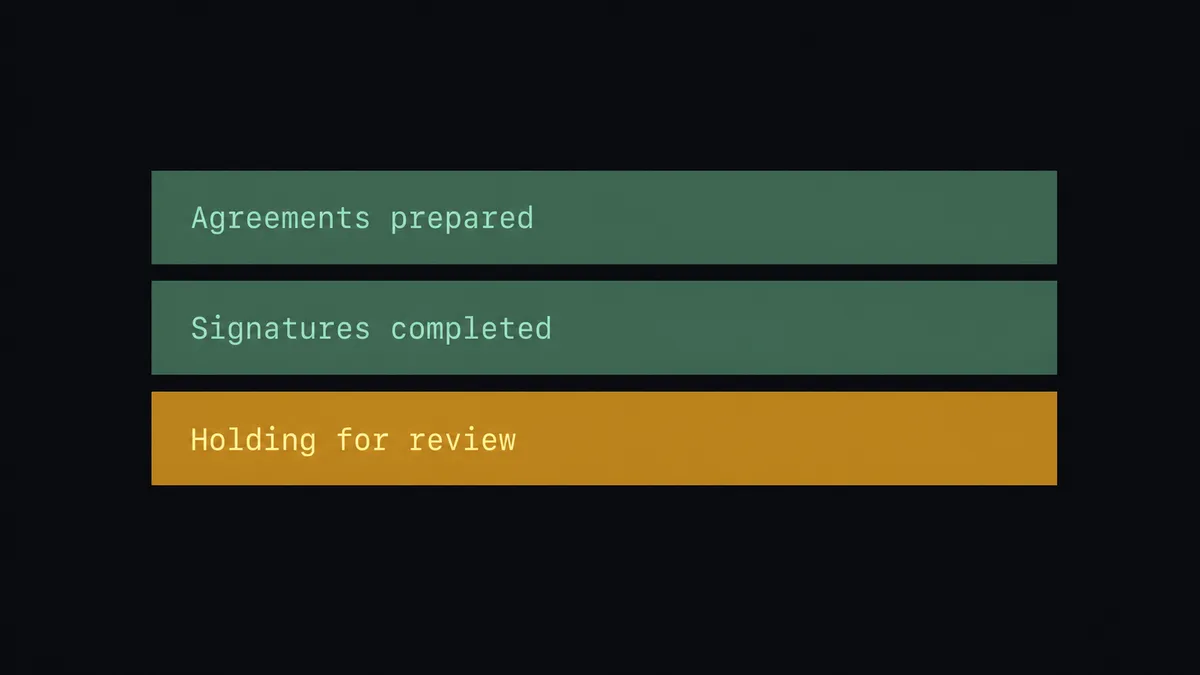
Contract stage to signature request. The scheduled run finds the deal, the agent gathers entity and signers with Get Associations, stages the file with Upload Transient Document, prepares Create Draft Agreement, and queues the gated Send Agreement.
Deal-to-document reconciliation. Before any send, the agent compares the agreement’s amount, entity, and signer list against the deal record, and posts discrepancies to a person instead of shipping them to the customer.
Signature chase without the nagging. Get Agreement Events shows who has not signed. The agent sends Send Reminder on a cadence you set and escalates to the account owner when a signer goes quiet past your threshold.
Executed-contract filing. On completion, the agent pulls Get Form Data, saves Download Agreement PDF and Download Audit Trail, and attaches the outcome to the record with Update Deal, so the deal and the document never drift apart.
Cancellation with a witness. When terms change mid-signature, the agent proposes Cancel Agreement with the reason attached, waits for approval, and then re-runs the prep with the corrected document, keeping the whole sequence in the audit trail.
Common questions
Is it free to connect HubSpot and Adobe Acrobat Sign on FlowRunner? You can build and run the connection on FlowRunner’s free plan, which includes 100 executions a month and every integration with no credit card required, and new accounts also get 14 days of Professional. Both connectors are available on every FlowRunner tier, and every tier includes unlimited users and unlimited workflows.
Can I self-host the HubSpot to Adobe Acrobat Sign workflow? Yes. FlowRunner offers a cloud-hosted option and a self-hosted option, so the connection can run inside your own environment.
Does the AI agent need my own OpenAI or Claude key? FlowRunner uses a bring-your-own-keys model, so you connect the AI provider key you already have. You are not locked to one model, and you control which provider runs the agent.
What happens when the deal record and the contract disagree? Nothing goes out. When the agent finds a mismatch between the deal’s amount, entity, or signer and what the document says, it pauses and posts both versions to your team’s channel. A named person resolves the discrepancy before Send Agreement runs, and the resolution is recorded in the audit trail.
Neither HubSpot nor Adobe Acrobat Sign has a trigger in FlowRunner. How does the workflow start? On a schedule. The workflow polls HubSpot with Get All Deals, compares stages against its last run, and processes any deal that reached the contract stage since. Agreements are prepared within the polling interval you choose.
What happens after the client signs? The workflow tracks progress with Get Agreement and Get Agreement Events, pulls any filled fields with Get Form Data, saves the executed contract with Download Agreement PDF and Download Audit Trail, and calls Update Deal so the HubSpot record reflects the signature the moment it lands.
Getting started
Start on the free plan: 100 executions a month, every integration included, no credit card required, plus 14 days of Professional for new accounts. Both connectors are available on every tier, and every tier includes unlimited users and unlimited workflows, so sales ops, the deal desk, and legal review share one workspace from day one.
Explore the integration details:
- HubSpot integration (21 actions covering contacts, companies, deals, and associations)
- Adobe Acrobat Sign integration (21 actions covering agreements, signing, reminders, and audit trails)
Start building free at flowrunner.ai or book a demo to see a live HubSpot to Adobe Acrobat Sign workflow, send approval and all.
Frequently asked questions
Is it free to connect HubSpot and Adobe Acrobat Sign on FlowRunner?
You can build and run the connection on FlowRunner's free plan, which includes 100 executions a month and every integration with no credit card required, and new accounts also get 14 days of Professional. Both connectors are available on every FlowRunner tier, and every tier includes unlimited users and unlimited workflows.
Can I self-host the HubSpot to Adobe Acrobat Sign workflow?
Yes. FlowRunner offers a cloud-hosted option and a self-hosted option, so the connection can run inside your own environment.
Does the AI agent need my own OpenAI or Claude key?
FlowRunner uses a bring-your-own-keys model, so you connect the AI provider key you already have. You are not locked to one model, and you control which provider runs the agent.
What happens when the deal record and the contract disagree?
Nothing goes out. When the agent finds a mismatch between the deal's amount, entity, or signer and what the document says, it pauses and posts both versions to your team's channel. A named person resolves the discrepancy before Send Agreement runs, and the resolution is recorded in the audit trail.
Neither HubSpot nor Adobe Acrobat Sign has a trigger in FlowRunner. How does the workflow start?
On a schedule. The workflow polls HubSpot with Get All Deals, compares stages against its last run, and processes any deal that reached the contract stage since. Agreements are prepared within the polling interval you choose.
What happens after the client signs?
The workflow tracks progress with Get Agreement and Get Agreement Events, pulls any filled fields with Get Form Data, saves the executed contract with Download Agreement PDF and Download Audit Trail, and calls Update Deal so the HubSpot record reflects the signature the moment it lands.