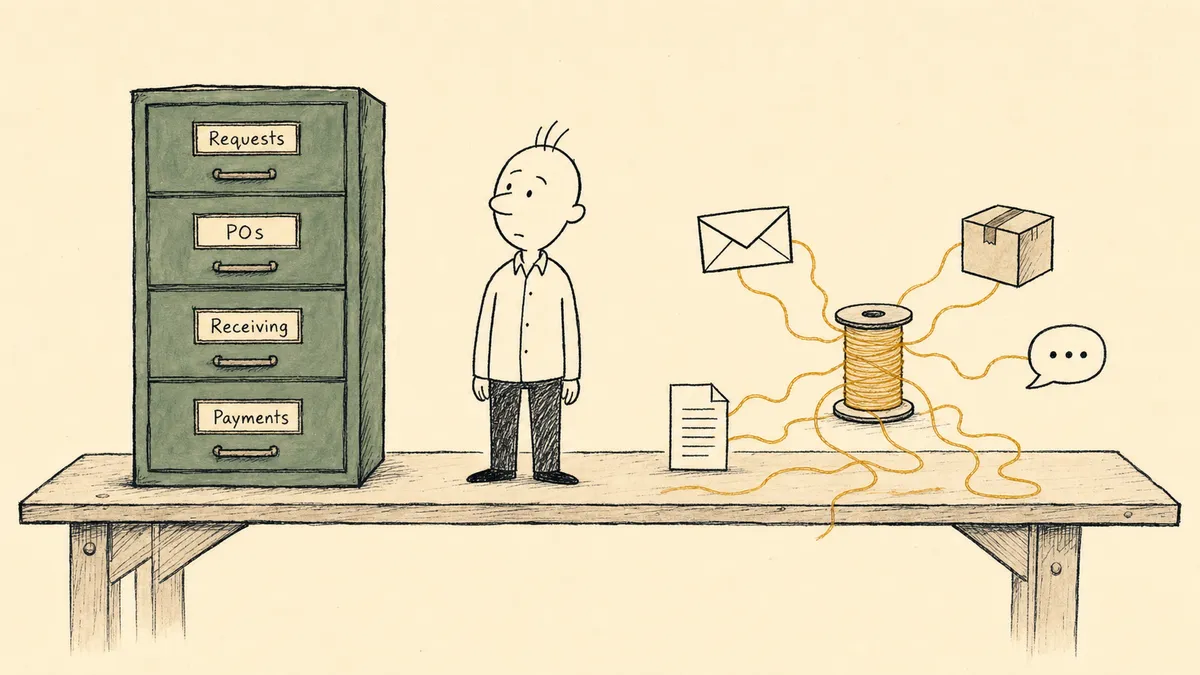
Most articles framed as automation in procurement try to crown a winner between products that are not actually competing. The honest version of the Procurify versus FlowRunner question is a scope question, not a feature question. Procurify is a procure-to-pay application with native depth in purchase requests, POs, receiving, AP invoice processing, bill management, and vendor payments. FlowRunner is an orchestration layer that coordinates work and AI agents across the tools a procurement team already runs. A procurement leader who confuses the two ends up either underbuying (an orchestration layer when they needed a P2P system) or overbuying (a P2P application when the real bottleneck was the work happening between systems).
Side by side, at a glance
| Procurify | FlowRunner | |
|---|---|---|
| Category | Procure-to-pay application | Orchestration layer for work and AI agents across tools |
| Primary job | Run the structured P2P cycle: requests, POs, receiving, AP invoice processing, bill management, vendor payments | Coordinate exceptions and handoffs across procurement and adjacent processes |
| Built for | Procurement and AP teams in mid-market companies | Procurement, finance, and ops leaders coordinating work across multiple systems |
| Catalog purchasing | Native PunchOut catalogs with Amazon Business, Grainger, Home Depot, Staples, Uline | Not a procurement feature; orchestration around purchasing happens outside the catalog |
| PO matching | Two-way and three-way matching against POs, receipts, and invoices | Not a native P2P feature |
| ERP integrations | Pre-built connectors to QuickBooks, NetSuite, Sage Intacct, Microsoft Dynamics 365 Business Central | Broad orchestration substrate, expandable with new connectors in 30 minutes or less, narrower out-of-the-box than Procurify in the P2P-adjacent finance category |
| Spending Cards | Physical and virtual cards for decentralized purchasing, tied to the P2P platform | Not offered |
| Mobile app | Purpose-built for purchasing, with role-specific views for requesters, approvers, receivers | No mobile purchasing interface |
| Human-in-the-loop | Approval gates inside the P2P workflow | Callable action: agents pause and route to a named human via Slack, email, WhatsApp, or phone with full context, resume on response |
| Workflow scope | Procurement and AP, end to end | Any ops workflow, with or without procurement involvement |
| Governance pricing | Tier-gated; pricing not publicly listed | Audit trails, RBAC, and SSO at the Professional tier ($299/mo) |
The table tells most of the story. The rest of this article is the part the table cannot.
What Procurify is good at, said honestly
Procurify describes itself as “the leading AI-powered procurement, AP, expense, and payment platform for the mid-market” that “standardizes and streamlines the purchasing process from request to payment.” That positioning is accurate. Procurify is a mature, purpose-built procure-to-pay application that covers the full P2P arc in one product, with the kind of domain depth that accumulates from working with procurement teams across years of actual buying cycles.
Specific things Procurify does that FlowRunner does not:
- Native PunchOut catalogs with major suppliers. Procurify publishes integrations with Amazon Business, Staples Advantage, Home Depot, Grainger, Uline, and others as embedded purchasing experiences. A buyer punches out to the supplier site, fills a cart, and the cart returns into Procurify as a structured request. FlowRunner has nothing equivalent.
- Two-way and three-way matching against POs, receipts, and invoices. Procurify positions bill management as “speed up reconciliation with automated three-way matching and sync approved bills from Procurify to ERP.” Three-way match is a core P2P control. FlowRunner does not implement it as a native feature.
- Pre-built, certified ERP and accounting integrations. Procurify ships connectors to QuickBooks (Online and Desktop), NetSuite, Sage Intacct, and Microsoft Dynamics 365 Business Central with the operational depth that comes from years of mid-market accounting integration work. FlowRunner’s connector library is broad and expandable in 30 minutes or less, but does not match Procurify’s pre-built depth in this specific category.
- Physical and virtual Spending Cards. Procurify offers Spending Cards for decentralized purchasing, tied to the same platform that owns the rest of the P2P workflow, with real-time spend visibility and automated reconciliation against the buying record. FlowRunner does not issue cards.
- A purpose-built mobile app with role-specific views. Procurify’s mobile app handles requests, approvals, receiving, and expenses with views designed for the requester, the approver, and the receiver as distinct roles. FlowRunner has no comparable mobile purchasing interface.
- Domain depth across the full P2P cycle. Blanket POs, accrual tracking, vendor onboarding flows tied to the buying record, role-specific approval views: Procurify has accumulated these by serving procurement teams as its primary buyer for years. FlowRunner does not.
This is not a list of FlowRunner gaps to be filled later. It is the deliberate scope difference between a procure-to-pay application and an orchestration layer. A procurement team that needs a complete P2P system should buy one. If the comparison stopped at the feature checklist, this article would end here with “buy Procurify.” The reason it does not is that the comparison rarely stops there once the buyer walks through what actually happens between the systems.
What automation in procurement actually looks like for most teams
Here is what most posts on automation in procurement will not say plainly: the procurement application owns the structured part of the buying motion. The unstructured work happens around it.
For a large slice of mid-market procurement and finance teams, the day-to-day pattern looks like this:
- A vendor invoice arrives in a shared inbox in PDF or email body form. Somebody parses it (or asks a teammate to), enters it somewhere, and reconciles it against a PO that may or may not exist
- A distributor sends a billback or chargeback statement that does not map cleanly to the goods received, and the dispute has to be chased across email, the ERP, and a spreadsheet before anyone can approve or reject it
- A new vendor needs to be onboarded with W-9, insurance certificate, contract reference, banking details: documents that arrive piecemeal over a week and need to land in the right systems before the first PO can clear
- A rush order or unusual request lands at a threshold the routing rule does not handle gracefully, and a procurement coordinator manually nudges it through Slack, attaching context that was already gathered but lives in three other places
- A request gets approved against a vendor record that has not been reviewed in two years, against a contract reference that may or may not still be valid
A P2P application owns the part of this that fits into the request-PO-receive-pay arc. That part is real and Procurify does it well. The parts that do not fit live in inboxes, Slack threads, spreadsheets, and the operator’s head. They are the exception work, and they are typically where procurement teams spend the time they want back.
The standard advice on automating procurement is to pick a procurement application. The honest version is that picking one solves the structured part of the problem and surfaces the unstructured part as a separate question.
Where FlowRunner fits: the layer around the P2P boundary
FlowRunner is an orchestration layer. It coordinates work and AI agents across the tools a team already runs, regardless of whether those tools are inside or outside the procure-to-pay boundary. Procurement work, in that frame, is one set of orchestration patterns the platform handles. Vendor invoice intake, exception routing, vendor onboarding documentation, and the cross-system handoffs that touch procurement plus adjacent processes are the patterns where FlowRunner does work a P2P application is not built to do.
The shape of those patterns:
- A trigger fires (a vendor email arrives, a parsed document lands, a webhook from a distributor portal posts, an ERP record changes)
- A workflow gathers context across every system involved (the ERP, the inbox, a parser like Parseur, a distributor portal, an internal vendor record)
- The workflow attempts the mechanical part of the decision: does this invoice match a PO, is this vendor approved, does this threshold trigger a category review, is this a duplicate of something processed yesterday
- If the answer is clean, the workflow writes the entry, posts the notifications, and moves on without involving a human
- If the answer carries an exception (mismatch, missing reference, new vendor, duplicate risk, unusual amount, missing documentation), the workflow pauses and calls a human as a callable action, not a status gate. The human receives a Slack message, email, WhatsApp message, or phone outreach with the full context attached and a structured response (approve, reject, adjust, escalate)
- The workflow resumes from the response, writes the entry with the human’s decision captured, and produces an audit-trail record of who decided what at what time
Concretely, this is the same shape as parsing vendor documents into Acumatica with human review on exceptions, where matched documents flow into the ERP and exceptions pause for a named reviewer with the parsed extract attached. The same shape as processing vendor documents into NetSuite without manual entry, where duplicate and outlier checks happen before a bill is created. The same shape as invoice processing from email to payment, where the inbox is the trigger and the audit trail spans the parser, the ERP, and the Slack approval. The same shape as automating accounting workflows in Acumatica, where ERP entries and downstream notifications happen in one workflow with one audit trail.
The category that owns this layer is orchestration as a service: a system above the systems of record that listens for what they emit, gathers context the procurement application did not have, brings a human in only when judgment is required, and writes one audit trail across the whole motion. FlowRunner is built for that layer. Procurify is built for the structured P2P workflow that sits inside it.
The honest version of the human-in-the-loop difference, said carefully so it does not become a strawman: Procurify’s approval gates are a legitimate and well-designed control for the procurement workflow they govern. They route requests through structured thresholds, capture approver identity, and write the approval against the PO record. That is a real control and procurement teams rightly value it. FlowRunner’s escalation model is a different shape, suited to a different kind of decision. Where a procurement approval gate fires on a known threshold against a known request type, an orchestration-layer escalation fires when an agent or workflow encounters something it cannot resolve on its own (a vendor not on the approved list, an invoice that almost matches a PO but is short by a freight line, a parsed document with a low-confidence field) and needs a human to decide. Both are forms of human-in-the-loop. They are designed for different work.
Where FlowRunner reaches that a P2P application does not
The procurement team’s actual tool inventory almost always extends past what a P2P application natively connects to. Internal vendor portals with no public API. Parsed inbox documents that need to land in two systems at once. Distributor portals whose statements need to be reconciled before AP can pay. Slack workflows where exception decisions are already happening and the audit trail leaks. Custom approval thresholds that need to combine GL coding plus vendor category plus contract status.
FlowRunner addresses this with two architectural choices a procurement application does not share by design:
- A broad, extensible orchestration substrate. Stripe, QuickBooks Online, Acumatica, NetSuite, Slack, email, WhatsApp, parser services like Parseur, internal APIs, and most of what a mid-market ops stack actually runs. New connectors are built in 30 minutes or less when the catalog does not already cover the system the team needs to reach.
- A visual builder for non-developers. A procurement operator or ops analyst can compose a workflow that combines a parser, an ERP write, a Slack approval, and an audit-trail entry without filing an engineering ticket. The bar to add a new exception path is low enough that the workflow can evolve with the buying motion instead of becoming a maintenance debt.
Said honestly: this is the differentiator paired with a real FlowRunner limitation. The breadth and depth of Procurify’s certified ERP and accounting integrations in the specific finance-systems category exceeds FlowRunner’s pre-built depth there. FlowRunner is not the better choice for the structured P2P workflow itself. It is the better choice for orchestrating across the long tail of tools and exception patterns a P2P application is not designed to reach.
Governance at a price a procurement director can authorize
Mid-market procurement and finance teams typically need audit trails, role-based access control, and SSO without a six-month enterprise procurement cycle. The standard pattern in the procurement-application category is to publish governance features behind tiered pricing that asks for an RFP, a security review, and a vendor approval committee.
FlowRunner publishes audit trails, RBAC, and SSO at the Professional tier ($299 per month). The framing matters: this article is not claiming auditor acceptance of any specific compliance framework. It is claiming the governance infrastructure exists at a price a procurement director or finance director can authorize without an enterprise procurement cycle. Specific framework attestations (SOC 2, HIPAA) are separate conversations.
The honest version: a team running Procurify for P2P already gets procurement-specific audit trails for the buying record inside the Procurify application. Where FlowRunner adds workflow-level governance is across the cross-system orchestration work happening around the P2P boundary, where the exception decisions, the parsed documents, and the Slack approvals would otherwise produce audit gaps that the P2P application is not aware of.
Where Procurify is the better fit
Choose Procurify (and probably not FlowRunner as a substitute for it) when:
- You need a structured procure-to-pay system as the system of record for purchase requests, POs, receiving, AP invoice processing, and vendor payments
- PunchOut catalogs with Amazon Business, Grainger, Home Depot, Staples, or Uline are core to how your team buys
- Two-way and three-way matching, blanket POs, and accrual tracking are required controls in your buying motion
- You need physical or virtual Spending Cards integrated with the same platform that owns the procurement record
- A purpose-built mobile app with role-specific views is required for field, remote, or distributed buyers
- The ERP integration you need is already in Procurify’s certified list and the depth of that integration matters more than orchestrating across the long tail of systems outside it
That set of conditions describes a real and common procurement organization. If it describes yours, the rest of this article is interesting but not actionable. The right answer is Procurify or a peer P2P application, and an orchestration layer is a question to revisit later.
Where FlowRunner is the better fit
Choose FlowRunner when:
- The procurement work that consumes your team’s time lives between systems rather than inside one P2P application
- Vendor invoices, distributor statements, vendor onboarding documents, and chargeback notices arrive across email, parsers, portals, and Slack threads that need to be coordinated into one workflow with one audit trail
- You need to route exceptions to humans with full context attached, via the channel the human actually reads (Slack, email, WhatsApp, phone), and capture the decision against the source record automatically
- The systems your procurement work touches include tools no P2P application natively connects to, and you need new connectors built in 30 minutes rather than a quarterly product roadmap request
- You want non-developers in procurement, finance, or ops to configure new exception routing without waiting on engineering capacity
- You see AI agents arriving in your stack from multiple vendors (extraction agents, approval bots, supplier-side AI) and want a coordination layer above them before that becomes its own problem
- You want governance infrastructure (audit trails, RBAC, SSO) at mid-market pricing rather than enterprise-tier procurement
These two products coexist comfortably in the same procurement and finance stack. Procurify owns the structured P2P workflow. FlowRunner orchestrates the exceptions, the cross-system handoffs, and the work that touches procurement plus everything adjacent to it. The structured part flows through Procurify with the controls procurement teams expect. The exceptions and the off-P2P work flow through FlowRunner with the context already attached.
How to decide
Two questions, with the order intentional.
1. Where is the system of record for the buying motion? If you do not have one, or the one you have is a spreadsheet and an ERP module that no one trusts, the question is which P2P application to buy, and an orchestration layer is the wrong starting point. Buy Procurify or a peer, get the structured workflow in place, and revisit orchestration once the structured part is solved. If you already have a system of record (Procurify, a peer P2P application, or a tightly used ERP procurement module), the question is what is happening outside it, and that points to an orchestration layer.
2. Where does the exception live today? Walk through the last five things that consumed your team’s time and required judgment. The unusual rush request, the vendor invoice that did not match a PO, the new vendor whose paperwork dragged across three weeks, the distributor billback that took four people to resolve, the request approved against a vendor record that turned out to be stale. For each one, name where the resolution actually happened. If the answer is “inside Procurify’s approval gates,” the P2P application is doing the work it was built to do and the orchestration question is small. If the answer is “across an inbox, a parser, a spreadsheet, two Slack threads, and a phone call before anyone updated the system of record,” that is the work an orchestration layer is built to absorb.
The honest read on a procurement automation decision is to use the questions in that order. The decision about whether the structured P2P workflow is worth automating is a different question than the decision about whether the surrounding orchestration is worth automating, and a separate framework on how to know what is worth automating handles the latter as a financial calculation rather than a gut call.
Most mid-market procurement teams will end up with both kinds of tool in the stack, used for different work. That is not a hedged answer. It is the honest one.
Quick answers
Is FlowRunner a replacement for Procurify?
No. Procurify is a procure-to-pay application with purchase requests, POs, receiving, AP invoice processing, bill management, and vendor payments in one product. FlowRunner is an orchestration layer that coordinates work and AI agents across the tools a procurement team already runs. A team that needs a dedicated P2P system would still buy Procurify or a similar tool.
Where does FlowRunner fit if we already use Procurify?
FlowRunner sits around the P2P boundary. It parses vendor documents into systems Procurify is not the system of record for, routes exceptions that need judgment across Slack or email with full context attached, and coordinates work that touches procurement plus adjacent processes (AP exception handling, distributor billbacks, vendor onboarding documentation) in one workflow with one audit trail.
Does FlowRunner have PunchOut catalogs or three-way matching?
Not as a native procure-to-pay feature. Procurify offers PunchOut catalogs with Amazon Business, Grainger, Home Depot, Staples, Uline, and others, plus automated three-way matching against POs, receipts, and invoices. FlowRunner does not replicate those. If those capabilities are core to your buying motion, Procurify is the right product.