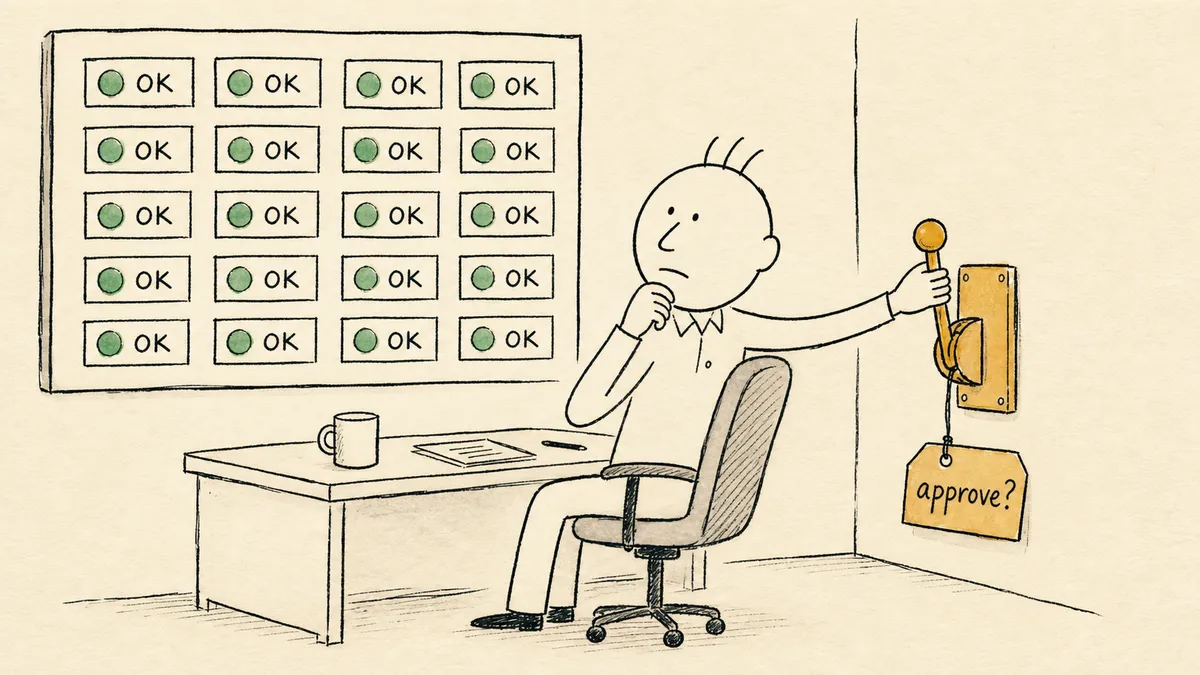
A CFO comparing Drata against FlowRunner for SOX is usually one toggle into a mistake, and the mistake is treating SOX like one more framework you switch on next to SOC 2. SOX is not a framework you enable. It is a set of human decisions inside your close cycle, and a decision is not something software can poll. Drata is very good at proving the state of your systems. SOX 404 turns on proving the judgment of your people: who approved this bill, who signed off this reconciliation, who decided the exception was acceptable and why. Those are different problems, and a finance leader should know which one they are buying for before the demo flatters them into the wrong one.
This piece compares the two products on the axes a SOX buyer actually weighs: framework coverage, where the control evidence comes from, integration scope, the auditor experience, pricing, and the buyer each product is shaped for. Drata is a strong product. FlowRunner is a different kind of product. They are not substitutes, and the most useful thing this comparison can do is draw the line cleanly.
Drata and FlowRunner, side by side on SOX
| Axis | Drata | FlowRunner |
|---|---|---|
| Category | Continuous-compliance and trust management platform | Orchestration layer above the systems of record |
| Self-description | ”The Agentic Trust Management Platform”, “Continuous Real-Time Trust” | An orchestration layer that runs the control activities and captures the evidence at the moment of work |
| Framework coverage | SOC 2, ISO 27001, ISO 42001, GDPR, HIPAA, PCI DSS, DORA, FedRAMP, “30+ Pre-Mapped Frameworks”. SOX is not listed. | No pre-mapped frameworks. Designed to support common control-evidence requirements at the moment of the transaction. |
| Evidence model | Monitor and pull: “automated tests across your environment to monitor success, surface failures” | Capture at the moment of work: named approver, timestamp, and decision recorded against the record |
| What it sees in SOX | The IT general controls slice: access, provisioning, change management on financial systems | The financial-process controls: AP approvals, segregation of duties on transactions, reconciliation sign-offs, exception decisions |
| Integrations | ”Hundreds of tools”: cloud, identity, HRIS, version control, ticketing | Newer and narrower; centered on ERPs, accounting platforms, payment processors, document parsers, channels |
| Auditor experience | Audit Hub: “centralize auditor collaboration, evidence requests, and approvals” | No auditor portal |
| Human-in-the-loop | Review queues and workflow status | Agents pull a named human in as a callable step and resume with that decision as context |
| Pricing | Quote-based, contact sales | Audit trails and RBAC at $299/mo (Professional); SSO at $999/mo (Business) (source) |
| Honest replacement question | Replaces no part of your financial-process control activities | Replaces no part of your continuous-monitoring or SOC 2 program |
Both products can sit in the same stack without stepping on each other. The sections below explain where each one earns its place, and where it does not belong.
What Drata actually is, in Drata’s own words
Drata describes itself as “The Agentic Trust Management Platform”, built to “leverage autonomous AI agents to automate compliance, manage internal and third-party risk” and deliver “Continuous Real-Time Trust.” The compliance-automation product promises to “run automated tests across your environment to monitor success, surface failures and determine remediation plans” and to “automate collection across your tools so your compliance program stays current.” It carries strong public proof: Drata advertises 8,000+ global customers and a 4.8 out of 5.0 G2 rating on its homepage.
That is a serious continuous-compliance platform, and the description tells you exactly what it is built around. The frameworks Drata names are SOC 2, ISO 27001, ISO 42001, GDPR, HIPAA, PCI DSS, DORA, FedRAMP, and what it calls “30+ Pre-Mapped Frameworks.” SOC 2 is the anchor. ISO 27001 and HIPAA cluster around the same security-and-trust posture. ISO 42001 is the AI governance extension. PCI DSS, DORA, and FedRAMP are the regulated-industry and public-sector additions. Read the list twice and notice what is not on it. SOX is absent.
That absence is honest on Drata’s part, and it is the whole reason this comparison exists. SOX is not a security-posture framework. It is an SEC statute about internal controls over financial reporting, and the external auditor tests those controls under PCAOB AS 2201. Its control families live in entity-level governance, access and segregation of duties, approvals, reconciliations, the procure-to-pay cycle, and the IT general controls that support the financial systems.
Drata is excellent at one slice of that picture. Its connector library reaches “hundreds of tools” across cloud providers, identity, HRIS, and version control, which gives it real depth on the IT general controls layer of SOX: user provisioning, access reviews, change management, the configuration state of the systems your financial data sits in. If you are already buying Drata for SOC 2 and your SOX program needs the ITGC slice automated, you get genuine adjacency value and you should take it.
What Drata is not built to do is sit inside the AP approval, the reconciliation, the journal-entry review, or the exception handling that finance owns. Those activities are what a CFO personally certifies under Sections 302 and 404, and they run in the ERP, the AP system, the close tool, and the channels finance works in. Drata can confirm who has access to the ERP. It cannot tell you who approved which bill, or what they decided when the bill did not match the purchase order.
What FlowRunner actually is, plainly
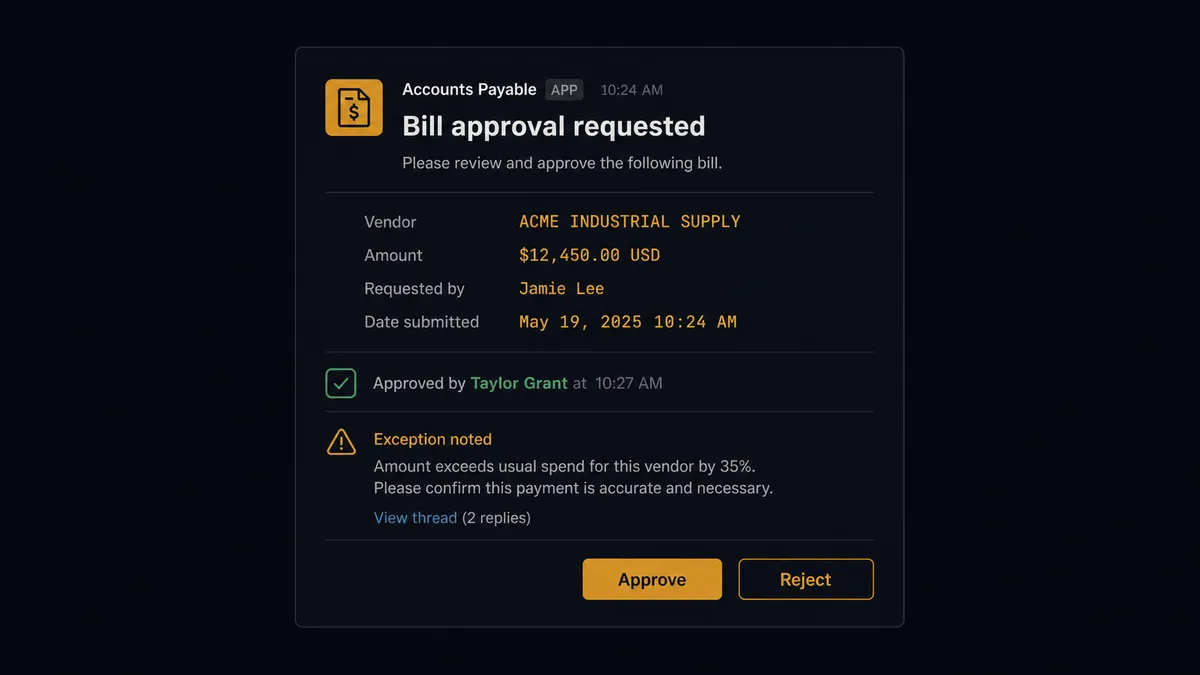
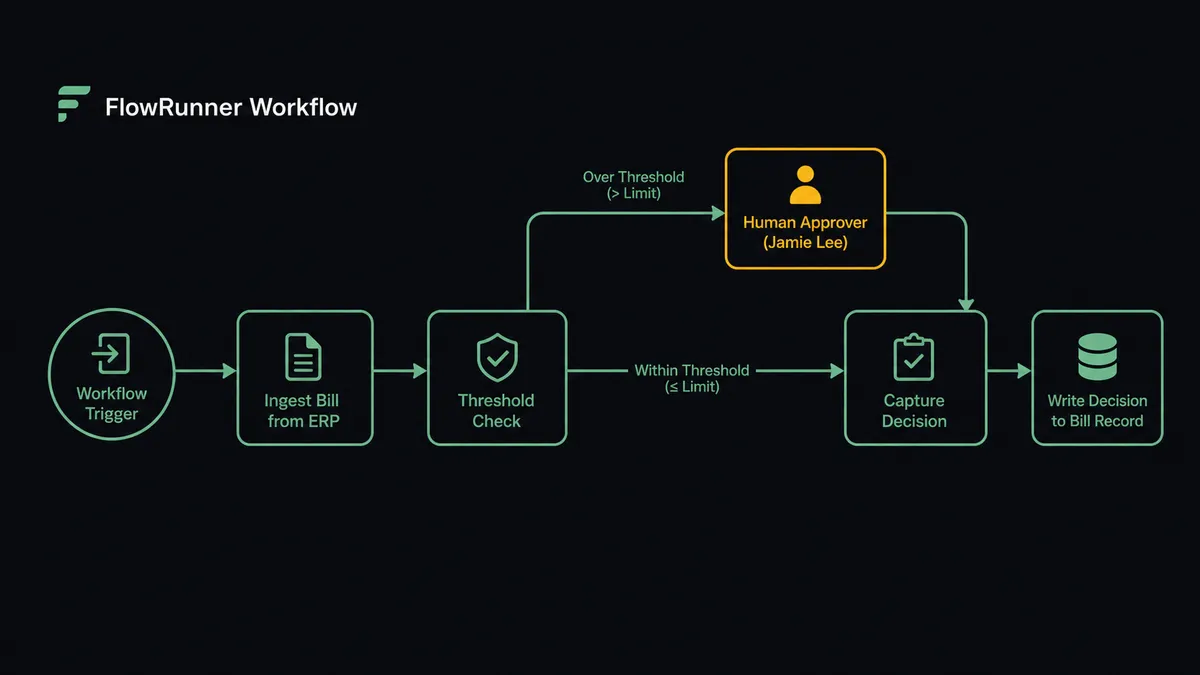
FlowRunner is an orchestration layer. It sits above the systems of record, the ERP, the AP system, the billing platform, the payment processor, the document repository, and the channels your team works in, and it runs the work that moves between them. In an approval flow, FlowRunner posts the request into the channel approvers already use, captures the response, writes the named approver and timestamp back to the bill record, and routes anything unusual to a designated reviewer with full context attached.
FlowRunner is not a GRC platform, and pretending otherwise would not survive a single product evaluation. It has no pre-mapped frameworks. It does not run continuous control monitoring across your cloud infrastructure. It has no Audit Hub, no third-party risk module, no framework-mapped control library. If those are the capabilities you are shopping for, FlowRunner does not have them and a comparison with Drata on those axes is one Drata wins outright. I will say where else Drata wins further down, plainly, because the comparison is worthless if I do not.
What FlowRunner does deliver is the moment-of-work evidence a control activity produces, written into the system that owns the underlying record. The named approver captured against the bill. The timestamp of the decision. The exception rationale stored next to the transaction. The reviewer identity logged on the reconciliation step. An audit trail that does not need to be reconstructed during fieldwork because it was never scattered across inboxes in the first place.
Framework coverage
Drata is a category leader on framework breadth, and it is not close. The 30-plus pre-mapped frameworks span security, privacy, AI governance, and regulated-industry standards, each with the control mappings and automated tests already built. For a buyer whose primary need is a SOC 2 program manager with framework mapping and continuous monitoring, Drata is the right tool and FlowRunner is not in the conversation. Full stop.
FlowRunner offers no framework coverage at all. There is no SOC 2 module, no ISO module, no SOX module, because the product is structurally different. It captures evidence at the point a control executes rather than mapping evidence to a framework after the fact.
For a SOX buyer, though, the framework-coverage axis is a trap. SOX is not on Drata’s list, so “Drata covers more frameworks” is true and irrelevant to the specific question on the table. The real question is which product produces the evidence a SOX tester asks for at the line item, and that is a question about where evidence comes from, not how many frameworks a dashboard maps. That is the next axis, and it is the one that matters most.
Where the evidence is born
Here is the thing most comparisons of compliance software will not say, because it cuts against the dominant product narrative in the category: continuous control monitoring, the capability Drata is genuinely best at, is the capability SOX 404 needs least. That sounds like a knock on Drata. It is not. It is a statement about what kind of thing a SOX control is.
Continuous monitoring works by polling. It connects to a system, reads the configuration, and tests that state against a control. “Run automated tests across your environment to monitor success, surface failures.” When the control is “access to production is restricted to authorized users,” Drata polls the identity provider and proves the state. That is a real, valuable control, and it is a state. You can read it off a system at any moment and the answer is the same until something changes.
Now take the controls SOX 404 actually turns on. “Every bill over the threshold requires named approval from a controller, with the timestamp captured.” “The reconciliation was prepared by one person and reviewed by another.” “The exception was escalated, examined, and accepted with a documented reason.” None of these are states. They are events. They happen once, at a specific moment, when a specific human makes a specific judgment, and then they are over. There is no configuration to poll afterward. A control that is a human saying yes is not a state you can read off a system. It is a decision, and if you did not capture it at the instant it was made, you are reconstructing it from memory and email threads in October.
That gap, the difference between a control you can poll and a control that is a decision, is where an entire category lives that neither the GRC dashboard nor the system of record owns. The approval that routes from the AP clerk to the controller to the CFO does not live inside QuickBooks; QuickBooks holds the bill, not the conversation. It does not live inside Drata; Drata monitors the systems, not the judgment. It lives in the seam between them, in the work that moves a decision from one human and one system to the next. An orchestration layer is the category that owns that seam: a layer above the systems of record that listens for what they emit, pulls the right human in at the moment a judgment is required, captures what they decided, and writes that evidence back into the system that owns the record. This is the digital andon cord one operations leader described to us, the cord that stops the line when something needs a person and records exactly what the person did. FlowRunner is built for that layer. It does not replace the tool that monitors your infrastructure state. It captures the decisions that monitoring is structurally blind to.
So the evidence models are not competitors. Drata’s model is monitor and pull, and it is strong wherever the SOX evidence lives in infrastructure that holds a state. FlowRunner’s model is capture at the moment of work, and it is strong wherever the SOX evidence lives in a human decision that has to be recorded against a financial record as it happens. A program that covers both slices needs both kinds of tools, or it assembles the moment-of-work evidence by hand at audit time, which is the failure mode the SOX compliance checklist walks through control family by control family.
Integration scope
Drata wins this axis, and the win is real. A connector library reaching “hundreds of tools” that pulls compliance evidence automatically from cloud infrastructure, identity providers, HRIS, version control, and security tooling is years of category investment FlowRunner has not matched. A finance team standardizing on FlowRunner for evidence will have fewer pre-built integrations available than it would on Drata. That is the honest read, and I am not going to dress it up.
The qualification is what each library is optimized for. Drata’s connectors are built for security-and-trust posture: they cover what a SOC 2 program needs to monitor, which is cloud, identity, and engineering systems. FlowRunner’s connector set is centered on the systems financial work actually runs in: ERPs, accounting platforms, payment processors, document parsers, and the channels approvals route through. A finance team’s SOX evidence problem leans heavily on those finance systems and far less on the cloud-monitoring surface where Drata has its depth.
So “hundreds of tools” is the right thing to weigh if your evidence problem is “is our cloud environment configured to standard.” It is the wrong thing to weigh if your evidence problem is “can we prove who approved the bills and signed the reconciliations across the seven systems where the financial work happens.” For that problem, the question is not how many connectors exist but whether the ones that own your transactions are covered.
The auditor experience
This is a genuine Drata strength worth naming on its own. Drata’s Audit Hub is built to “centralize auditor collaboration, evidence requests, and approvals in one secure hub.” When the auditor can pull evidence directly through a structured workspace instead of chasing the controller for screenshots, the fieldwork cycle compresses. That is a real advantage in the frameworks Drata covers, and it reflects the kind of compounding investment a platform whose entire business is compliance certification can make and a newer entrant cannot match in the short term.
FlowRunner has no auditor portal, and it is not building one. What it offers the auditor instead is upstream of the portal question: evidence that is already complete and already attached to the record, so the evidence request is a query rather than a reconstruction project. Those are different contributions to the same audit. Drata makes the handoff to the auditor smoother. FlowRunner makes the evidence exist in defensible form before the handoff. A program can value both.
Pricing and packaging
Drata’s pricing is quote-based and not publicly listed; the buying motion is a sales-led evaluation, which is appropriate for a multi-framework platform sold to security and compliance teams.
FlowRunner publishes its tiers. Audit trails and RBAC start at the Professional tier at $299 per month. SSO and SAML start at the Business tier at $999 per month. I am stating that split precisely on purpose, because it is easy to imply that everything governance-related arrives at $299, and it does not: SSO is a Business-tier capability. The packaging is shaped for mid-market finance teams that need named-approver capture and an audit trail in their day-to-day workflows without standing up a six-figure enterprise program.
Comparing the two on price directly is misleading, because they are different categories of product. The signal that matters is what each tier is shaped for. Drata is shaped for security-led, multi-framework compliance programs. FlowRunner at the Professional tier is shaped for a finance team that needs approval and reconciliation evidence captured in the systems it already works in.
Where Drata is the better fit
The comparison is not honest unless it stops and says plainly where Drata wins. It wins in a lot of places.
- SOC 2, ISO 27001, HIPAA, PCI DSS, and the rest of the marketed frameworks. This is what Drata was built for. There is no version of this comparison where FlowRunner is the better choice for the SOC 2 program-manager role.
- Continuous control monitoring across infrastructure. Automated tests that watch your cloud and identity configuration and surface failures continuously. FlowRunner does not do this and is not trying to.
- Automated evidence collection from connected systems. Pulling evidence from hundreds of tools without manual gathering is the core of Drata’s value, and it is real.
- The auditor handoff. Audit Hub compresses fieldwork in the frameworks Drata covers. FlowRunner has no equivalent.
- Third-party and internal risk management. Drata has dedicated products for vendor risk and enterprise GRC. FlowRunner has neither.
- A recognized GRC name on the slide. A CFO whose buying decision has to clear an audit committee that wants an established compliance vendor will find Drata, with its 8,000+ customers, delivers that signal in a way FlowRunner does not.
- A published security certification. Drata’s business is certification, and it carries the trust attestations a security-conscious buyer expects. FlowRunner does not currently publish a SOC 2 or equivalent certification page, and for a CFO weighing a vendor on exactly that axis, that absence is a fair and material consideration. I am not going to wave it away.
If those criteria describe your actual problem, Drata is the right tool and FlowRunner should not be on the shortlist.
Where FlowRunner is the better fit
FlowRunner earns its place in the part of SOX that Drata is not built to reach: the control activities that are decisions, not states.
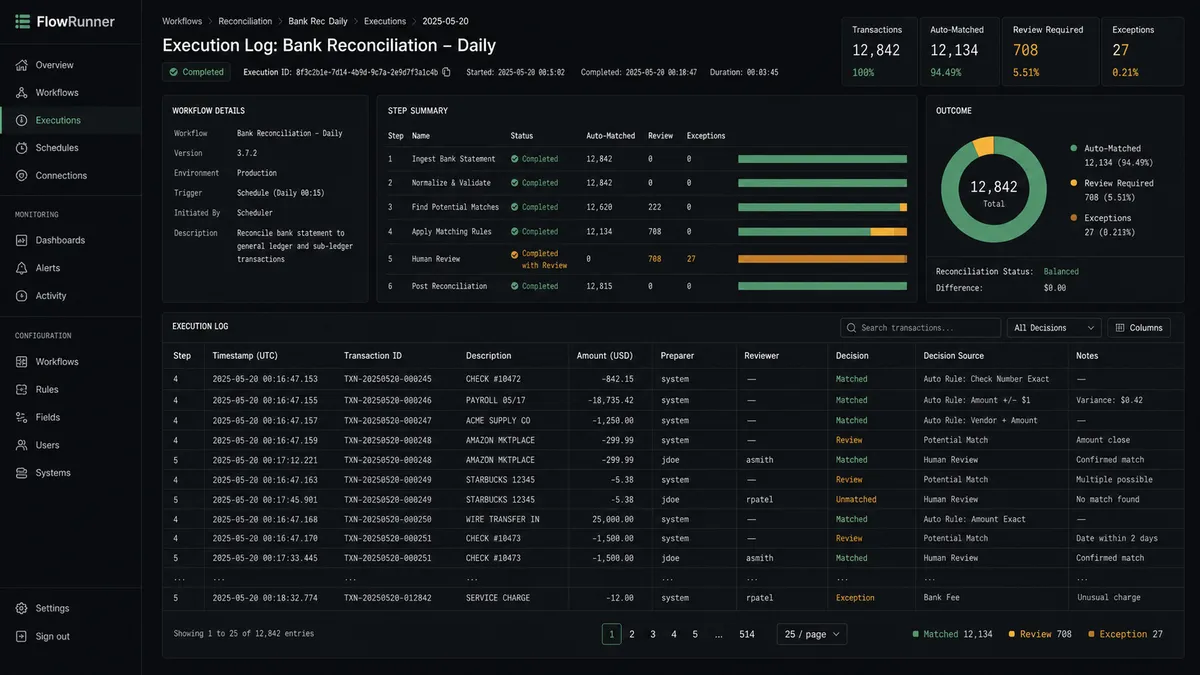
- Approval evidence at the moment of the transaction. The named approver and timestamp captured against the bill record, not pieced together from email later. The QuickBooks and Slack approval workflow does exactly this: a named approver and timestamp recorded for every approval, in the system that owns the bill.
- Reconciliation decision history per step. Bank, merchant-processor, and intercompany reconciliations where each reconciling item carries a logged decision. The Stripe and QuickBooks reconciliation pattern retains decision history for every reconciliation step, kept against the transaction.
- AP control evidence inside the ERP. The Acumatica AP automation pattern captures approver identity on every bill approval and routes exceptions for explicit review, producing procure-to-pay control evidence inside the system of record.
- Exception handling as a callable step. When the automation hits something it should not decide alone, a named human is pulled in with full context, the decision is recorded, and the workflow resumes carrying that decision forward. The exception evidence is the audit trail, not a thread you rebuild in the fall.
- Mid-market governance pricing. Audit trails and RBAC at $299 per month put evidence infrastructure inside the budget of finance teams that cannot stand up a multi-tool enterprise GRC program on day one.
- Compliance evidence as an automation byproduct. The same approval and reconciliation workflows that produce SOX evidence are the automation a finance team would justify on efficiency grounds anyway. The framework for deciding what is worth automating treats compliance evidence as a value multiplier on that work, not a separate line item.
The framing FlowRunner supports is “designed to support common SOX control-evidence requirements,” not “auditors accept FlowRunner output as SOX evidence.” SOX compliance is the issuing company’s responsibility, not a vendor’s, and no automation tool satisfies Section 404 on its own. What an orchestration layer delivers is evidence in the form an auditor expects to receive it: named approver, timestamp, context, exception rationale, all retained against the underlying record.
This is the same line FlowRunner sits on against Vanta, the other continuous-compliance platform a SOX buyer will weigh. The pattern repeats across GRC tools because they all share the same architecture: monitor the systems, prove the state. The financial-process controls that are decisions live in the seam those tools do not reach.
How to decide
You can resolve almost every version of this decision with two questions, in order.
First: is the evidence you are missing a state or a decision? If the gap is “can we continuously prove our cloud and identity systems are configured to standard, across SOC 2 and a stack of other frameworks,” that is a state problem, and Drata is built for it. If the gap is “can we prove who approved the bills, who signed the reconciliations, and what was decided on the exceptions,” that is a decision problem, and a monitoring platform is structurally blind to it no matter how many connectors it has.
Second: are you running a multi-framework compliance program, or tightening financial-process evidence? A company building or running SOC 2 alongside several other frameworks needs a continuous-compliance platform as the program’s backbone, and Drata is a strong choice for that backbone. A finance leader asked to harden control evidence ahead of an investor diligence cycle, a lender covenant, an audit, or an M&A event usually has a narrower problem: named-approver and reconciliation evidence in workflows that currently live in spreadsheets and inboxes. A full GRC platform is more tool than that problem needs at the buying stage. FlowRunner is shaped for it and priced for it.
If both answers point the same way, you have your tool. If the first answer is “both,” and for a company on a public-company path it often is, then both tools belong in the stack and they will not get in each other’s way. Drata watches the systems hold their state. FlowRunner stops the line and records the decision when a human has to make one. Buy the tool that closes the gap you actually have, and if you are honest with yourself about whether that gap is a state or a decision, the rest of the choice makes itself.
Quick answers
Is Drata a SOX compliance platform?
Drata markets coverage of SOC 2, ISO 27001, ISO 42001, GDPR, HIPAA, PCI DSS, DORA, FedRAMP, and 30+ pre-mapped frameworks. SOX is not among the frameworks Drata lists. Its continuous control monitoring overlaps with the IT general controls slice of SOX, but it is not a SOX 404 program manager and does not run the financial-process controls a CFO certifies under Sections 302 and 404.
Can FlowRunner replace Drata?
No. FlowRunner is an orchestration layer, not a GRC platform. It has no pre-mapped frameworks, no continuous control monitoring across cloud infrastructure, no third-party risk module, and no Audit Hub. If you need a continuous-compliance platform for SOC 2 and adjacent frameworks, you need Drata or a tool like it. FlowRunner solves a different layer.
Where does FlowRunner fit if a finance team is buying SOX software?
FlowRunner runs the control activities SOX 404 turns on: AP approvals, reconciliations, and exception handling. It captures the named approver, the timestamp, and the decision against the record in the system that owns it, at the moment the work happens. It is designed to support common SOX control-evidence requirements at the point of the transaction rather than reconstructing them at fieldwork.