How to Connect ActiveCampaign to Shopify: Tag Every New Order
Connect Shopify orders to ActiveCampaign contacts and automations automatically, and run it as an AI agent that pauses for a sales manager before a high-value order becomes a deal.
How do you connect ActiveCampaign to Shopify?
Shopify’s On New Order trigger fires the moment a customer checks out, and FlowRunner maps that order into ActiveCampaign with Sync Contact, Add Tag To Contact, and Add Contact To Automation, so the buyer exists as a segmented, automation-enrolled contact within minutes instead of the next manual export. FlowRunner is a visual AI-agent orchestration platform where automations run autonomously and pause for human judgment on the steps that carry real consequence. The same connection can run as a straightforward sync, or it can run as an AI agent that also watches order value and pauses for a sales manager before a high-value order becomes a deal.
The problem it solves
A marketer running ActiveCampaign off Shopify sales usually inherits a queue instead of a feed. Orders come in all day, but the marketer copies each buyer’s details into ActiveCampaign by hand when they get a chance, so segmentation and post-purchase nurture wait behind whatever else is on their plate that afternoon. The same customer checking out twice, once as a guest and once with an account, often creates two contact records because nothing upserts before it creates, and the tags that should drive the next email never quite catch up to what actually happened in the store.
The other half of the problem sits on the sales side. A first-time customer who places a $3,000 wholesale-size order looks, in the marketing system, exactly like someone who bought a $30 accessory. Nobody notices the size of the order until someone happens to scroll past it in the ActiveCampaign contact list, days later, by which point a warm lead that should have gone to a sales manager as a deal has already cooled into an unremarkable subscriber.
How it works: the connection
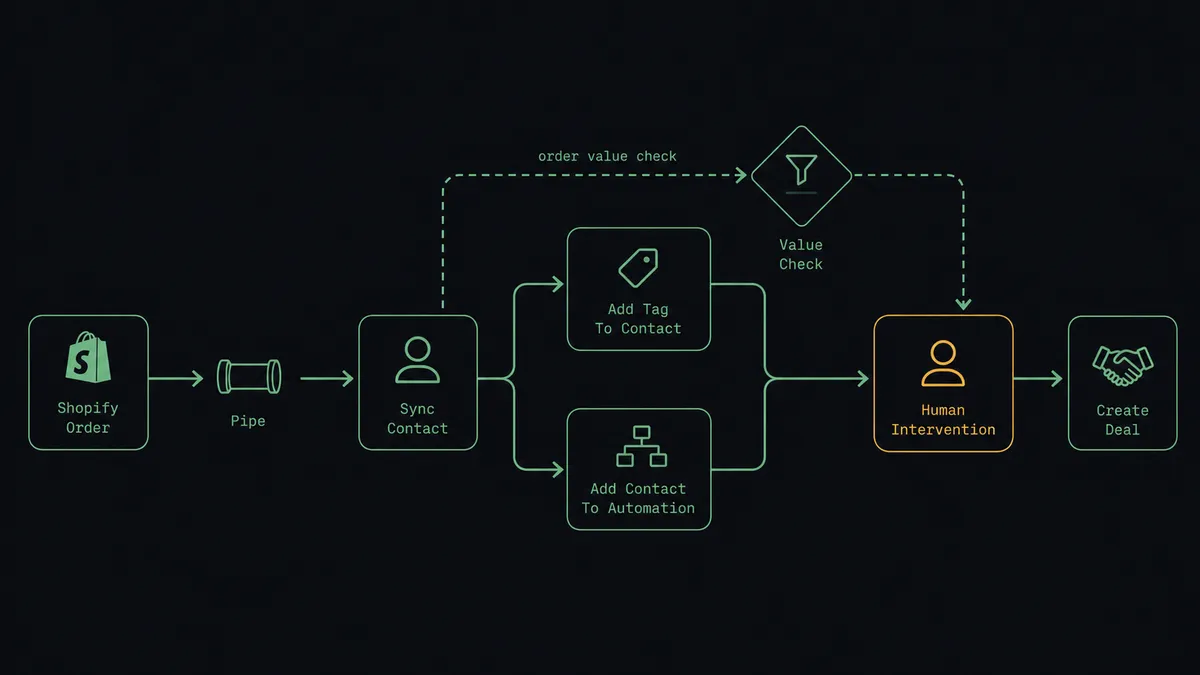
The flow starts on Shopify’s On New Order trigger. When a customer checks out, the agent reads the line items, the customer’s email and details, and the order total, then calls Sync Contact in ActiveCampaign, which upserts the contact matched by email so the same buyer never becomes two records no matter how many times they order. From there the agent calls Add Tag To Contact to segment the buyer by what they bought, using List Tags to confirm the right tag exists first, and calls Add Contact To Automation to enroll them in the post-purchase sequence that already exists in the account.
That covers every order. For the orders that matter more, the agent checks the order total against a threshold you set. Under the threshold, the flow ends there and the contact simply flows into marketing like any other buyer. At or above it, the agent calls List Pipelines and List Stages to confirm where the opportunity belongs, then prepares to call Create Deal so the order becomes a tracked opportunity instead of a line in a newsletter list. That last call is the one that gets a person first.
Can an AI agent run it? (and why a human stays in the loop)
Yes, and this is where it stops being a data-mapping tool. A scripted sync moves fields from one system to another on a schedule or a webhook and does not reason about what the numbers mean. An AI agent reads the order total, compares it against the threshold and the buyer’s history, and decides on its own whether the situation is routine or whether a sales manager should see it before anything gets created in the pipeline.
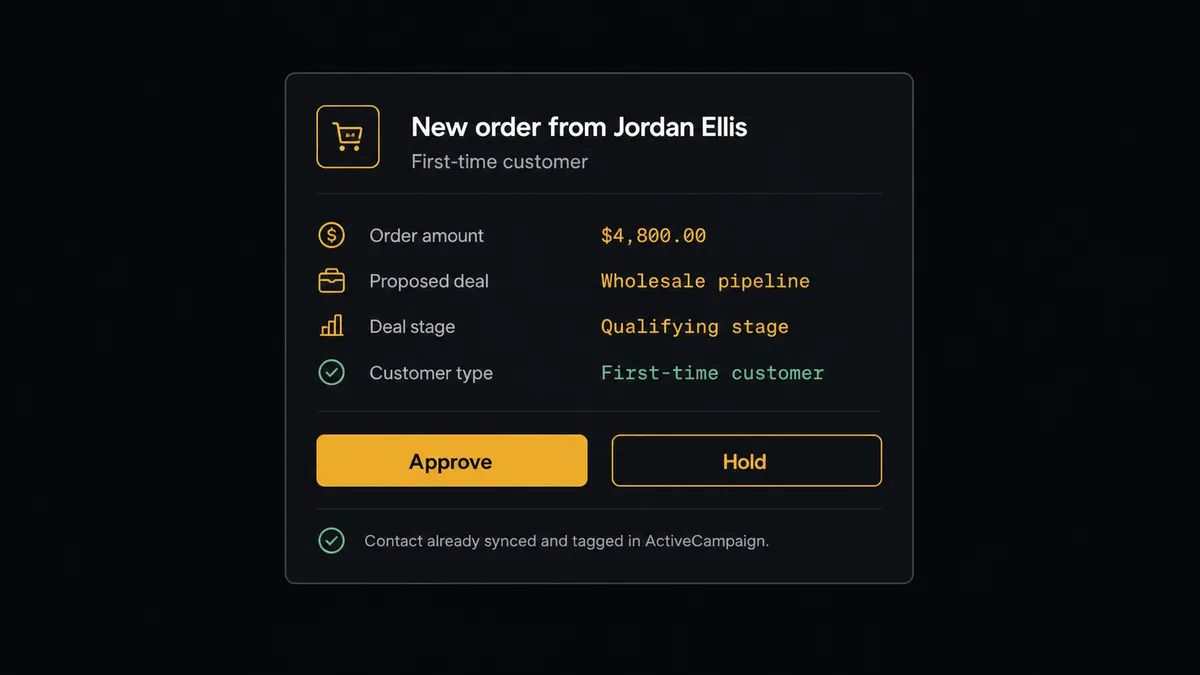
Here is the actual decision moment. A first-time customer places an order for $4,800, well above the account’s usual order size. The agent has already synced the contact and applied the tags, the same as it would for any order. But before it calls Create Deal, it treats that step as a human-in-the-loop moment: it pauses, and posts to the sales channel: “New order from Jordan Ellis, $4,800.00, first-time customer. Proposed deal: Wholesale pipeline, Qualifying stage. Approve to create?” The manager sees the full context in one message, no digging through Shopify or ActiveCampaign required. They approve, and the agent calls Create Deal immediately, placing the opportunity where the manager confirmed it belongs. They hold, and the deal waits. A routine $45 reorder from a repeat customer never reaches this gate at all; it flows straight through untouched.
This is not a sync tool. The agent knows when a number is ordinary and when it is not, and it does the surrounding work, checking pipelines and stages, drafting the summary, so the manager’s only job is the judgment call the business actually needs a person for. Prospects who have seen this pattern before call it a digital andon cord: the line keeps running, and it stops the instant something needs a human eye.
FlowRunner vs Zapier
Zapier is a reasonable starting point for this exact connection. It has both a Shopify and an ActiveCampaign app, the field mapping is genuinely fast to set up, and for a straight order-to-contact sync with no branching logic, plenty of teams get it running in an afternoon. That part is fair to credit.
Where it runs out of room is the deal decision. Zapier can trigger on a Shopify order and call an ActiveCampaign action, but it cannot look at an order total, weigh it against what is routine for that account, and decide on its own to stop and ask a specific manager before a deal gets created. That logic gets built as a rigid if-total-then-notify step at best, or the sales team just never finds out a big order came in until someone happens to look.
| Capability | FlowRunner | Zapier |
|---|---|---|
| Human-in-the-loop on the deal step | Native: the agent reasons about order value and invokes a manager approval as a callable tool | Not native: conditional branches can route to a notification, not a judgment call |
| Pricing model | Transparent workflow-based tiers with a stated execution ceiling per tier | Per-task pricing that scales with volume and gets harder to predict at growth |
| Users included | Unlimited users on every tier | Seat-based pricing on higher tiers |
| Self-hosting | Available on Enterprise | Not offered |
| AI provider access | Bring your own key for the AI agent step | AI features tied to Zapier’s own model access |
Before and after
| Metric | Before | After |
|---|---|---|
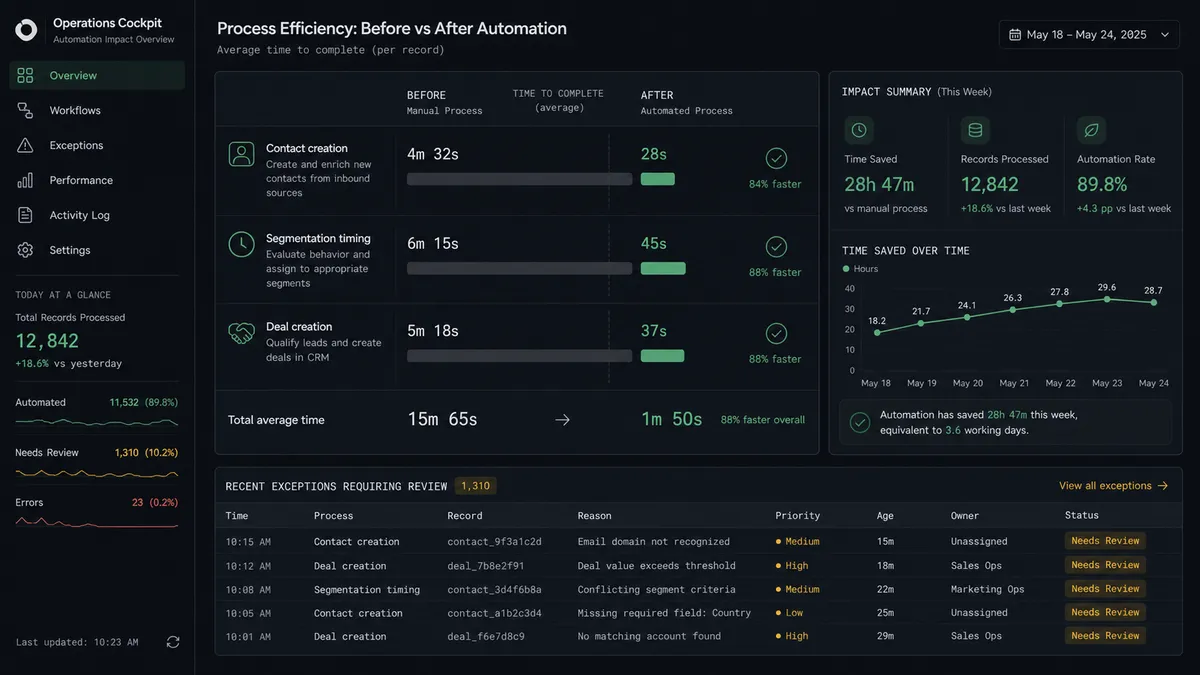
| Contact creation | A marketer copies inbound buyer details into ActiveCampaign one order at a time | Sync Contact upserts the buyer the moment the order is placed, matched by email |
| Duplicate contacts | The same customer enters twice because no upsert runs before create | Every repeat buyer updates the same record instead of creating a new one |
| Segmentation timing | Tags and automation enrollment wait for someone to get to them | The agent tags and enrolls the contact in the same run as the sync |
| High-value order visibility | A large order looks identical to a small one until someone happens to notice | Orders above the threshold route to a sales manager before a deal is ever created |
| Deal creation | Opportunities get opened days late, if a rep remembers to check | Create Deal places the opportunity on the right pipeline and stage the same day, with approval on record |
What you can build
Order-to-contact sync with instant segmentation. Every Shopify order calls Sync Contact, Add Tag To Contact, and Add Contact To Automation in ActiveCampaign, so a buyer is a segmented, automation-enrolled contact within minutes of checkout instead of the next time someone opens the export file.
High-value order to sales deal, with approval. Orders above a value you set route through a human-in-loop approval before Create Deal runs, so a sales manager sees the opportunity and confirms the pipeline before it ever hits the board.
New customer welcome with order context. Shopify’s On New Customer trigger feeds the buyer into Sync Contact, and the agent calls Add Note To Contact with their first order details, so the sales and marketing history starts with real context instead of a blank record.
Won deal syncs back to the storefront. ActiveCampaign’s On ActiveCampaign Event trigger fires when a deal moves to won, and the agent calls Add Tags in Shopify on the matching customer, so a VIP or wholesale flag follows the buyer back into the store for the next order.
Product launch reaches the right segment. Shopify’s On New Product trigger feeds the new SKU into the flow, and the agent calls List Contacts and Add Tag To Contact in ActiveCampaign to target buyers whose tag history matches the new product’s category on launch day.
Common questions
Is it free to connect ActiveCampaign and Shopify on FlowRunner? Yes. FlowRunner has a free plan with 100 executions a month, every integration included, and no credit card required, and new accounts get 14 days of Professional on top.
Can I self-host the Shopify to ActiveCampaign flow? Yes. FlowRunner offers a self-hosted Enterprise option alongside the cloud tiers, so the same order sync and deal-approval workflow can run on infrastructure you control.
Does the agent need my own OpenAI key? The AI agent step runs on a bring-your-own-key model, so you connect the AI provider you already use rather than routing usage through a vendor-owned key.
What happens when the agent isn’t sure about creating a deal? The agent does not guess. It packages the contact, the order value, and the pipeline it would use, posts that to the channel your sales team already watches, and waits for a named manager to approve before Create Deal ever runs.
Does this replace ActiveCampaign’s native Shopify integration? No. FlowRunner sits above the connection as an orchestration layer, so the same contact sync and tagging can also carry a deal-approval gate and a manager escalation that a native storefront sync does not reason about.
Can the same flow route a high-value order to a sales manager? Yes. When an order total clears the threshold you set, the agent holds Create Deal, sends the contact and order details to a sales manager through Slack or email, and only opens the deal after they approve.
Getting started
FlowRunner has a free plan with 100 executions a month, every integration included, and no credit card required, and new accounts get 14 days of Professional on top. Start with the order-to-contact sync, then add the deal-approval gate when your sales team is ready for it. Get started at flowrunner.ai or book a walkthrough at calendly.com/flowrunner/intro.
Frequently asked questions
Is it free to connect ActiveCampaign and Shopify on FlowRunner?
Yes. FlowRunner has a free plan with 100 executions a month, every integration included, and no credit card required, and new accounts get 14 days of Professional on top.
Can I self-host the Shopify to ActiveCampaign flow?
Yes. FlowRunner offers a self-hosted Enterprise option alongside the cloud tiers, so the same order sync and deal-approval workflow can run on infrastructure you control.
Does the agent need my own OpenAI key?
The AI agent step runs on a bring-your-own-key model, so you connect the AI provider you already use rather than routing usage through a vendor-owned key.
What happens when the agent isn't sure about creating a deal?
The agent does not guess. It packages the contact, the order value, and the pipeline it would use, posts that to the channel your sales team already watches, and waits for a named manager to approve before Create Deal ever runs.
Does this replace ActiveCampaign's native Shopify integration?
No. FlowRunner sits above the connection as an orchestration layer, so the same contact sync and tagging can also carry a deal-approval gate and a manager escalation that a native storefront sync does not reason about.
Can the same flow route a high-value order to a sales manager?
Yes. When an order total clears the threshold you set, the agent holds Create Deal, sends the contact and order details to a sales manager through Slack or email, and only opens the deal after they approve.