
n8n alternative: FlowRunner vs n8n
FlowRunner runs the automation n8n runs, with agents that pause for a person, audit trails at $299, and nothing to host. Where each wins and how to choose.
Use FlowRunner when
- Your AI agents need to pull in a person mid-run and wait days or weeks for the answer.
- The team that owns the process should build and run the automation, with no server to host.
- You need audit trails and RBAC on a plan with a published price ($299 Professional).
- You want a permanent free cloud plan: 100 executions a month with every integration.
Use n8n when
- Your team writes its automation code in Python and wants it inside the workflow.
- You want to self-host for free with unlimited executions and have the DevOps time to run it.
- You need built-in Kafka, RabbitMQ, MQTT, SSH, FTP, or Git nodes.
- Fair-code licensing matters, or you plan to fork and extend the platform.
TL;DR
- Start with the automation both run: connector-based, trigger-to-action flows, now with AI agents and human-in-the-loop on top. FlowRunner runs all of it, and the operations team that owns the process ships it without an engineering bottleneck, a server to host, or compliance to bolt on. FlowRunner is Orchestration as a Service, built so non-developers ship production agents.
- This page is about AI-agent automation with human oversight. For that work the fit is not 50/50: FlowRunner is built for it, and n8n is reached through developer ownership of code and infrastructure.
- FlowRunner is stronger where this reader lives: operations-team accessibility, human-in-the-loop as a whole flow an agent calls and waits on for up to a year, audit trails and RBAC at a published mid-tier price, and agent-tool metadata on every action.
- n8n is stronger on free unlimited self-hosting, Python in its code runtime, its GitHub community, fair-code control, and a handful of protocol nodes (message brokers, SSH, FTP, Git).
Who this comparison is for
You are building AI-agent automation where the agent has to do more than fire a linear sequence and finish. It needs to stop and pull in a person when the rules do not cleanly apply. It may touch data an auditor will ask about later. And it needs to get built and maintained by the team that owns the process, whether or not that team writes code. You might be a COO, VP of operations, or operations director at a 50-to-500-person company, coming from n8n or starting fresh, deciding which platform is built for that work.
The overlap is large: the connector-based, trigger-to-action automation n8n runs, FlowRunner runs too, with AI agents and human-in-the-loop on top. This page is about where the two part ways: the agent that hits an automation exception it should not decide alone and has to hold the run open until a human answers, built by people who would rather not run a server.
What FlowRunner is good at
FlowRunner is built around one commitment: agents that know when to stop and ask a human for help, built by the team that owns the process rather than by an engineering group they have to queue behind. Everything else in the platform exists to make that commitment reliable at production scale.
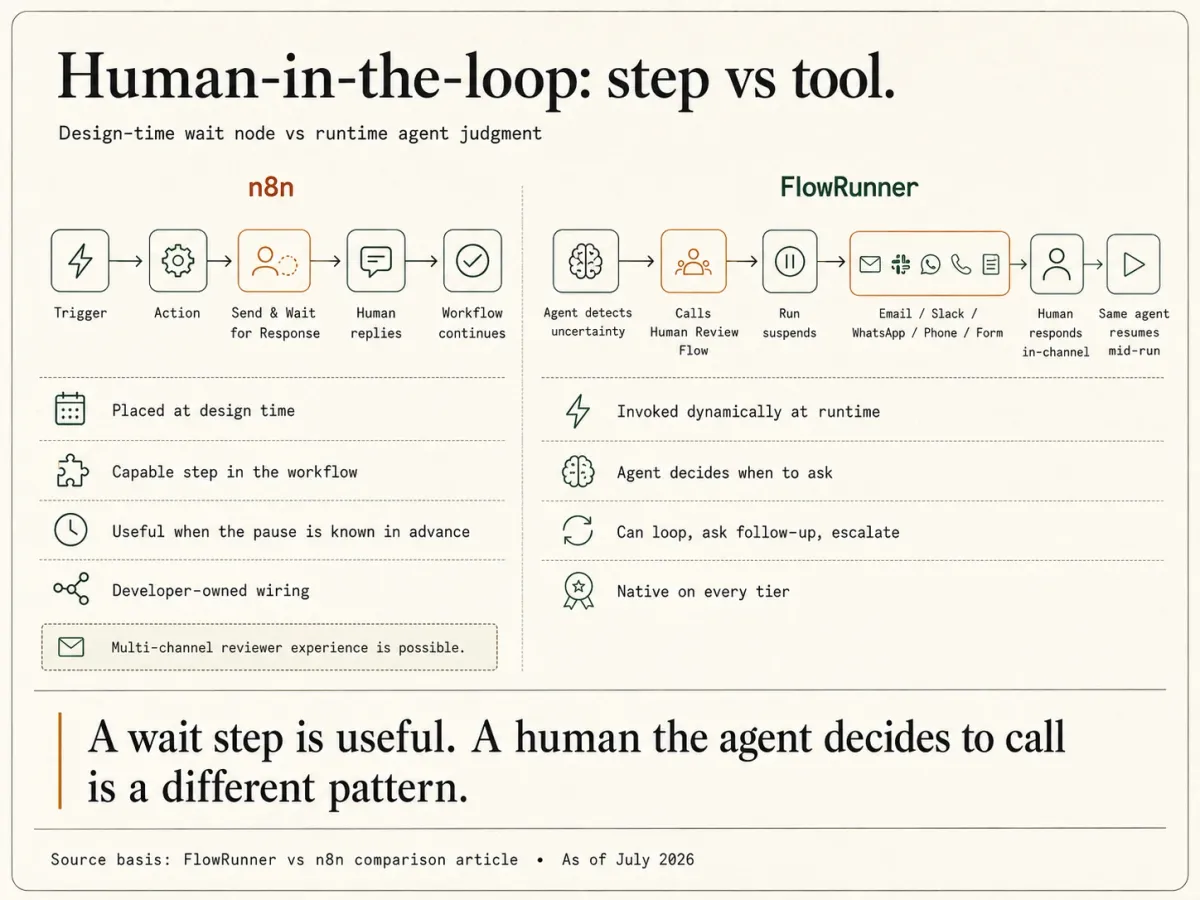
In FlowRunner, an AI agent invokes one of your own flows as a callable tool. When the agent calls that flow, it suspends while the flow runs, and the flow can hold on an external callback until a human replies through email, Slack, WhatsApp, phone, or a Form, then the agent resumes mid-run. This is human-in-the-loop as an execution pattern: the agent pauses on its own judgment, assembles the context and the choices available, routes to a human on their channel, and resumes the moment they answer. Some teams call it a digital andon cord, after the Toyota factory pull cord any worker can pull to stop the line when something needs a human eye.
FlowRunner is strong on:
- Operations-team accessibility. The people who own the process build the automation. The visual editor lets an operations director ship a production agent without a JavaScript primer, and FlowRunner Prompt to Flow builds flows from a plain-language description in the AI tool the team already uses (Claude, ChatGPT, Codex, Cursor). There is no infrastructure to own.
- Human-in-the-loop as an agent tool. The agent decides at runtime to pull in a person, calls a human-review flow as a tool, and suspends until they reply in their own channel: email, Slack, WhatsApp, phone, or a Form. That flow can loop over a batch, ask a follow-up question, and escalate if no one answers. It is native on every plan, including Free.
- Compliance at published prices. Audit trails and RBAC start at the Professional tier ($299/month). HIPAA support with a signed BAA, SSO/SAML, and 90-day audit trails arrive at Business ($999/month).
- An agent-ready catalog with depth. 2,100+ integrations and 56,000+ callable actions (as of September 2026, and growing), roughly 26 actions per integration, each carrying the structured metadata an LLM needs to call it as a tool.
- Long waits. A run can wait up to 30 days on Free, Starter, and Growth, and up to a year on Professional and above. One execution covers the whole run, however long it waits.
- BYOK with no markup. You bring your own AI provider keys, pay providers directly, and FlowRunner takes no markup on inference.
What n8n is good at
n8n is a developer-first workflow automation platform with a self-hosted deployment model at its center. Its homepage cites 209.3k GitHub stars and a community of 250,000+ developers.
n8n is strong on:
- Free unlimited self-hosting. n8n’s self-hosted Community edition runs unlimited executions for free under its fair-code license, and self-hosting is the flagship deployment model.
- Python in the code runtime. n8n’s Code node runs JavaScript or Python at any point in a workflow.
- Protocol nodes. Built-in nodes for the Kafka, RabbitMQ, and MQTT message brokers and for core SSH, FTP, and Git.
- A large developer community. A big GitHub following, a community forum, and a community template library, built over a several-year head start.
If your team is developer-owned and wants to host and extend the platform with code, those strengths line up with how you work.
Where FlowRunner is stronger
For the agentic, human-oversight work this page is about, built and maintained by an operations team, these are the differences that decide the platform:
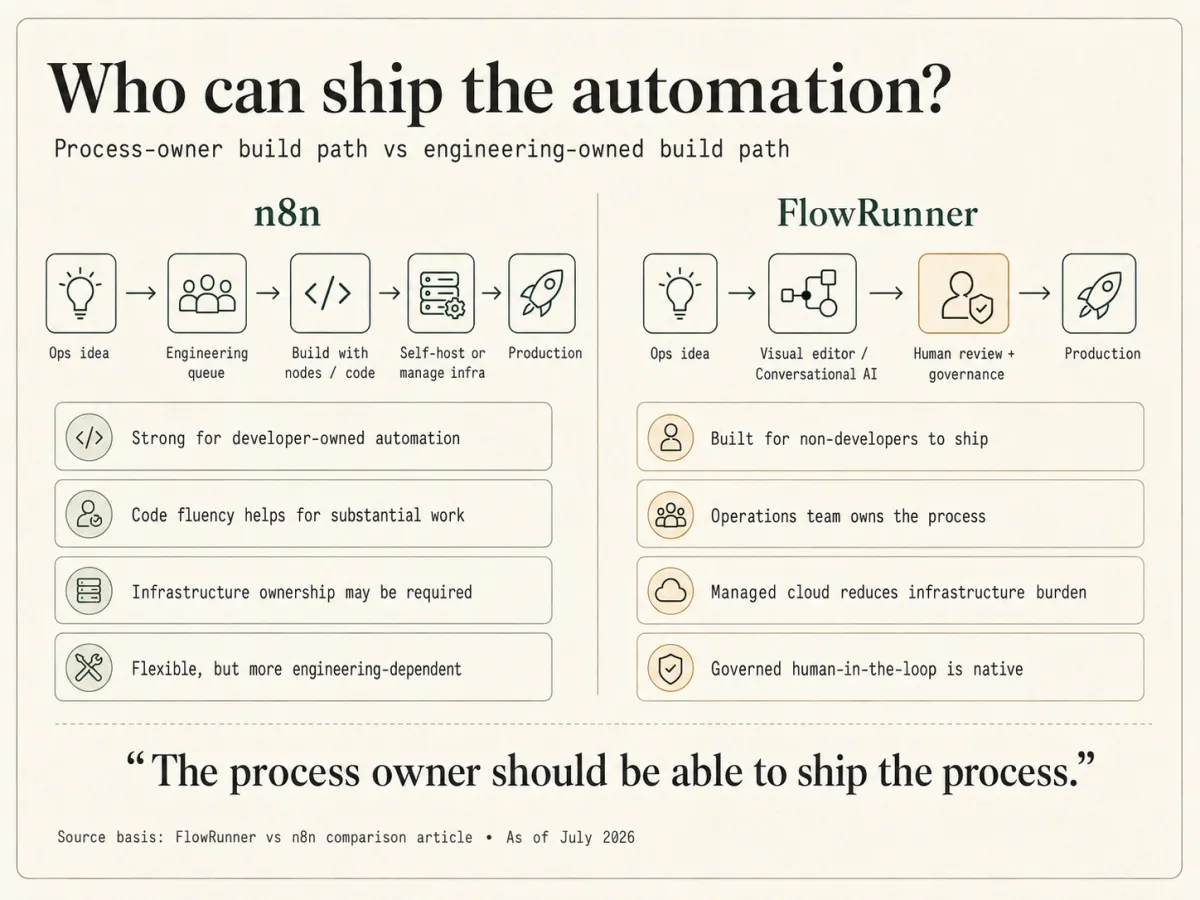
- The operations team can build and maintain it. This is the largest practical difference for the buyer this page is written for. n8n’s design assumes developers will own the platform: the editor is forgiving for simple flows, but anything substantial expects code, and self-hosting expects infrastructure ownership. FlowRunner is built so the operations team that owns the process owns the automation, with no translation between business logic and JavaScript and no server to patch, back up, or monitor.
- Compliance at published prices. FlowRunner ships audit trails and RBAC starting at Professional ($299/month), and signs a BAA from Business ($999/month). n8n Cloud signs no BAA at any price, and puts audit logs, log streaming, and its fuller role set in custom-priced Enterprise. A regulated team on n8n ends up either negotiating Enterprise or self-hosting and owning all of its own compliance. For a 100-person healthcare or financial services company, that difference can decide the platform on its own.
- Human-in-the-loop as a flow the agent calls. n8n has two human steps: the Send and Wait for Response node, placed in the workflow at design time, and a human review gate in front of specific agent tools, where a reviewer approves or denies the tool call. FlowRunner goes further. The agent calls a whole human-review flow as a tool and suspends until it returns. That flow decides who to ask and on which channel, can ask a follow-up, loop over a batch, or escalate when no one answers, and the agent picks up with the person’s actual answer, not just a yes or no. The wait can run up to a year on Professional and above.
- Depth per integration, with agent-tool metadata. FlowRunner’s 2,100+ integrations span 56,000+ actions, roughly 26 per integration, and every action carries typed parameters, descriptions, and sample output so an agent can call it as a tool directly. n8n counts 500+ native integrations on its own homepage. An app-by-app audit found FlowRunner has built 228 of 246 tracked n8n app-nodes, plus 40+ integrations n8n has no node for (Databricks, Snowflake, Azure data services, a security and ITSM stack).
- Composability across agents. An agent assembled in the Agent Factory can call other agents and existing flows as tools, and the Code of Conduct governs how agents communicate, escalate to humans, and leave audit trails across many agents from many authors.
Where n8n is stronger
n8n wins on these dimensions, and if they are your priorities, n8n is the right call.
- Free unlimited self-hosting, available today. n8n’s self-hosted Community edition runs unlimited executions for free, and FlowRunner’s free Community Edition is still coming (its Enterprise on-prem option exists today). The free number covers the license; the server, upgrades, backups, and monitoring are yours, and with no Cloud BAA a regulated team on that path owns all of its own compliance. For a team with DevOps capacity and no compliance requirement, it is a clear cost edge.
- Python. n8n’s Code node runs Python as well as JavaScript. FlowRunner’s code is JavaScript: Custom Cloud Code calls APIs with
fetchand can be handed to an agent as a tool, and custom extensions carry npm packages. A team that writes its automation code in Python will find n8n the more direct fit, though most workflows need little code once the integration does the work. - Message brokers and protocol nodes. n8n has built-in nodes for Kafka, RabbitMQ, and MQTT and for core SSH, FTP, and Git, which FlowRunner does not yet cover. For a genuinely obscure service, n8n’s community nodes or its generic HTTP node may reach it first. On mainstream business apps the catalogs are at parity, so this matters when one of those protocols is your deciding factor.
- The developer community. n8n’s GitHub following, forum, and community templates give a developer starting cold a large library of examples. FlowRunner’s community is smaller today, and its answer is a growing catalog of install-and-configure packages plus FlowRunner Prompt to Flow, which builds the flow from a description instead of a template.
- Fair-code licensing and developer control. Teams that want to fork and extend the platform’s own code, or self-host without a commercial contract, get that from n8n’s Sustainable Use License, which permits free self-hosting and restricts commercial resale. FlowRunner’s Community Edition will be free but proprietary.
Starting free: FlowRunner Free against n8n’s free options
“Free n8n alternative” usually means one of two things, and FlowRunner answers both from the same plan. n8n’s permanent free option is the self-hosted Community edition: unlimited executions, on infrastructure you run and maintain. n8n Cloud has no permanent free plan; it starts at €20 a month for Starter (2,500 executions, annual billing) after a time-limited trial.
FlowRunner Free is a permanent cloud plan: 100 executions a month, with one execution being one whole workflow run, the same unit n8n uses. It includes every integration, AI agents on your own provider keys, human-in-the-loop across email, Slack, WhatsApp, phone, and Form, unlimited users, unlimited workflows, one concurrent run, and 24 hours of log history. The first paid rung is $5 a month (Starter, 300 executions; $15 for 3,000), and every new account starts with 14 days of Professional, the tier with audit trails and RBAC.
The difference is what “free” costs to operate. n8n’s free option is a server you provision, patch, back up, and scale; the $0 is the license. FlowRunner’s Free plan is the platform itself, already running, with every capability on it and nothing to host, and the step up from it is a $5 upgrade rather than a move to a different deployment.
Feature comparison
| Dimension | FlowRunner | n8n |
|---|---|---|
| Primary buyer | Operations team plus builder | Developer / platform team |
| Who builds and maintains | Operations team, no code required | Developer team, code and infrastructure ownership |
| Billing unit | Execution (one whole run) | Execution (one whole run); Community self-host unlimited free |
| Visual builder | Yes (operations-oriented) | Yes (developer-oriented) |
| Build from a prompt | FlowRunner Prompt to Flow, from Claude, ChatGPT, Codex, or Cursor | AI Workflow Builder in the editor (one credit per message) |
| Custom code | Custom Cloud Code (JavaScript with fetch, also an agent tool); custom extensions (your own JavaScript actions and triggers, with npm packages) | Code node: JavaScript or Python |
| AI agents | Native (Agent Factory) | AI Agent node (LangChain) |
| Human-in-the-loop | Native every tier; the agent calls a whole human-review flow as a tool; can loop, branch, escalate | Send and Wait for Response node; approve or deny gate on agent tool calls |
| HITL reviewer channels | Email, Slack, WhatsApp, phone, Form | Chat, Slack, Discord, Telegram, Teams, Gmail, WhatsApp, Google Chat, Outlook |
| Max wait per run | 30 days Free, Starter, Growth; up to 1 year Professional and above | Wait node; no ceiling published on the node page |
| MCP | Consumes external MCP servers as agent tools; FlowRunner Prompt to Flow is an MCP server for building and running flows | Native (server trigger + client) |
| Integrations | 2,100+ integrations, 56,000+ actions (~26 each) | 500+ native integrations (n8n’s homepage count) |
| Mainstream app coverage | 228 of 246 tracked n8n app-nodes built, plus 40+ n8n lacks | Native nodes plus community nodes |
| Agent-tool metadata on actions | On every action | Not the model |
| Cloud entry price | Free $0 (100 executions); Starter $5/mo (300) or $15 (3,000); Growth $45/mo (12,000) | €20/mo Starter (annual) |
| Free evaluation | Permanent Free plan plus 14 days of Professional on signup, no card | Time-limited Starter and Pro trial; unlimited free self-host |
| HIPAA / BAA | HIPAA with a signed BAA from Business ($999) | No Cloud BAA |
| Audit trails | Professional ($299) | Audit logs and log streaming: Enterprise (custom) |
| RBAC | Professional ($299) | Project editor on Cloud Pro; viewer and custom roles Enterprise |
| SSO/SAML | Business ($999) | Enterprise (custom); Business €667 self-host lists SSO |
| Self-hosting | Enterprise on-prem; Community Edition coming | Fair-code, free unlimited executions |
| BYOK for AI | Yes, no markup on inference | Yes, your own provider credentials |
| Inter-agent governance | Code of Conduct | No equivalent |
| SOC 2 | Security program designed to meet common audit requirements | Yes |
Decision framework
Pick FlowRunner if:
- Your agents need to stop and pull in a human mid-run, the human might take days to answer, and you want the agent to call that person as a tool rather than hit a fixed step.
- The operations team that owns the process needs to build and maintain the automation without an engineering bottleneck or a server to run.
- You handle regulated data and need audit trails, RBAC, and a signed BAA on a plan with a published price, which n8n Cloud does not offer.
- You want every action in the catalog callable by an agent as a tool, with the depth and the metadata to make that reliable.
- The buyer in your organization is a COO, VP of operations, or operations director, not a CTO.
Pick n8n if:
- You have a developer team that owns automation as part of its job and wants to write and control the code.
- Free unlimited self-hosting is your priority, you have the DevOps capacity to run it, and you do not need a Cloud BAA.
- You need built-in message brokers or core SSH, FTP, or Git, or a specific community-contributed node today.
- Your automation code is written in Python and you want to keep it inside the workflow.
- Fair-code licensing matters to your procurement or technical leadership, or you plan to fork and extend the platform.
If the answer is mixed, run a real workflow on both before committing.
Ready to move?
Moving an n8n workflow is a download and a chat. Download the workflow as JSON, paste it into your AI tool with FlowRunner Prompt to Flow connected, and it builds the same flow in your workspace, asking about anything the file doesn’t say. How to move from n8n to FlowRunner has the steps and the request to paste. Have a bigger estate or a question first? Contact us.
Frequently asked questions
Is FlowRunner cheaper than n8n?
Both bill the same unit: one execution is one full workflow run, however many steps it has, so the numbers compare directly. On managed cloud, FlowRunner starts lower: a permanent Free plan at 100 executions a month, then Starter at $5/month for 300 executions or $15 for 3,000, with every integration, AI agents, and human-in-the-loop included at every step. n8n Cloud's cheapest plan is Starter at €20/month on annual billing. FlowRunner Growth ($45/month, 12,000 executions) sits between n8n's Starter and its Pro plan (€50/month). n8n's self-hosted Community edition runs unlimited executions for free; the cost there is the server and the time to patch, back up, and monitor it. The gap widens when compliance matters: FlowRunner ships audit trails and RBAC at Professional ($299/month) and signs a BAA from Business ($999/month), while n8n Cloud signs no BAA at any price and puts audit logs and log streaming in its custom-priced Enterprise tier.
Can I migrate from n8n to FlowRunner?
Yes. Download each workflow from n8n as JSON, connect FlowRunner Prompt to Flow to the AI tool you already use, and paste the file in with a short request. It builds the same flow in your FlowRunner workspace and asks about anything the file doesn't say. You reconnect accounts and test. The step-by-step guide is How to move from n8n to FlowRunner.
Does FlowRunner have as many integrations as n8n?
Yes, and more on native integrations. FlowRunner ships 2,100+ integrations; n8n's homepage counts 500+ native integrations. n8n's directory shows a larger figure (2,000+), which is a broader count than its native integrations. An app-by-app audit found FlowRunner has built 228 of the 246 tracked n8n app-nodes, and FlowRunner covers 40+ integrations n8n has no built-in node for, including Databricks, Snowflake, Azure data services, and a full security and ITSM stack. n8n's built-in set reaches further on protocol nodes: message brokers (Kafka, RabbitMQ, MQTT) and core SSH, FTP, and Git. Every FlowRunner action also ships agent-tool metadata, so an agent can call it as a tool directly.
Can I self-host FlowRunner like I can n8n?
Both platforms self-host. n8n's self-hosted Community edition is free, unlimited on executions, and available now. FlowRunner offers a self-hosted Enterprise option with audit trails, SLA tracking, RBAC, and SSO, and a free Community Edition for single-instance deployments is coming. Self-hosting either platform means you own the infrastructure and its operating cost. FlowRunner's cloud plans, including Free, have nothing to host.
Does FlowRunner work without writing code?
Yes. Non-developers build agents and flows in the visual editor, or describe them in plain language through FlowRunner Prompt to Flow from Claude, ChatGPT, Codex, or Cursor, and ship them to production without owning code or infrastructure. When code helps, Custom Cloud Code runs JavaScript as a step or as an agent tool. n8n works without code for simple flows and exposes JavaScript and Python in its Code node; its design assumes code fluency for anything substantial.
Is n8n open source and FlowRunner is not?
n8n uses a fair-code license: its Sustainable Use License permits free self-hosting and restricts reselling or embedding n8n commercially. FlowRunner is proprietary, with a free self-hosted Community Edition coming. The licensing question matters most to teams who plan to fork or modify the platform itself.
Is there a free alternative to n8n that does not require self-hosting?
Yes. FlowRunner's Free plan is a permanent cloud plan: 100 executions a month, every integration, AI agents on your own keys, human-in-the-loop, unlimited users and workflows, with nothing to host. n8n's permanent free option is the self-hosted Community edition, which runs on infrastructure you operate; n8n Cloud starts at €20 a month after a trial. Both platforms count one whole workflow run as one execution, so the numbers compare directly. Paid FlowRunner plans start at $5 a month, and every new account starts with 14 days of Professional.
Keep reading



I like that aspect of the human in the loop when it's needed. That's ultimately what we need to get to.
Ready to try it?
Start on the Free plan. No card required, and every new account gets 14 days of Professional.