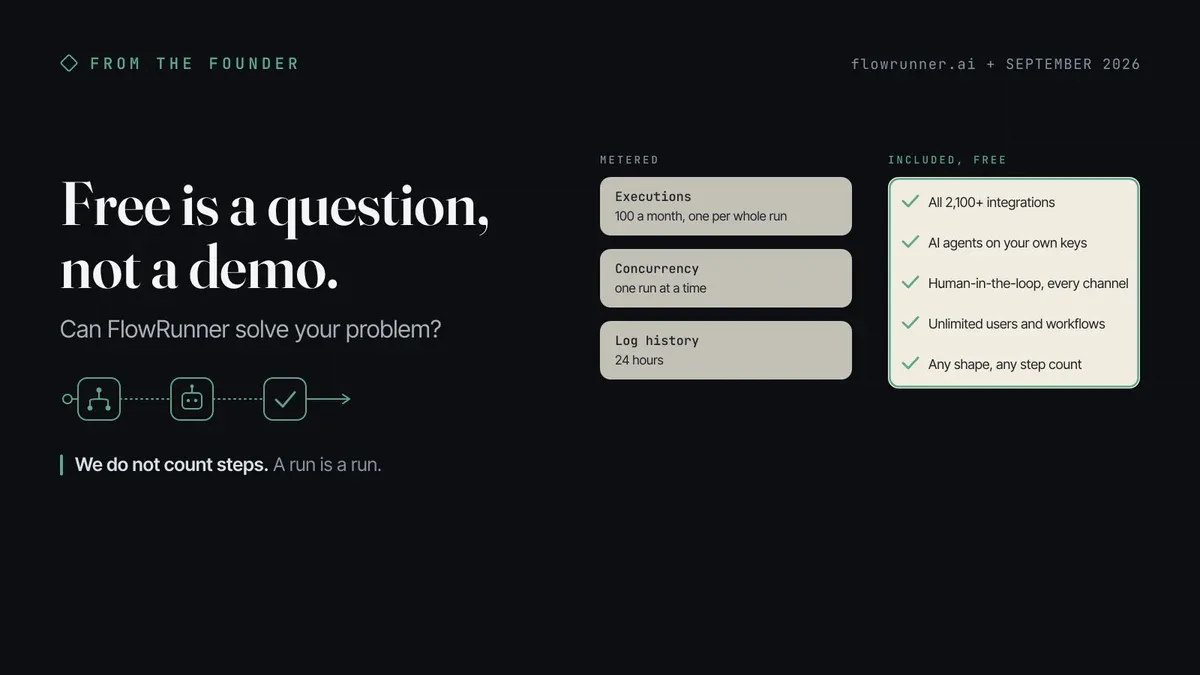
A free plan has one job, and lead generation is not it. Its job is to answer a question: can this thing solve your problem? We built FlowRunner’s Free plan around that question, and answering it honestly meant giving up the levers most free plans pull.
Here is the plan, stated flat. The Free plan is $0, with no card and no clock, and it is the whole platform: all 2,100+ integrations, AI agents on your own keys, human-in-the-loop, unlimited users, unlimited workflows. What it meters is what scales with use. Executions, 100 a month, where one execution is one whole run however many steps it contains. Concurrency, one run at a time. Log history, a 24-hour window on run detail in the app.
The rest of this is why we drew the line there instead of somewhere easier.
What a feature gate does to the question
Disable the integrations, or the agents, or the human step, or the kinds of workflow someone is allowed to build, and they are no longer evaluating FlowRunner. They are evaluating a reduced version of it. They will learn something real from that. It is just not the thing they came to find out.
This is the part of the category nobody says out loud: most free plans are demos with a meter attached. That is a legitimate business decision and we understand why it gets made. A demo answers the question “is this pleasant to use.” It cannot answer “does this solve my problem,” because the problem is never in the part of the product a demo keeps.
The moment a free plan gates capability, it starts producing a specific kind of false negative. You build the thing you need, hit the wall where the real feature lives, and form an opinion about the product from the side of the wall you were allowed to stand on. We would rather you built the real workflow, connected the real systems, and ran it in production. Then the opinion is about us.
What we meter, and why those three
We prefer to meter the things that naturally scale with usage. Volume, parallelism, and how much run history you can see. All three grow when the work grows, which means the meter moves for the same reason your business does.
On the Free plan that is 100 executions a month, one run at a time, and 24 hours of log history. Everything else is the product as we ship it.
That includes BYOK, a model where the customer supplies their own AI provider API credentials, pays providers directly for usage, and FlowRunner orchestrates calls across providers without taking a markup on inference. There is no AI meter on any plan, Free included. Your keys, your rates, your invoice from OpenAI or Anthropic or Google.
It also includes human-in-the-loop, an execution pattern where AI agents pause autonomously, assemble the relevant context and the decision choices available, route to a human via their preferred channel, and resume the moment the human responds. That one matters more than the others. It is the reason a large share of these workflows exist inside a business at all, and it is the single most commonly gated feature in this category. It is on the Free plan because a platform whose tagline is agents that ask cannot ask you to pay before an agent asks anything.
The ice cream shop
Think about walking into an ice cream shop. You see several dozen flavors and you can try any of them. It would seem incomprehensible if some were available only at full price.
We go further than that with FlowRunner. If you like a flavor, you can enjoy it in moderation with us for free. In fact, 100 times a month.
The best part is that your flow has no limit for the number of steps, simply because we do not count them.
What you cannot sample for free is the waffle cone. The toppings are not free either. The cone and the toppings are the parts a business buys once the flavor is settled. Bulk workspace export and API export unlock at Growth. Thirty-day audit trails and role-based access control arrive at Professional. SSO with SAML and SLA tracking arrive at Business. A run that waits up to 30 days on Free, Starter, and Growth waits up to a year on Professional and above. Every flavor in the case is free to try and free to enjoy in moderation. The cone and the toppings are what you buy.
For the first two weeks you get those too. Every new account gets 14 days of Professional on its first workspace, no card, with audit trails and role-based access control switched on, so the governance features can be evaluated the same way the flavors are. When the trial ends without a payment method, the workspace moves to Free and the flows keep running. Nothing is paused and nothing is deleted. The reasoning behind each rung is in the Free plan announcement.
The step count nobody counts
One execution is one complete workflow run, start to finish. A run with two steps and a run with forty each count as one. Step count is not a meter on any plan, which is why there is no ceiling on it: there is nothing to cap.
That is not how the rest of the field counts. Zapier defines a task as one successful action step, so a five-step Zap consumes five tasks per run. Make counts a credit per module run per bundle of data, which is why Make documents a three-module scenario over ten items as roughly 31. Several AI-native plans meter the model itself as credits that bundle inference cost. Each of those is verified from the vendor’s own page as of September 15, 2026, and the full side by side lives in our comparison of free plans.
We count runs because a run is the errand. Under a step meter, every branch you add and every enrichment call you make is a line item on next month’s bill, and the design of the workflow becomes a budgeting exercise. Under a run meter, the shape of the flow goes back to being a design question. We would rather people design well than design cheap.
You cannot evaluate a layer by removing the layer
There is a reason this decision was not hard for us, and it has less to do with generosity than with what the product is.
The work our customers automate almost never sits inside one system. It lives in the handoffs between them, and every system on either side of a handoff is authoritative about its own data and indifferent past its own edge. Nobody owns the handoff. That is the hard part of the job, and it is the first part a sampler takes out: the connectors to the systems you actually run, the agent that reasons across them, the moment the run stops and asks a person.
Which means a capability-gated free plan of a product like this is not a smaller version of the product. It is a different product. The thing being evaluated is exactly the thing that was removed. A layer above the systems of record is the category that owns that seam: Orchestration as a Service, a platform category that coordinates, governs, and supervises multi-agent environments while keeping humans in control of the decisions that require judgment. FlowRunner is built for that layer. You can only judge a layer by running it across your real systems, so we let you.
The line this all comes down to
In other words: we do not want to charge you to discover whether FlowRunner is useful. We want to charge when it becomes useful enough that you need more of it.
Start on the Free plan
Open a free workspace, build the workflow you would actually put in front of your business, and put the human step in it on the first pass. That is the flow that answers the question. If you would rather have someone build it alongside you, send us a note.
Frequently asked questions
What does FlowRunner's Free plan include?
The whole platform. All 2,100+ integrations, AI agents on your own provider keys, human-in-the-loop over email, Slack, WhatsApp, phone, or a Form, unlimited users, unlimited workflows, and single-flow export. It is $0 with no card and no time limit, and one Free workspace per account.
What is metered on the Free plan?
Three things, all of which scale with use: executions, 100 a month, where one execution is one complete run; concurrency, one run at a time; and log history, a 24-hour window on run detail in the app.
Does the Free plan limit how many steps a workflow can have?
No. One execution is one complete run from start to finish, so a run with two steps and a run with forty each count once. Step count is not a meter on any plan, which is why there is no cap on it.
When does upgrading to a paid plan make sense?
When the workflow is already working and you need more of it: more volume than 100 executions a month, more than one run at a time, or a longer log history window. Governance features arrive on the higher rungs too, with 30-day audit trails and role-based access control at Professional and SSO and SLA tracking at Business.