Proof of delivery (POD) is the document the receiver signs when your load is delivered. In truckload freight it is the bill of lading signed at the receiving dock, with the delivery date, the receiver’s name, and any shortage or damage written next to the signature. Your customer expects it before paying, so a broker or 3PL bills only once a signed POD is on the load.
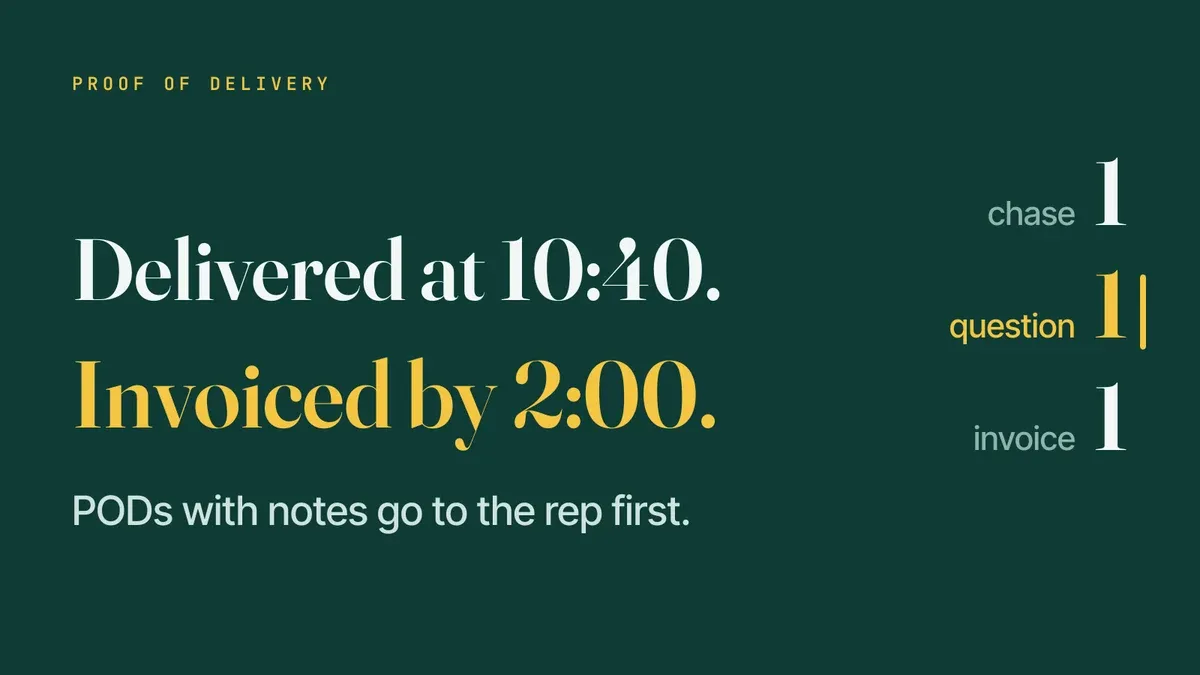
Billing waits on the carrier. The truck is empty by mid-morning, and the POD shows up two days later after someone on your team has asked for it twice. A FlowRunner flow asks for the POD on every delivered load within hours and invoices the customer as soon as a clean one arrives.
- 1Load deliveredTurvo marks it Delivered with no POD on file
- 2Carrier askedAn email to the dispatcher and a text to the driver
- 3Agent reads the PODSignature, date, counts, and notes
- 4The rep on the load decidesOnly PODs with a shortage, damage, or a mismatch
- 5Invoice sentPOD on the load, invoice out from QuickBooks Online
One delivered load, start to finish
Pine Ridge Freight delivered load 40231-88412 for Harbor Foods to Lakeside Grocery DC in Indianapolis at 10:40 AM on Nov 12. Turvo marked it Delivered, which started the flow. The load had the rate confirmation and the pickup BOL, but no POD.
The flow waited two hours and checked again. Still nothing, so it emailed the carrier’s dispatcher, Tom Becker, and texted the driver, Andre Wallace, asking for a photo of the signed BOL. Tom replied in the email thread at 1:37 PM, and the AI agent read the attachment against the load:
| Field | On the load | On the POD |
|---|---|---|
| BOL number | 88412-HF | 88412-HF |
| Consignee | Lakeside Grocery DC, Indianapolis, IN | Lakeside Grocery DC, Indianapolis, IN |
| Delivered | Nov 12, 10:40 AM | Nov 12, in 10:05 AM, out 10:40 AM |
| Seal | 448190 | 448190, intact |
| The POD belongs to this load and is signed and printed by J. Moreno, receiving. | ||
| Cases | 1,200 shipped | 1,198 received |
| The receiver wrote "2 cases short" next to the signature. | ||
The paperwork is good, but a shortage note can turn into a short payment if the customer sees it first on their own copy. The flow holds the invoice and asks Kevin Tran, the rep on the load, in Slack:
Slack, direct message to the rep on the load
Shortage on the POD: Harbor Foods, load 40231-88412
Pine Ridge Freight sent the POD at 1:37 PM, signed by J. Moreno at Lakeside Grocery DC. The receiver noted 2 cases short of 1,200. The invoice to Harbor Foods is ready at $3,348.00.
Was the seal intact at delivery?
Yes. The POD shows seal 448190 marked intact, the same number as on the pickup BOL. The pickup BOL is marked shipper load and count.
With the seal intact on a shipper load and count, the two cases are between Harbor Foods and its receiver. Kevin clicks Bill now. The flow attaches the POD to the load in Turvo and moves the load to Ready for billing. Then it creates the invoice in QuickBooks Online from the customer charges on the load, with the decision on it:
Load 40231-88412, BOL 88412-HF. Linehaul $2,850.00 and fuel $498.00 from the customer charges in Turvo. POD from Pine Ridge Freight received Nov 12, 1:37 PM, signed by J. Moreno. 2 cases short noted on the POD, seal 448190 intact, shipper load and count. Billed in full, approved by Kevin Tran in Slack, Nov 12, 1:52 PM.
QuickBooks Online emailed the invoice to Harbor Foods at 1:53 PM, the afternoon the truck was unloaded. A POD with no notes goes from the inbox to a sent invoice without anyone touching it. Every run keeps a step-by-step record of each chase message, what the agent read, and who approved billing.
The load, its documents, and the carrier contacts come from Turvo. The chase goes out through Gmail and Twilio, the rep answers in Slack, and the invoice goes out from QuickBooks Online.
What a proof of delivery is
Wikipedia defines a POD as “a document that substantiates that goods have been delivered to their intended recipient.” In truckload, the driver hands the receiver the BOL, the receiver counts the freight and signs, and that signed copy becomes the POD.
A POD your customer will accept has these on it:
| Field | What billing checks |
|---|---|
| Load, BOL, or PRO number | It belongs to the load you are invoicing |
| Consignee name and address | The freight went where the customer sent it |
| Delivery date, with in and out times | It matches the delivery on the load, and the times back up any detention |
| Receiver’s signature and printed name | Someone at the consignee accepted the freight |
| Piece or pallet count | What was received against what shipped |
| Exception notes | Shortage, overage, or damage the receiver wrote down |
| Seal number | Whether the trailer was opened on the way |
POD vs. BOL
| Bill of lading | Proof of delivery | |
|---|---|---|
| Signed when | At pickup | At delivery |
| Signed by | The shipper and the driver | The receiver at the consignee |
| What it records | What was tendered and on what terms | That the freight arrived, when, and in what condition |
| What billing uses it for | The shipment details on the invoice | Releasing the customer invoice |
Why a missing POD delays payment
Your customer pays for freight that arrived, and the POD is how their AP team knows it did. SAP’s own proof of delivery process works the same way: “an invoice is issued only after the customer has confirmed the delivery’s arrival.” If you factor, the documents are checked before the load is funded. Truckstop’s Document Audit, for example, flags a missing document when a load is submitted for funding.
Every day the POD sits in a truck cab adds a day to when you get paid. The same POD is also checked before you pay the carrier, covered in freight invoice audit.
Getting every POD the same day, step by step
- Find the loads that delivered today with no POD attached.
- Give the carrier a short window to send it on their own.
- Ask the dispatcher and the driver directly, with the load and BOL numbers.
- Read the POD when it arrives: signature, date, counts, and notes.
- Attach it to the load and mark the load ready to bill.
- Send exceptions to the rep, then invoice the customer.
Exceptions and what the flow does
| Exception | What it looks like | What the flow does |
|---|---|---|
| No POD after the window | The load delivered at 10:40 AM and nothing is on file by 12:40 PM | Emails the dispatcher, texts the driver, and asks again after a second wait |
| Unsigned POD | A BOL photo with no receiver signature or printed name | Asks the carrier for the signed copy and holds the invoice |
| Unreadable photo | A dark or cropped picture of the BOL | Asks the carrier for a clearer scan |
| Shortage, overage, or damage | ”2 cases short” or “1 pallet crushed” next to the signature | Asks the rep in Slack before billing, with the counts and the seal |
| Wrong load | The BOL number on the POD belongs to another load | Doesn’t attach it and asks your billing team |
How to start
Start with the carriers whose PODs arrive last. They are where most of your unbilled loads sit today.
Set the first wait from your own history: the time by which most carriers send the POD unasked. For the first two weeks, send every POD with a note to the rep, then decide which notes can go straight to billing. Brokers and 3PLs can see more on the logistics page.
Frequently asked questions
What is a POD in logistics?
A POD, or proof of delivery, is the document the receiver signs when freight is delivered. In truckload freight it is the bill of lading signed at the receiving dock, with the delivery date, the receiver's name, and any shortage or damage notes.
What is the difference between a BOL and a POD?
The BOL is signed at pickup and records what was shipped and on what terms. The POD is signed by the receiver at delivery and records that the freight arrived and in what condition. In truckload, the POD is the BOL itself, signed a second time at delivery.
What happens if a POD is missing?
The customer invoice waits, because customers and factoring companies want the signed POD before they pay or fund the load. Ask the carrier's dispatcher and driver for it within a few hours of delivery, while the paperwork is still in the truck.