The prior authorization process is how a practice gets a health plan’s approval before it delivers a service the plan covers only with approval. Your team finds out whether the service needs one and sends the payer a request with the records that show medical necessity. Then it follows up until the payer decides, and records the authorization number before the patient starts.
Most of the time goes into pulling the packet together from the chart and waiting on payers. In an AMA survey of 1,000 physicians in late 2024, practices completed 39 requests per physician each week, and physicians and staff spent 13 hours a week on them. A FlowRunner flow checks each new appointment and builds the packet from the chart. Once your PA coordinator approves, it faxes the payer and files the decision on the chart.
- 1Appointment bookedIn Healthie or DrChrono
- 2PA checkedEligibility and your payer rules
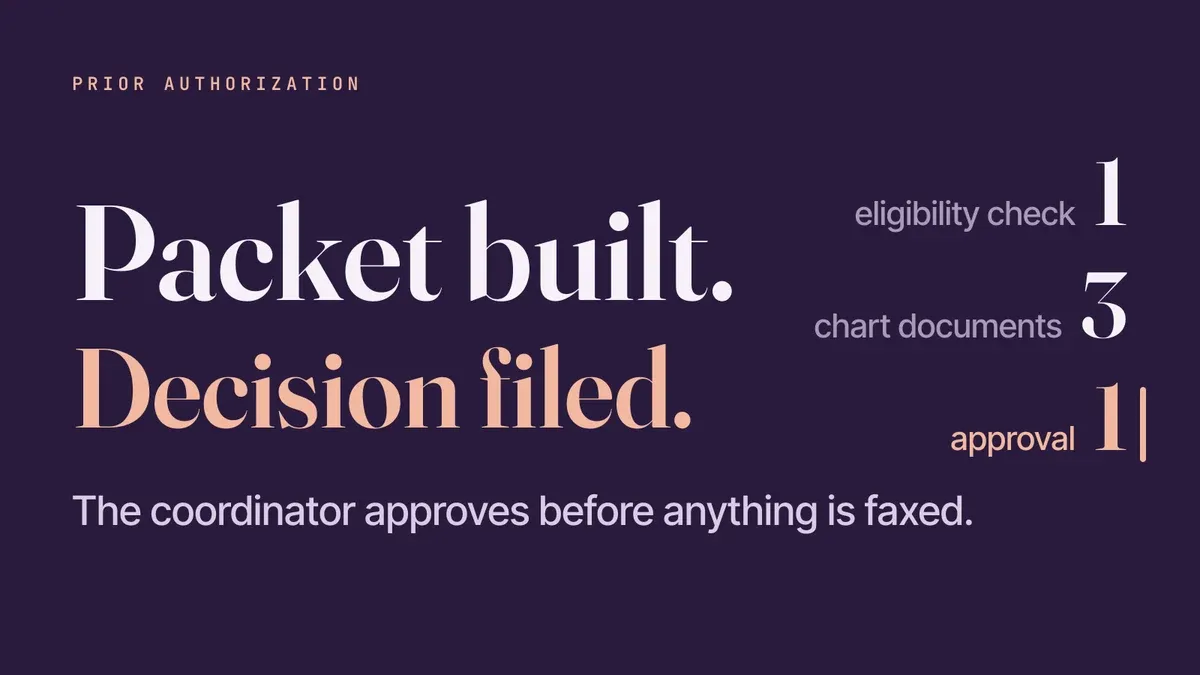
- 3Packet builtChart documents, diagnoses, summary
- 4Coordinator approvesAsks the flow, then sends
- 5Faxed and filedDecision on the chart, scheduler told
One authorization, start to finish
Here is a sample from Tidewell Health, a virtual intensive outpatient program (IOP) for adults with depression. On Nov 12, intake booked Marcus Hill’s first IOP day for Nov 24 in Healthie. Stedi shows the coverage active and flags outpatient mental health for prior authorization, so the flow built the request from the chart:
| Field | From the chart |
|---|---|
| Patient | Marcus Hill, born 03/14/1985, member ID PSH-77310452 |
| Service | Virtual IOP (HCPCS S9480), 3 days a week for 4 weeks, starting Nov 24 |
| Requesting provider | Elena Park, MD, NPI 1999999984 |
| Diagnosis | F32.9, major depressive disorder, single episode, unspecified |
| That is the problem list code. Dr. Park's Nov 6 evaluation describes a third episode (F33.1), and your Prairie State notes say it returns unspecified codes. | |
| Prior treatment | 14 weeks of weekly therapy, sertraline 100 mg since June |
| From the therapist's discharge summary of Oct 28 and the medication list. | |
| Attached | Psychiatric evaluation, intake assessment, therapy discharge summary, 9 pages |
| Medical necessity | A one-page summary drafted by the agent |
| Written from the attached documents, for the coordinator to read first. | |
The flow then asks Tasha Greene, the PA coordinator, in Slack:
Slack, the #prior-auth channel
PA needed: M.H., virtual IOP from Nov 24, Prairie State Health Plan
The packet is ready: the request and summary plus 3 chart documents, 9 pages in all, going to Prairie State's PA fax line. One thing to settle first. The problem list has F32.9, and Dr. Park's Nov 6 evaluation describes recurrent depression, F33.1.
Does the evaluation say why IOP and not more weekly therapy?
Yes, on page 3. PHQ-9 rose from 14 to 19 over 14 weeks of weekly therapy, and Dr. Park recommends a higher level of care. The evaluation records no suicidal intent and no need for inpatient care.
Tasha clicks Fax with F33.1, and the flow merges the request, the summary, and the chart documents into one PDF and faxes it to the payer. On Nov 17, Prairie State’s determination arrives by fax and starts its own run. The agent reads it and files it on Marcus’s chart:
Prior authorization approved by Prairie State Health Plan. Authorization PA-2611-48213, 12 IOP days from Nov 24 to Dec 19, 2026. Requested by fax on Nov 12 at 10:12 AM with diagnosis F33.1, approved for sending by Tasha Greene in Slack. Determination received by fax on Nov 17 at 2:06 PM.
The scheduling team gets a Slack message that Marcus is cleared for Nov 24. A denial goes to Tasha with the payer’s reason, so Tasha can arrange a peer-to-peer review or an appeal with Dr. Park. If nothing comes back by the day you set for that payer, the flow asks Tasha to call.
When eligibility shows no prior authorization needed, nobody is asked. Every run keeps a step-by-step record of what the flow read and sent and who approved it. When a payer says it never got the request, you open the run and see the fax confirmation.
The appointment and the chart come from Healthie or DrChrono, and eligibility goes through Stedi. Faxes go out and come back through Documo, SRFax, or RingCentral, and the coordinator answers in Slack or by email.
The prior authorization process, step by step
- Check whether the service needs approval, against the payer’s list for that service code and the eligibility response.
- Gather the clinical records that show medical necessity.
- Fill in the request with the service codes and the dates of care.
- Submit it the way the payer takes it, by fax or on its portal, and keep the confirmation.
- Follow up until the payer decides, and answer any request for more records.
- Record the authorization number and the approved dates where scheduling and billing will see them.
- On a denial, read the reason, then appeal or fix the request and resubmit.
Each step happens in a different system, from the EHR to the payer’s fax line, so keeping a request on track takes an orchestration layer that works in all of them. FlowRunner is built for that layer.
What goes in a prior authorization packet
| Item | Why the payer wants it |
|---|---|
| Patient name, date of birth, member ID | To match the request to the member |
| Service codes (CPT or HCPCS), units, and dates | To know exactly what it is approving |
| Diagnosis codes (ICD-10), as specific as the notes support | To check the service against its coverage criteria |
| Clinical notes and test results | To show the service is medically necessary |
| Prior treatment and how it went | To see that a lower level of care was tried or doesn’t fit |
| The payer’s request form, where it has one | Some payers return requests sent without it |
Exceptions that stall a prior authorization
| Exception | What it looks like | What the flow does |
|---|---|---|
| Unspecific diagnosis | The chart’s code is unspecified and the notes say more | Shows the coordinator both before anything is sent |
| No PA flag | The eligibility response is silent, and your payer rules say the service needs one | Treats it as required and builds the packet |
| Request for more information | The payer faxes back asking for more notes | Finds the documents on the chart and asks the coordinator to send them |
| Portal-only payer | The payer takes requests only on its website | Builds the packet, and the coordinator submits it there |
| Authorization ending | The approved dates run out before treatment ends | A week before the end date, asks the coordinator about a reauthorization |
For referrals that arrive by fax before the appointment is booked, see fax referral intake.
HIPAA and what each person sees
FlowRunner signs a Business Associate Agreement on the Business plan and higher, and the BAA must be executed before any PHI flows through your workspace. Details are on our Trust and Security page. Every other service in the path handles PHI too, so each needs its own BAA with you:
- the EHR
- Stedi
- the fax service
- Slack, or your email provider
- the AI provider whose model reads the chart and the faxes
FlowRunner runs the agent on your own AI provider key, so the documents go to that provider under your account. Our HIPAA software checklist covers what to ask each vendor. Keep the Slack message short, as in the example.
How to start
Write down your payer rules first. For each payer, the flow needs:
- the services that need a request
- its PA fax number
- what it wants in the packet
- its turnaround for a decision
Those notes go into a knowledge base the agent reads, and they catch what an eligibility response leaves out. Start with your two busiest payers and one service, and have the coordinator check each summary against the chart for the first two weeks. Healthie’s API is an add-on on its Group and Enterprise plans, so confirm you have it. More on prior authorization and on digital-health teams is on the healthcare page.
Frequently asked questions
How long does prior authorization take?
It depends on the payer and on whether the request is urgent. Since January 2026, a CMS rule requires Medicare Advantage, Medicaid, and CHIP plans to decide within 72 hours for expedited requests and seven calendar days for standard ones. Employer plans set their own timelines, so track a turnaround for each payer.
Who is responsible for getting prior authorization?
The provider who orders or delivers the service submits the request. In most practices a PA coordinator or the intake team assembles and sends it, and the provider stands behind the clinical content.
What happens if a prior authorization is denied?
The payer sends a denial with its reason. The provider can ask for a peer-to-peer review with the payer's medical reviewer or file an appeal, and the team fixes whatever the reason names, such as a missing record or an unspecified diagnosis code, before resubmitting.