How to Connect Dropbox with Google Sheets (With or Without an AI Agent)
Connect Dropbox and Google Sheets so every new file uploaded to a watched folder is logged as a row in your spreadsheet automatically, with an AI agent and a human in the loop for exceptions.
How do you connect Dropbox to Google Sheets?
You connect Dropbox to Google Sheets by setting the On New File trigger in Dropbox to watch an intake folder, then using Add Row in Google Sheets to log each file as a row when it arrives. FlowRunner is a visual AI-agent orchestration platform where automations run autonomously and pause for human judgment on the steps that carry real consequence. The same connection can run as an AI agent that reads each file, reasons about what it found, and routes exceptions to a human before writing anything to the sheet.
The problem with the manual version
Right now, files arrive in Dropbox and sit there. Someone checks the folder eventually, downloads what they need, opens the spreadsheet, and types in the details by hand. That person is an ops coordinator, an AP clerk, or a billing manager. The work itself takes a few minutes. The delay before anyone gets to it can be hours. And when a file lands with a problem, an unexpected format, a missing field, a size that doesn’t match what’s expected, it either gets processed incorrectly or it waits until someone figures out what to do with it.
The spreadsheet is supposed to be the record of truth. Instead it reflects whatever a person remembered to enter, whenever they got around to it. Files that fall through the cracks during a busy week become reconciliation work the following month. The team is not slow or careless. The system just has no way to notice a file and act on it.
How it works: the connection
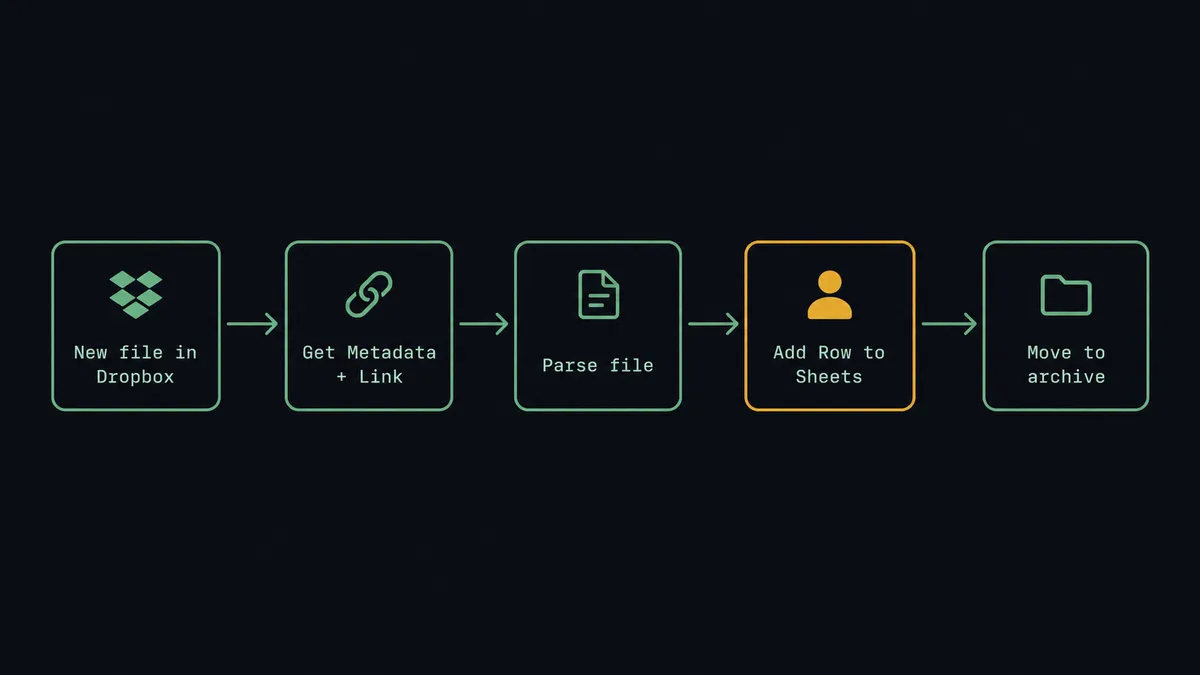
The On New File trigger fires the instant a file lands in a watched Dropbox folder. No polling. No delay. The flow starts.
From there, the agent calls Get File Metadata to read the filename, size, and timestamps. It calls Get Temporary Link to get an authenticated download URL it can pass downstream without buffering the file itself. If the file needs parsing, the agent hands the URL to the document processor and waits for the result.
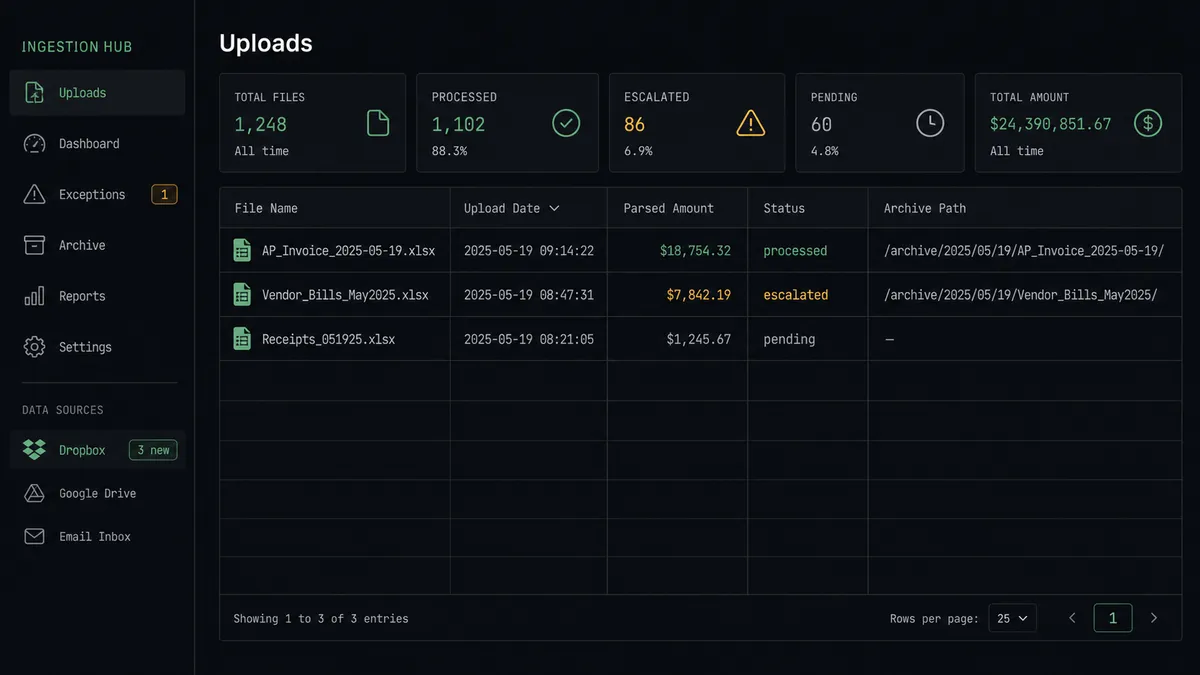
Once it has the extracted data, the agent calls Add Row in Google Sheets to write the record. Column mapping connects the Dropbox metadata to the right sheet columns: file name, path, upload timestamp, parsed fields, and processing status. After writing the row, the agent calls Move File or Folder to relocate the original from the intake folder into a structured archive path, so the intake folder stays clean and the archive reflects everything that has been handled.
The sheet is now current. The file is filed. No one touched either.
Can an AI agent run it? (and why a human stays in the loop)
A direct trigger-to-action connection handles the predictable case. The agent handles everything else.
The agent does not just call actions in sequence. It reads the file metadata and parse result, evaluates what it finds, and decides what to do. When a vendor uploads their usual monthly invoice and the parser returns clean structured data, the agent writes the row, files the document, and moves on. When the same vendor uploads a file that is twice its usual size and the parser returns low confidence on the amount field, the agent does not push that row into the sheet. It stops.
This is where FlowRunner’s human-in-loop works differently from a basic conditional branch. The agent does not hit a hardcoded threshold like “if confidence < 80%, escalate.” It evaluates the full context: the vendor’s history, the anomaly type, the stakes involved. A $300 invoice from a vendor it has never seen might trigger escalation. A $15,000 invoice from a vendor with two years of clean history might not. The agent decides.
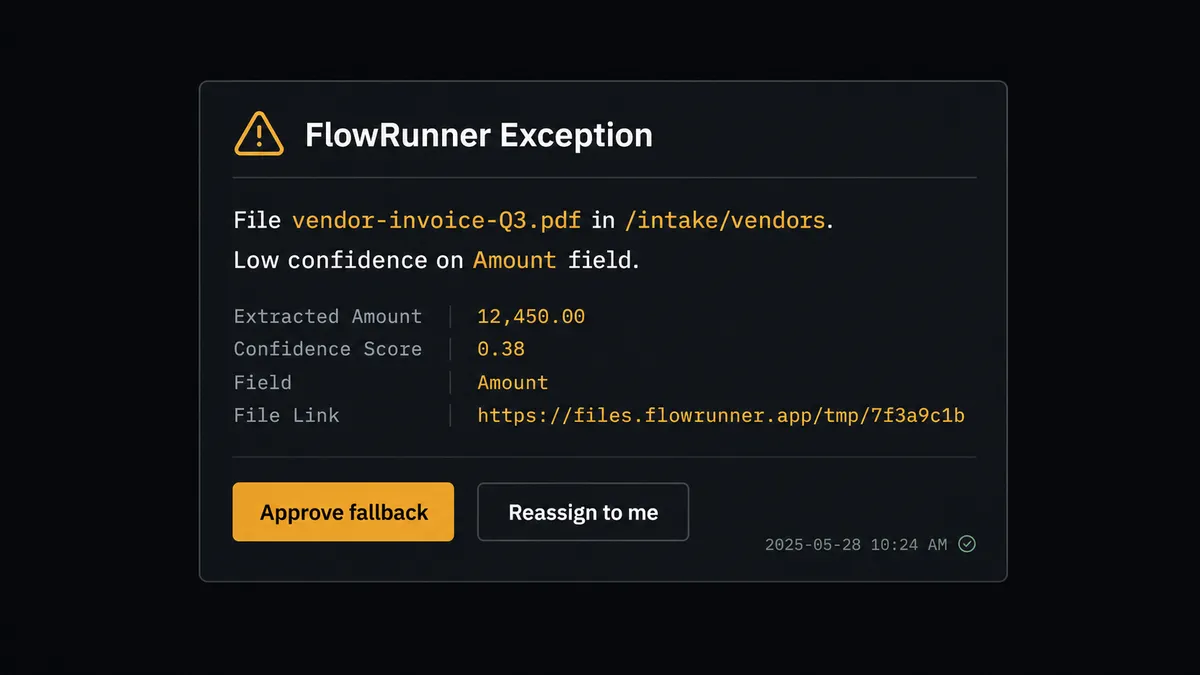
When it escalates, it invokes the human-in-loop subflow as a callable tool. That subflow sends a Slack message to the operations lead:
“Intake file [vendor-invoice-Q3.pdf] uploaded to /intake/vendors. Parsing returned low confidence on the Amount field. File link: [temporary link, expires in 24 hours]. Approve fallback handling or reassign?”
The workflow pauses. The operator opens the file, reviews it, and responds. The agent resumes with the decision as input. The file either gets processed with corrected data or flagged in the sheet for manual handling. The decision, the operator’s identity, and the timestamp all land in the audit trail.
This is not a sync tool. The agent knows when to stop and ask. Prospects call it a digital andon cord: like Toyota’s quality control pull cord, FlowRunner stops the line when the agent hits real uncertainty.
FlowRunner vs Zapier
Zapier is the right comparison for most non-technical teams connecting cloud apps. It has a large template library, a simple setup experience, and a wide connector catalog. For straightforward trigger-to-action flows, Zapier gets the job done quickly.
Where the comparison shifts:
| Capability | Zapier | FlowRunner |
|---|---|---|
| Human-in-loop | Not available natively; requires workarounds | Native: AI agent invokes human oversight as a callable tool at any decision point |
| AI agent reasoning | Basic AI steps; no autonomous decision-making across tools | Agent reads data, picks tools, and escalates based on context, not hardcoded rules |
| Unlimited users | Seat-based pricing | All tiers include unlimited users |
| BYOK for AI | Not available | Bring your own AI provider keys; not locked into one model |
| Self-hosted option | Not available | Community Edition (free) and Enterprise self-hosted tiers |
| Pricing model | Per-task execution pricing | Workflow-based tiers with clear execution limits; no execution anxiety |
For a team that just wants to log Dropbox files to a sheet and never deal with exceptions, Zapier works. For a team where exceptions are the point, where an anomalous file reaching the sheet unchecked is a real problem, the agent-plus-human-in-loop architecture makes a meaningful difference.
Before and after
| Before | After | |
|---|---|---|
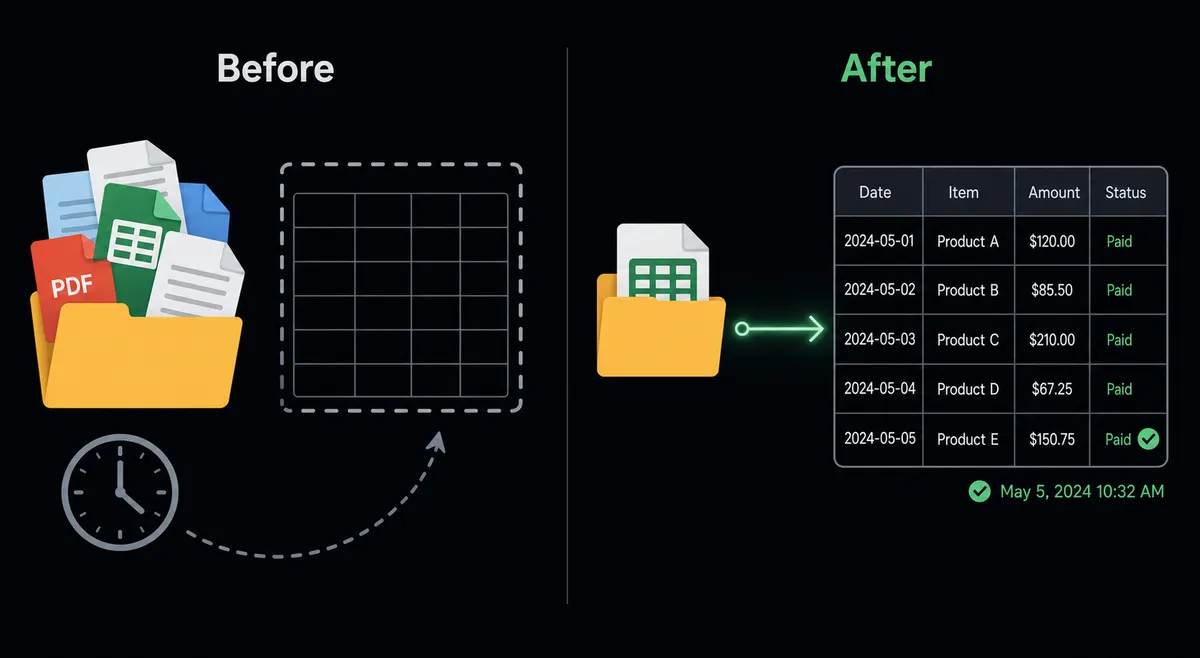
| File intake speed | Files sit until someone checks the folder | Flow fires the moment a file lands in Dropbox |
| Row entry | Typed by hand after downloading and reviewing the file | Agent writes the row automatically from extracted data |
| Exception handling | Caught only if someone notices the problem | Agent routes anomalous files to a human before they reach the sheet |
| File organization | Processed documents stay in the intake folder or get dragged manually | Agent archives each file to a structured path after processing |
| Audit trail | No record of who processed what or when | Every decision, escalation, and human approval logged automatically |
| Status visibility | Unknown until someone opens the folder and the sheet | Sheet reflects current status of every file in near-real time |
What you can build
Vendor invoice intake with auto-logging. On New File fires when a vendor uploads an invoice to the shared Dropbox folder. The agent calls Get File Metadata, parses the document, and calls Add Row to log the invoice in the tracking sheet. Anomalous invoices route to the AP lead via Slack before the row is written. The sheet is the live AP queue with no manual entry.
Contract change notification with version tracking. On File Modified fires when a contract file is updated. The agent calls Get File Metadata to read the revision timestamp, Create Shared Link to generate a fresh URL, and Update Row in the contracts sheet to record the new version and link. The legal team receives the Slack alert with the direct file link.
Client onboarding document tracker. On New Folder fires when a new client folder is created in Dropbox. The agent calls Add Row in the onboarding tracker sheet to register the new client, then calls Add Sheet in a separate document to create a dedicated tab for that client’s document status. The ops team has a live tracker from day one.
Batch report delivery. On a schedule, the agent calls List Folder Contents in Dropbox to enumerate the latest reports, Export Sheet from Google Sheets to produce a PDF of the delivery summary, and Upload File from URL to archive the export in Dropbox. The stakeholder receives the report link without anyone opening a folder.
External file delivery with expiry. After an agent generates a month-end report and writes the summary row to Google Sheets, it calls Create Shared Link in Dropbox to produce an expiring URL and writes that URL into the sheet as a column value. When the retention window closes, the agent calls Revoke Shared Link. The sheet shows the file was delivered and the link is no longer active.
Common questions
Is it free to connect Dropbox and Google Sheets on FlowRunner? FlowRunner has a free plan with 100 executions a month, every integration included, and no credit card required, and new accounts get 14 days of Professional on top. After that, Growth is $45 per month. All tiers include unlimited users and unlimited workflows.
Can I self-host FlowRunner? Yes. FlowRunner offers a free Community Edition for self-hosted single-instance deployments. An Enterprise self-hosted tier is available for multi-instance clustering and the full compliance suite.
Does the AI agent need my own OpenAI key? FlowRunner uses a BYOK (Bring Your Own Keys) model. You connect your own AI provider credentials, so the agent runs on whatever model you choose. You are not locked into one provider.
What happens when the agent is not sure about a file? The agent pauses and routes the exception to a human. It packages the file name, path, and reason for escalation into a Slack message or email, waits for a response, then resumes. The decision is recorded in the audit trail.
Can the agent write back to Google Sheets after it processes a Dropbox file? Yes. The agent calls Add Row or Update Row in Google Sheets as a tool after processing a file. The sheet stays current without anyone touching it manually.
What triggers the flow in Dropbox? The On New File trigger fires the moment a file lands in a watched Dropbox folder. You can also use On File Modified to react when an existing file changes, or On New Folder for provisioning workflows.
Getting started
Start on the free plan: 100 executions a month, every integration included, no credit card required, plus 14 days of Professional for new accounts. Corporate email required.
Connect both integrations from the FlowRunner connector library: Dropbox and Google Sheets. Both authenticate over OAuth2 and are ready to use as soon as you connect.
Build the trigger-to-action version first. Once the basic file-to-row flow is running, add the AI agent layer and the human-in-loop subflow. The agent handles the routine cases autonomously from day one.
Start at flowrunner.ai or book a 30-minute intro call to see the Dropbox and Google Sheets flow running live.
Frequently asked questions
Is it free to connect Dropbox and Google Sheets on FlowRunner?
FlowRunner has a free plan with 100 executions a month, every integration included, and no credit card required, and new accounts get 14 days of Professional on top. After that, Growth is $45 per month. All tiers include unlimited users and unlimited workflows.
Can I self-host FlowRunner?
Yes. FlowRunner offers a free Community Edition for self-hosted single-instance deployments. An Enterprise self-hosted tier is available for multi-instance clustering and the full compliance suite.
Does the AI agent need my own OpenAI key?
FlowRunner uses a BYOK (Bring Your Own Keys) model. You connect your own AI provider credentials, so the agent runs on whatever model you choose. You are not locked into one provider.
What happens when the agent is not sure about a file?
The agent pauses and routes the exception to a human. It packages the file name, path, and reason for escalation into a Slack message or email, waits for a response, then resumes. The decision is recorded in the audit trail.
Can the agent write back to Google Sheets after it processes a Dropbox file?
Yes. The agent calls Add Row or Update Row in Google Sheets as a tool after processing a file. The sheet stays current without anyone touching it manually.
What triggers the flow in Dropbox?
The On New File trigger fires the moment a file lands in a watched Dropbox folder. You can also use On File Modified to react when an existing file changes, or On New Folder for provisioning workflows.